About Alauda arvensis Linnaeus, 1758
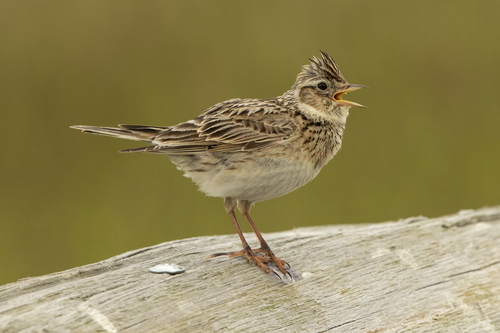
The Eurasian skylark (Alauda arvensis Linnaeus, 1758) measures 18–19 cm (7.1–7.5 in) in body length. Like most other larks, this species has rather dull plumage: it is primarily brown on its upper body and paler on its lower body. It has a short blunt crest on its head that can be raised or lowered as needed. When in flight, the species can be identified by its short tail and short, broad wings. The outer tail and the trailing rear edge of the wings are bordered with white; these white edges are visible when the bird is flying away from an observer, but not when it is flying toward them. Male Eurasian skylarks have broader wings than females. This trait supports more efficient hovering flight, and it may have evolved because females prefer males that can sing and hover for longer periods, which demonstrates good overall fitness. The species is well known for the male’s singing behavior: males sing their characteristic song while hovering at heights of 50 to 100 meters, where they appear as only a small dot from the ground. This long, unbroken song is a clear, bubbling warble that the male produces while rising, circling, or hovering high in the air. Most songs last two to three minutes, but songs get longer later in the mating season, and can extend to 20 minutes or more at that time. At wind farm sites, males have been observed singing at higher frequencies in response to noise from wind turbines. This lark breeds across most of Europe and Asia, as well as in the mountains of northern Africa. Populations in the western part of its range are mostly non-migratory year-round residents, while eastern populations are more migratory, moving further south for the winter. Even in the milder western portion of the range, many individuals move to lowlands and coastal areas during winter. The Asian subspecies A. a. pekinensis has been recorded as a vagrant in Alaska.