About Alasmidonta marginata Say, 1818
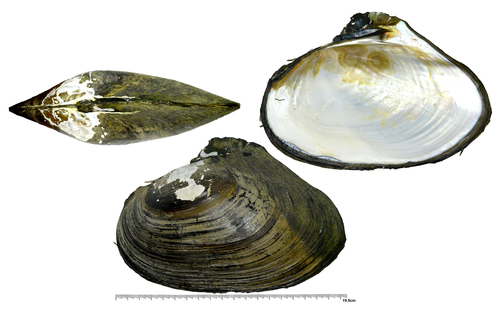
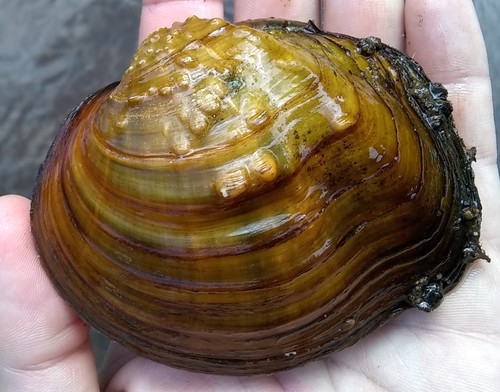
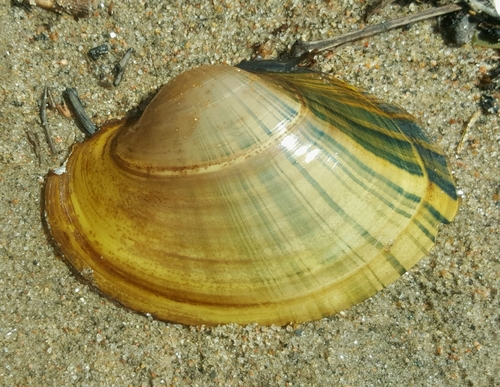
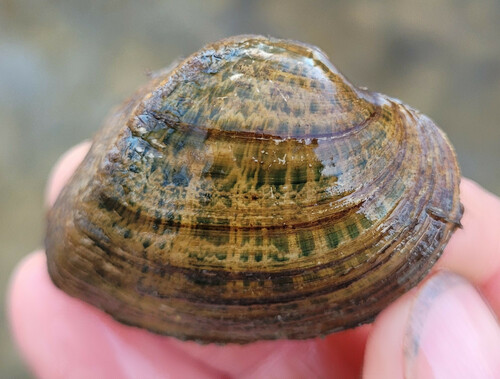
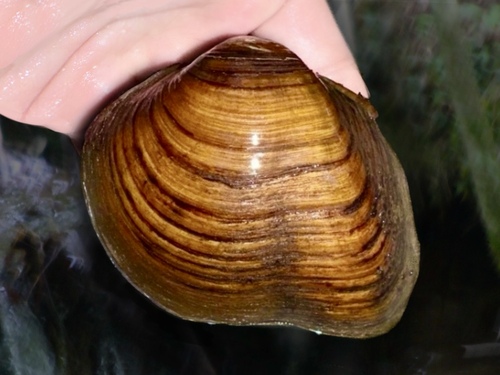
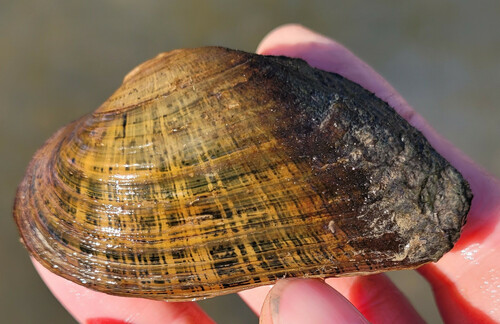
Alasmidonta marginata Say, 1818, commonly called the elktoe, is a moderately sized mussel that reaches approximately 4 inches in length. Its thin, triangular shell has an inflated center: the anterior end is elongated and rounded, and the shell’s outer edge is marked with fine ridges. The umbo, the hinge area connecting the two shell halves, is large and positioned near the center of the shell. The outer shell is a dull yellowish-green, patterned with multiple rays and dark green spots. The shell’s interior is glossy bluish-white, and may have salmon-colored patches near the edges and the beak. The beak has double-looped ridges lined with fine thin teeth. The elktoe looks most similar to the snuffbox and deertoe mussels, but both of these species lack a beak and teeth. In ecology, the elktoe is most often found in small, shallow, fast-moving rivers, though it can also survive in larger bodies of water. It prefers a substrate of sand or gravel. Substantial populations range from northeastern Canada to Arkansas. Along the east coast, it occurs from New York to Virginia, but it is found only inland in areas further south. Most of the species’ total population is concentrated in Ohio, Indiana, and Illinois. The species was historically present in Alabama, but it is now considered extirpated there, as no individuals have been recorded in the state for several decades. Like other mussel species, the elktoe can live for many decades, and may reach up to a century of age while buried in rock and other sediment. Elktoe are mostly sedentary, but they can use their internal muscular foot to move by extending and contracting between their two shell halves. The elktoe is a filter feeder that eats mostly bacteria, algae, and other organic matter. It draws water into its body through its siphon, removes food and oxygen from the water, then pumps the filtered water back out through the siphon. Mussels are gonochoristic, meaning individuals are either male or female, with separate sexes. The elktoe breeds during warm months. Females hold the species’ larval form, called glochidia, in their marsupia for up to eleven months. Once released, the larvae must attach to the gills of a host fish, where they live parasitically on the host until they develop into juvenile mussels. After leaving the host, juvenile mussels settle into substrate and filter feed until they mature into adult elktoe.