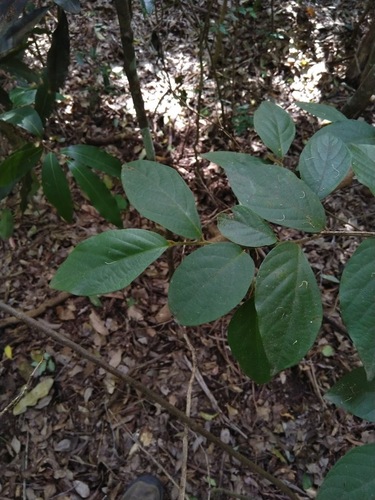
Alangium polyosmoides (F.Muell.) W.J.de Wilde & Duyfjes is a plant in the Cornaceae family, order Cornales, kingdom Plantae. Not known to be toxic.

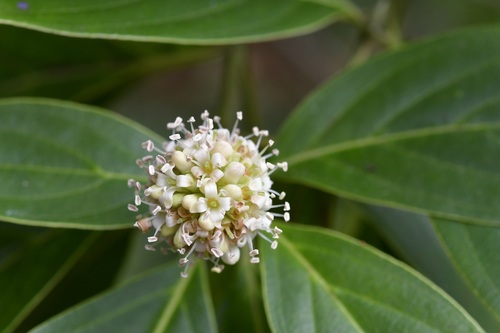
Photo of Alangium polyosmoides (F.Muell.) W.J.de Wilde & Duyfjes (Alangium polyosmoides (F.Muell.) W.J.de Wilde & Duyfjes)
🌿 Plantae

Alangium polyosmoides (F.Muell.) W.J.de Wilde & Duyfjes

Alangium polyosmoides (F.Muell.) W.J.de Wilde & Duyfjes

Alangium polyosmoides is a small to mid-sized rainforest tree with distinctive yellow bumps on the underside of its leaves.

Family
Genus
Alangium
Order
Cornales
Class
Magnoliopsida

About Alangium polyosmoides (F.Muell.) W.J.de Wilde & Duyfjes

Alangium polyosmoides is a small tree, and occasionally grows to be a mid-sized tree reaching up to 20 m (66 ft) in height, with a maximum trunk diameter of 90 cm (35 in). Larger individuals may have buttressed trunks. The bark is mostly greyish brown, and marked by lenticels, scales, corky bumps and surface irregularities. Small branches are thin and grey, becoming hairy and green near their tips. The section of twig between leaves is not notably hairy. Mature leaves measure 4 to 15 cm (1.4–6 in) long and 2 to 4 cm (0.8–1.6 in) wide; juvenile leaves are larger. Leaves grow in an alternate arrangement along the stem, and end in a fairly sharp point. Their shape is oblong-ovate or oblong-elliptical, and they have an unequal base. From the underside of the leaf, the midrib, lateral veins and net veins are clearly visible. Numerous yellow bumps also appear along the midrib and lateral veins on the underside; this distinctive feature makes Alangium polyosmoides easy to identify when it grows in rainforest. The leaf stem is 6 to 13 mm long.
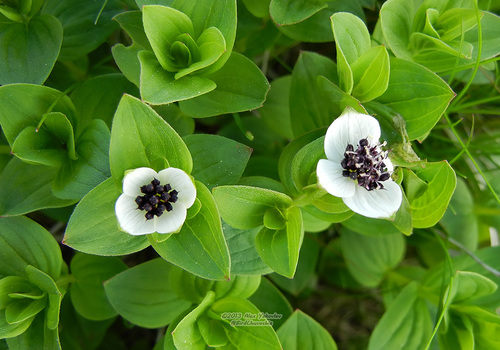
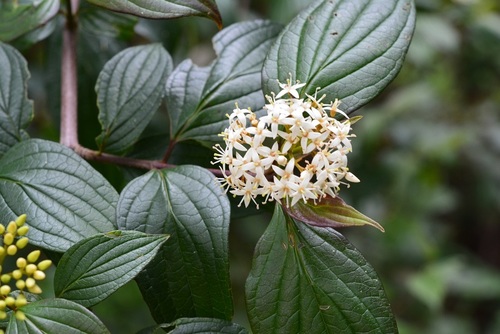
Photo: (c) Tony van Kampen, some rights reserved (CC BY), uploaded by Tony van Kampen · cc-by

Taxonomy

Plantae Tracheophyta Magnoliopsida Cornales Cornaceae Alangium

More from Cornaceae

Sources: GBIF, iNaturalist, Wikipedia, NCBI Taxonomy · Disclaimer

Identify Alangium polyosmoides (F.Muell.) W.J.de Wilde & Duyfjes instantly — even offline

iNature uses on-device AI to identify plants, animals, fungi and more. No internet needed.

Download iNature — Free

Start Exploring Nature Today

Download iNature for free. 10 identifications on us. No account needed. No credit card required.

Download Free on App Store