About Alaemon alaudipes (Desfontaines, 1789)
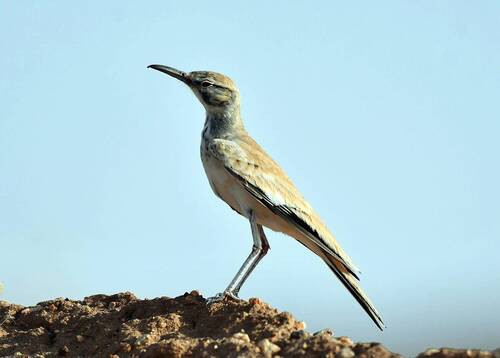
This large lark has long legs, a slender body, and a distinctive down-curved bill. The face has dark markings, including a line through the eye and whisker-like lines that run from the base of the bill under the eye. Its breast is spotted, the underside is buffy white, and the upper-parts are sandy grey. Females are slightly smaller, have less prominent markings, and a slightly shorter bill. The hind claw is short and straight, the curved upper beak has an exposed nostril opening, and the tip of the tongue is bifid. This species has a wide distribution made up of multiple populations that have been designated as subspecies. These include boavistae from the Cape Verde Islands, the nominate subspecies alaudipes from the north African Sahara region and northern Arabia, desertorum assigned to populations along the Red Sea coast, and doriae assigned to the eastern populations of Iraq, Pakistan, and north-western India. Forms like pallida and the variety cinerea are included within doriae. Greater hoopoe larks are seen singly or in pairs, and forage by running or walking in spurts, probing and digging the ground. They have been recorded feeding on the fruiting bodies of certain fungi. The breeding season is mainly after the first rains; in India, most breeding records are from March to July, with late breeding records in August noted when rains were delayed. The male’s courtship display involves rising with fluttering wing strokes, then diving down with closed wings to a perch. The slow flappy start to the song flight resembles a hoopoe, which is the origin of this species' common name. In flight, birds display a striking wing pattern: black wing feathers with a white base and trailing edge, and a white tail with black outer feathers. The male also sings during flight, with rising and falling notes made of trilled whistles and clicks that have been transcribed as tee-tee-tee followed by a prolonged tee-hoo while nosediving. The typical call is a rolling zreee or too. The nest is a cup-shaped structure built from small sticks, placed on a low bush or on the ground, sometimes at the base of a bush. Nests are prominent and often placed on an isolated bush. Clutches contain two or three eggs, and both sexes take turns incubating. The larks feed on insects and other invertebrates, small lizards, and seeds. Young birds can run quickly even before they are able to fly. When the young or nest are threatened, the female may perform distraction displays. During the heat of the day, they may shelter in the burrows of Uromastyx lizards. Water loss through their skin changes with temperature, allowing them to live in very arid conditions. Their breeding is dependent on rains, and they may not breed at all in very dry years.