About Ajuga reptans L.
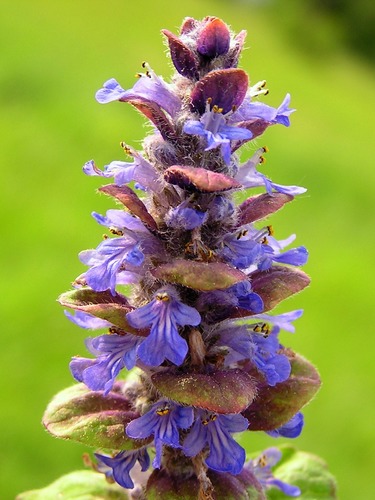
Ajuga reptans, commonly known as bugle or bugleweed, is a sprawling perennial herb that grows 10 to 35 cm (4 to 14 in) tall with erect flowering stems. Its stems are square in cross-section, with hairs growing on two sides, and the plant produces runners that spread across the ground surface. Its purplish-green stalked leaves grow in opposite pairs; the hairless leaf blades are usually elliptical or ovate with a rounded tip and shallowly rounded teeth along the margin. The inflorescence is a dense raceme made up of whorls of blue flowers, each with dark veins on the lower lip. The calyx has five toothed lobes, and the corolla forms a two-lipped flower 14 to 17 mm (0.6 to 0.7 in) long with a short tube. The upper lip of each flower is short, flat, and smooth-edged, while the lower lip is three-lobed; the central lobe is the largest, flat, and has a notched tip. There are two long stamens and two short stamens, all longer than the corolla and attached to the corolla tube. The ovary is superior, and the fruit is a four-chambered schizocarp. Bugleweed is evergreen. Its natural range extends across Europe, reaching as far as the middle taiga subzone of northeastern Russia. It grows best in the understory of mixed and parvifoliate forests, where soil nitrogen levels are higher and acidity is lower than in pure coniferous stands. It is common throughout Great Britain and Ireland. Ajuga reptans is monoecious, with both male and female flowers present on the same individual plant. It is pollinated by bees and Lepidoptera (moths and butterflies). It is a primary nectar source for the pearl-bordered fritillary and small pearl-bordered fritillary butterflies, and a secondary nectar source for the brimstone, chequered skipper, common blue, cryptic wood white, dingy skipper, Duke of Burgundy, green-veined white, grizzled skipper, heath fritillary, holly blue, large blue, large skipper, large white, marsh fritillary, orange-tip, painted lady, small white, and wood white butterflies. It is grown as a garden plant, where it provides useful groundcover. Numerous cultivars have been selected for garden use, and the cultivar 'Catlin's Giant' has earned the Royal Horticultural Society's Award of Garden Merit. Ajuga reptans is a somewhat common find for foragers in many regions where it grows. It is edible when consumed in small quantities; older leaves become more bitter. Its leaves are used somewhat commonly in salads and tea, and are also eaten raw. Bugle is also called "carpenter's herb" for its supposed ability to stop bleeding. Research has shown that bugleweed reduces prolactin levels in women. In traditional Austrian medicine, Ajuga reptans herb has been used internally as a tea to treat disorders of the respiratory tract.