About Aipysurus laevis Lacépède, 1804
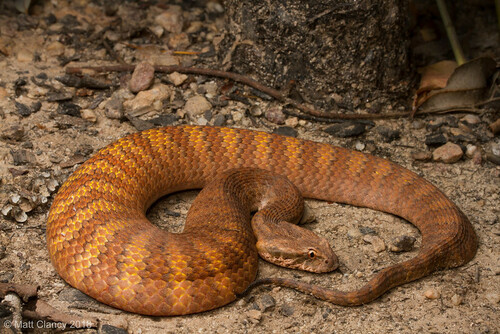
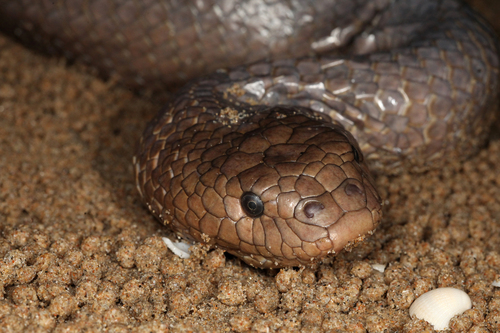
The olive sea snake, Aipysurus laevis, swims using a paddle-like tail. It has brownish and purple scales along the top of its body, and its underside is white. It usually grows up to 1 meter in length, and may reach up to 2 meters in some cases. This is a common, widespread species that lives on coral reefs, including the Great Barrier Reef. It can be found in the tropical eastern Indian Ocean and the western Pacific Ocean, ranging from Indonesia to New Caledonia. When it is not hunting or surfacing to breathe, the snake hides in small coves or protective coral areas. Males of this species reach sexual maturity in their third year, while females only reach maturity in their fourth or fifth year. Courtship typically involves a group of males competing for one female in open water. Male sea snakes sometimes approach divers, possibly because they mistake divers for female sea snakes. Fertilization is internal, and gestation lasts around nine months. Females usually give birth to up to five young at a time, though rare cases can produce ten or eleven young at once. The life expectancy of the olive sea snake is around fifteen years, and is sometimes slightly longer.