About Aiptasia mutabilis (Gravenhorst, 1831)
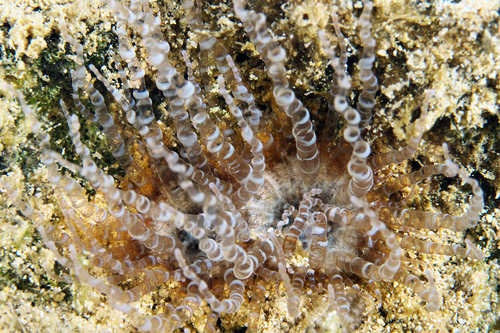
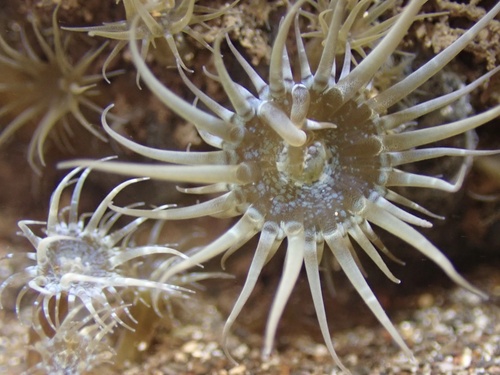
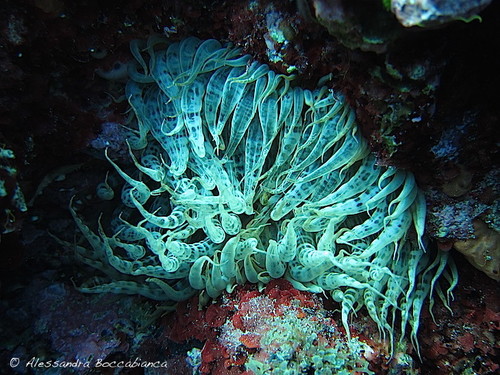
Anatomy and morphology: Aiptasia mutabilis typically has a trumpet shape. It can reach 12 cm in height, with a column diameter of 3 cm near the base and 6 cm at the mouth. The unsegmented tall column flares outward into a broad oral disc. The tentacles are shorter at the base and become finer toward their tips; inner tentacles are usually longer than outer tentacles, and an individual can have up to 100 tentacles total. Like other species in the genus Aiptasia, A. mutabilis has specialized stinging cells called nematocysts on its tentacles. When the column is extended, small perforations called cinclides are visible. The lower half of the column has numerous warts that work as adhesive spots to secure the organism to its substrate. Most A. mutabilis individuals are brownish with opaque white patches; tentacles are usually brown near the base and lighten toward the tips, and blue or green coloration can occur across the body. Distribution and habitat: Aiptasia mutabilis is usually found in colder waters, where it adheres to substrates under overhangs, on walls, or on rocks below the sea surface. The maximum depth it has been recorded at is 100 m below sea level, though the species most often occurs in shallower water, typically no deeper than 50 m below the surface. It is found in the Atlantic Ocean from Ireland to the Canary Islands, and also occurs in the Adriatic Sea, Aegean Sea, and Mediterranean Sea. Reproduction: Aiptasia mutabilis can reproduce both asexually and sexually, though asexual reproduction is the most common method observed in this species. For asexual reproduction, the anemone splits its column into two separate parts; both new parts adhere to a substrate, and fully developed individuals grow from the small original tissue pieces. Because this species reproduces very quickly and can become overabundant (any tissue fragment can grow into a full new individual), it is considered invasive and is not a popular anemone for aquariums, and it often becomes very common in areas where it becomes established. To develop from a zygote to an adult, A. mutabilis undergoes metamorphosis: the process starts with morphogenesis of the tentacles, septa, and pharynx, after which the larva settles and develops into its mature adult form.