About Aiphanes minima (Gaertn.) Burret
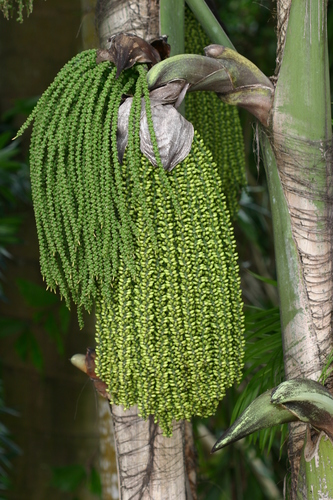
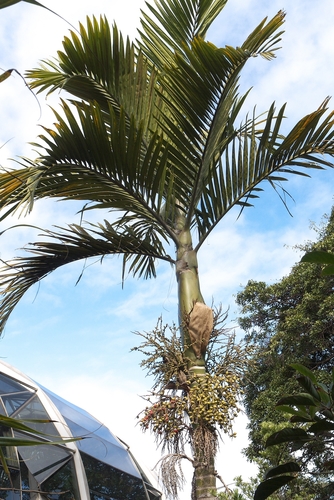
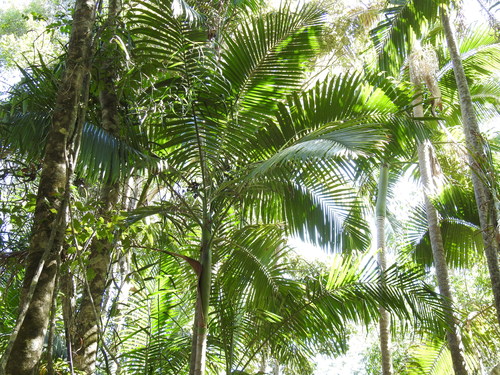
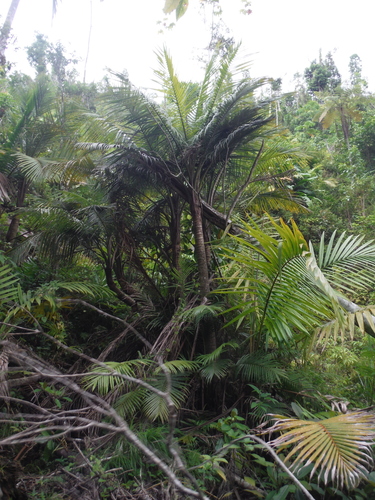
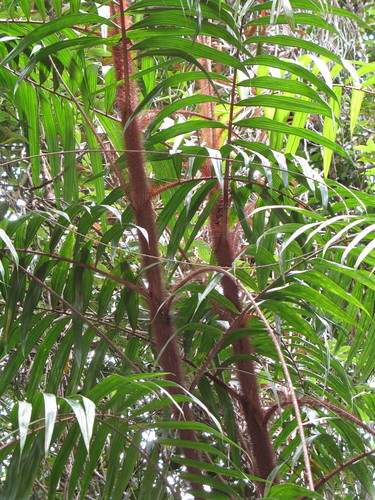
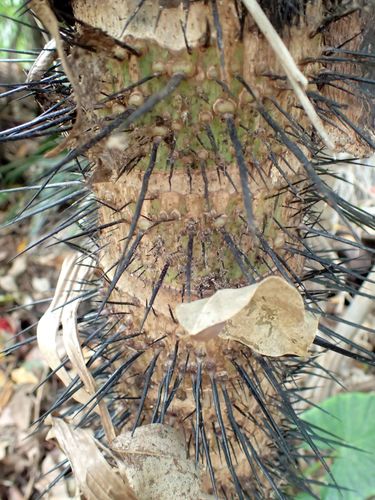
Aiphanes minima is a single-stemmed, spiny palm that produces pinnately compound leaves, where rows of leaflets grow on either side of the leaf axis in a feather-like or fern-like pattern. Its stems are typically 5 to 18 meters (16 to 59 feet) tall, occasionally reaching as short as 2 meters (6.6 feet), and measure 6 to 20 centimeters (2.4 to 7.9 inches) in diameter. Younger stems are covered in rings of black spines, but these spines are often lost on older stems. Mature individuals grow 10 to 20 pinnately compound leaves, which carry 18 to 34 pairs of leaflets along a central rachis that is 130 to 400 centimeters (51 to 157 inches) long. The leaflets grow in a single plane, are usually linear in shape, and sometimes widen toward their apex, an occurrence especially common in Puerto Rican specimens. The lower surface of the leaf may either be covered with spines up to 3 centimeters (1.2 inches) long or completely unarmed; the upper surface has a row of spines roughly 1 centimeter (0.4 inches) long along its midrib. The rachis can be unarmed, but is often covered with black spines up to 6 centimeters (2.4 inches) long. The petiole, which connects the rachis to the stem, is 15 to 110 centimeters (5.9 to 43.3 inches) long and covered with black spines up to 8 centimeters (3 inches) long. Aiphanes minima is native to the Dominican Republic, Puerto Rico, Dominica, Saint Vincent and the Grenadines, Saint Lucia, Martinique, Barbados, and Grenada, and is widely cultivated in other locations. It is the northernmost member of its genus Aiphanes, and the only Aiphanes species that does not grow on mainland South America. In the northern portion of its native range, Aiphanes minima grows on limestone hills and depends on gaps in the forest canopy to reach maturity. In the southern portion of its range, it grows as a subcanopy or understorey tree, for example at Turner's Hall Woods in Barbados. Its flowers have a sweet scent and are thought to be pollinated by bees. The fruit, flowers, and seeds of Aiphanes minima are eaten by the vulnerable Saint Vincent amazon (Amazona guildingii), and the species is considered potentially important as a food source for the critically endangered Puerto Rican amazon (Amazona vittata). Aiphanes minima is widely planted as an ornamental plant. The endosperm of its seeds is edible, and has a taste similar to coconut.