About Ailurus fulgens F.G.Cuvier, 1825
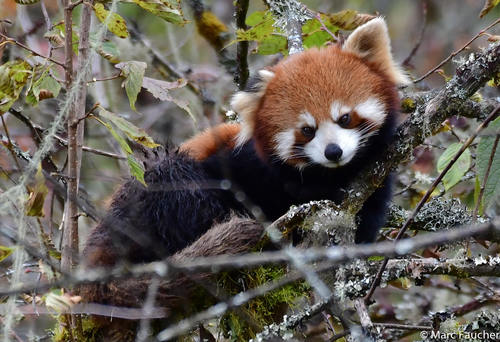
Ailurus fulgens F.G.Cuvier, 1825, commonly called the red panda, has a coat that is mostly red or orange-brown, with black fur on the belly and legs. Most of the muzzle, cheeks, brows, and inner ear margins are white, while its bushy tail has alternating red and buff ring patterns and ends in a dark brown tip. This colouration acts as camouflage in its native habitat, where trees are often covered in red moss and white lichen. The red panda’s outer guard hairs are longer and coarser than its shorter, denser, fluffier undercoat; guard hairs on the back have a circular cross-section and measure 47–56 mm (1.9–2.2 in) long. It has moderately long whiskers around the mouth, lower jaw, and chin, and hair covering the soles of its paws that lets it walk on snow. The red panda has a relatively small head, which is proportionally larger than the head of similarly sized raccoons, with a shortened snout and triangular ears, and limbs of nearly equal length. It has a head-body length of 51–63.5 cm (20.1–25.0 in) and a tail that is 28–48.5 cm (11.0–19.1 in) long. Himalayan red pandas weigh 3.2–9.4 kg (7.1–20.7 lb). For Chinese red pandas, females weigh 4–15 kg (8.8–33.1 lb) and males weigh 4.2–13.4 kg (9.3–29.5 lb). Each foot has five curved digits, each with a curved semi-retractile claw that helps with climbing. Flexible joints in the pelvis and hindlimbs are adaptations for an arboreal quadrupedal lifestyle. Though the tail is not prehensile, it helps the red panda maintain balance while climbing. The red panda’s forepaws have a "false thumb", which is an extension of the radial sesamoid wrist bone, a feature found in many carnivorans. This false thumb lets the red panda grip bamboo stalks, and both its digits and wrist bones are highly flexible. The red panda shares this false thumb trait with the giant panda, but the giant panda has a larger, more side-compressed radial sesamoid. Additionally, the red panda’s sesamoid has a more sunken tip, while the giant panda’s curves in the middle; these differences give the giant panda greater dexterity. The red panda has a wide skull and a robust lower jaw, but since it eats relatively soft leaves and stems, it has smaller chewing muscles than the giant panda. The red panda’s digestive system is only 4.2 times its total body length, with a simple stomach, no clear division between the ileum and colon, and no caecum. Both male and female red pandas have paired anal glands that produce a secretion containing long-chain fatty acids, cholesterol, squalene, and 2-Piperidinone; 2-Piperidinone is the most odorous compound, and humans perceive its scent as similar to ammonia or pepper. The red panda is distributed across Nepal, the Indian states of Sikkim, West Bengal, and Arunachal Pradesh, Bhutan, southern Tibet, northern Myanmar, and China’s Sichuan and Yunnan provinces. The maximum estimated global potential habitat for the red panda is 47,100 km2 (18,200 sq mi), all located in the temperate climate zone of the Himalayas, with a mean annual temperature between 18–24 °C (64–75 °F). Across its range, the red panda has been recorded at elevations of 2,000–4,300 m (6,600–14,100 ft). In Nepal, it lives in six protected area complexes within the Eastern Himalayan broadleaf forests ecoregion. The westernmost known records of red pandas to date are from three community forests in Kalikot District, recorded in 2019. In Nepal, its easternmost range is in Panchthar and Ilam Districts, where its forest patch habitat is surrounded by villages, livestock pastures, and roads. In the Kangchenjunga landscape of Sikkim and northern West Bengal, the red panda metapopulation in protected areas and wildlife corridors is partly connected through old-growth forests that lie outside protected areas. Forests in this landscape are dominated by Himalayan oaks (Quercus lamellosa and Q. semecarpifolia), Himalayan birch, Himalayan fir, and Himalayan maple, with bamboo, Rhododendron, and some black juniper shrubs growing in the understorey. Records from Bhutan, Arunachal Pradesh’s Pangchen Valley, West Kameng, and Shi Yomi districts show that red pandas often occupy habitats with Yushania and Thamnocalamus bamboo, medium-sized Rhododendron, whitebeam, and chinquapin trees. In China, the red panda lives in the Hengduan Mountains subalpine conifer forests and Qionglai-Minshan conifer forests of the Hengduan, Qionglai, Xiaoxiang, Daxiangling, and Liangshan Mountains in Sichuan. In adjacent Yunnan province, red pandas have only been recorded in the northwestern mountainous part. The red panda prefers microhabitats within 70–240 m (230–790 ft) of water sources. Fallen logs and tree stumps are important habitat features, as they make it easier for red pandas to reach bamboo leaves. Red pandas have been recorded using slopes steeper than 20° and stumps with a diameter larger than 30 cm (12 in). Red pandas observed in Phrumsengla National Park mostly used easterly and southerly slopes with an average steepness of 34°, 66 percent canopy cover, and bamboo growing to around 23 m (75 ft) tall. In Dafengding Nature Reserve, red pandas prefer steep south-facing slopes in winter, and live in forests with bamboo that is 1.5–2.5 m (4 ft 11 in – 8 ft 2 in) tall. In Gaoligongshan National Nature Reserve, they inhabit mixed coniferous forest with dense canopy cover of more than 75 percent, steep slopes, and a bamboo density of at least 70 bamboo plants per square meter (6.5 bamboo plants per square foot). In some parts of China, the red panda lives in the same area as the giant panda. In Fengtongzhai and Yele National Nature Reserves, red panda microhabitats are defined by steep slopes with abundant bamboo stems, shrubs, fallen logs, and stumps, while giant pandas prefer gentler slopes with taller but less abundant bamboo and fewer of these habitat features overall. This niche separation reduces competition between the two bamboo-eating species. The red panda is hard to observe in the wild, so most studies of its behaviour have been conducted in captive individuals. Red pandas are both nocturnal and crepuscular, and sleep intermittently through the night. They typically rest or sleep in trees or other elevated spaces; when it is warm, they stretch out prone on a branch with their legs dangling, and when it is cold they curl up with their hindlimb over their face. They are well adapted for climbing, and descend to the ground head-first, holding on to the middle of the tree trunk with their hindfeet. They move quickly on the ground by trotting or bounding. Red pandas are long-day breeders, and reproduce after the winter solstice as daylight hours increase. Mating occurs between January and March, and births take place between May and August. For captive red pandas kept in the southern hemisphere, reproduction is delayed by six months. A female’s oestrus lasts one day, and females can enter oestrus multiple times in a single breeding season, though the length of intervals between cycles is not known. When the breeding season begins, males and females interact more often, and will rest, move, and feed near one another. A female in oestrus will spend more time marking territory, and males will inspect her anogenital region. Receptive females flick their tails and position themselves in a lordosis pose, with the front of their body lowered to the ground and their spine curved. During copulation, the male mounts the female from behind and above, though face-to-face matings and belly-to-back matings while lying on the sides also occur. The male grips the female’s sides with his front paws instead of biting her neck. Intromission lasts 2–25 minutes, and the pair grooms each other between mating bouts. Gestation lasts around 131 days. Before giving birth, the female chooses a denning site, such as a hollow in a tree, log, or stump, or a rock crevice, and builds a nest using local materials including twigs, sticks, branches, bits of bark, leaves, grass, and moss. Litters usually have one to four cubs, which are born fully furred but blind. Cubs are completely dependent on their mother for the first three to four months, until they leave the nest for the first time. They nurse for their first five months. The bond between a mother and her offspring lasts until the next mating season. Cubs are fully grown by around 12 months of age, and reach sexual maturity at around 18 months. Two radio-collared cubs in eastern Nepal separated from their mothers at 7–8 months old, and left their birth areas three weeks later. They reached new home ranges within 26–42 days, and became permanent residents after exploring these new ranges for 42–44 days.

