About Ailuropoda melanoleuca (David, 1869)
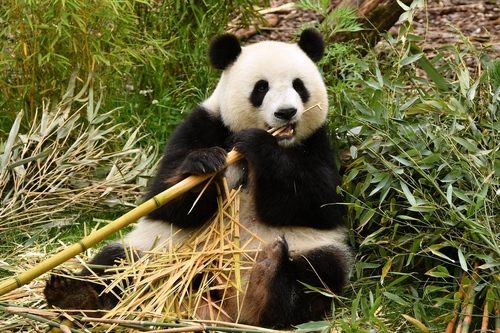
Scientific name: Ailuropoda melanoleuca (David, 1869). Description: The giant panda has a bear-typical body shape. It has black fur on its ears, limbs, shoulders, and around its eyes, with the rest of its coat being white. The species' distinctive coloration is thought to act as camouflage in both winter and summer environments, since giant pandas do not hibernate: white fur camouflages them against snow, while black shoulders and legs hide them in shade. Wild studies show that from a distance, the panda has disruptive coloration, while it relies more on blending in when viewed up close. Black ears may be used to display aggression, and eye patches may help giant pandas identify one another. The giant panda's thick, woolly coat keeps it warm in the cool forests of its habitat. Its skull shape is typical of durophagous carnivorans. It has evolved from ancestors to have larger, more complex molars and an expanded temporal fossa. One study recorded that a 117.5 kg (259 lb) giant panda had a bite force of 1298.9 Newton (BFQ 151.4) at the canine teeth, and 1815.9 Newton (BFQ 141.8) at the carnassial teeth. Finite element analysis confirms that among ursids, giant pandas have the highest bite force relative to their body size. Giant pandas have the largest masticatory muscles of any bear; for individuals with equivalent brain weight, their masticatory muscles are more than twice as large as those of the American black bear. The giant panda's digastric muscle equals 30% of its brain weight, compared to 10% in the American black bear. Adult giant pandas measure 1.2 to 1.9 m (3 ft 11 in to 6 ft 3 in) in total length, including a 10–15 cm (3.9–5.9 in) tail, and stand 60 to 90 cm (24 to 35 in) tall at the shoulder. Males can weigh up to 160 kg (350 lb). Females are generally 10–20% smaller than males, weighing between 70 kg (150 lb) and 125 kg (276 lb). The average adult weight is 100 to 115 kg (220 to 254 lb). The giant panda's paw has one thumb-like modified sesamoid digit plus five regular fingers; the pseudo-thumb helps it hold bamboo while eating. The pseudo-thumb likely evolved because the giant panda's original first forepaw digit, equivalent to a primate thumb, is not opposable and aligns with the rest of the digits. At 10 to 15 cm (3.9 to 5.9 in) long, the giant panda's tail is the second-longest in the bear family, only shorter than that of the sloth bear. Distribution and habitat: The giant panda is endemic to China, with small fragmented populations in six of the country's mountainous regions. Most populations live in Sichuan, with additional populations in neighboring Shaanxi and Gansu. Successful habitat preservation has led to an increase in giant panda numbers, though habitat loss from human activity remains the species' biggest threat. Giant panda populations are generally low in areas with high concentrations of medium-to-large mammals such as domestic cattle, which degrade the landscape; this is mostly attributed to the giant panda's avoidance of interspecific competition. Giant pandas have been recorded at elevations of 2,400 to 3,000 m (7,900 to 9,800 ft) above sea level. They prefer habitats with abundant bamboo, most commonly old-growth forests, but will also use secondary forest habitats. The Daxiangling Mountain population lives in both coniferous and broadleaf forests. The Qinling population often selects evergreen broadleaf and conifer forests, while pandas in the Qionglai mountain region exclusively select upland conifer forests. The two remaining populations, in the Liangshan and Xiaoxiangling mountains, live mostly in broadleaf evergreen and conifer forests. Giant pandas once ranged across Southeast Asia from Myanmar to northern Vietnam, and covered most of southeastern China. By the Pleistocene, climate change impacted giant panda populations, and the later spread of modern humans caused large-scale habitat loss. Subfossil remains from sinkholes show that giant pandas still lived in the Gaoligong Mountains of Yunnan Province, on the China-Myanmar border, as recently as 5,000 years ago. Heavy deforestation in this area during the early Ming Dynasty may have been the event that eliminated pandas from this region. By 2001 estimates, the giant panda's current range has declined by about 99% from its range in earlier millennia. Reproduction: Giant pandas reach sexual maturity between 4 and 8 years of age, and can remain reproductive until age 20. Mating season occurs between March and May, when females enter an estrus period that lasts two to three days and occurs only once per year. During mating, the female holds a crouching, head-down position while the male mounts her from behind. Copulation lasts from 30 seconds to five minutes, and males may mount females repeatedly to ensure successful fertilization. Gestation lasts between 95 and 160 days; this variability occurs because fertilized eggs can remain in the reproductive tract for some time before implanting on the uterine wall. Around half of all giant panda pregnancies result in twins. If twins are born in the wild, usually only one survives: the mother chooses the stronger cub, and the weaker cub dies of starvation. It is thought that mothers cannot produce enough milk for two cubs, as they do not store fat. Fathers do not participate in raising cubs. Newborn giant pandas are pink, blind, and toothless, weighing only 90 to 130 g (3.2 to 4.6 oz), approximately 1/800 of the mother's weight. This makes the giant panda cub proportionally the smallest baby of any placental mammal. Cubs nurse 6 to 14 times a day for up to 30 minutes per nursing session. For three to four hours each day, the mother may leave the den to feed, leaving the cub defenseless. One to two weeks after birth, the cub's skin turns gray in areas that will eventually grow black hair. A slight pink tint may appear on the cub's fur, caused by a chemical reaction between the fur and the mother's saliva. One month after birth, the cub's full adult color pattern is developed. A cub's fur is very soft when young, and becomes coarser as it ages. Cubs begin to crawl between 75 and 80 days old, and mothers play with their cubs by rolling and wrestling with them. Cubs can eat small amounts of bamboo after six months, but mother's milk remains their primary food source for most of their first year. Giant panda cubs weigh 45 kg (99 lb) at one year old, and stay with their mothers until they are 18 months to two years old. The interval between wild births is generally two years. Initially, artificial insemination was the primary method for breeding giant pandas in captivity, because captive pandas often lost interest in mating. This led scientists to test methods such as showing captive pandas mating videos and giving males sildenafil (commonly known as Viagra). In the 2000s, captive breeding programs began seeing consistent success. Researchers have now determined that giant pandas have breeding rates comparable to some populations of the thriving American black bear. In July 2009, Chinese scientists confirmed the birth of the first giant panda cub successfully conceived via artificial insemination using frozen sperm. The technique of freezing sperm in liquid nitrogen was first developed in 1980, and this first birth was seen as a solution to limited giant panda semen availability, which had previously led to inbreeding. Frozen panda semen can be stored for decades and shared between different zoos to support conservation of the species. As of 2009, it was expected that zoos in destinations including San Diego (U.S.) and Mexico City would be able to provide their own semen to inseminate more giant pandas. Attempts have also been made to produce giant pandas via interspecific pregnancy, by implanting cloned panda embryos into the uterus of another species. These attempts have produced panda fetuses, but no live births.