About Ailuroedus maculosus E.P.Ramsay, 1875
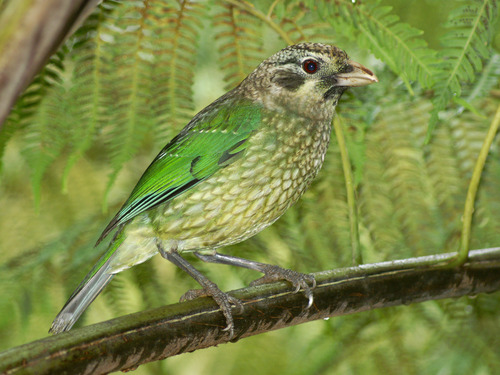
Spotted catbirds (Ailuroedus maculosus E.P.Ramsay, 1875) measure 26 to 30 cm in length. Males weigh 180 g while females weigh 168 g. Adult spotted catbirds have a large dusky-colored head, with a blackish cap and a black ear patch. Their upperparts are mostly bright green, marked with heavy olive chevrons. Their underbody has white streaking. They have slim white wing bars and a green tail tipped with white. Their eyes are red, and they have a stout cream-colored beak. Their legs and feet range from dark to bluish grey. Males and females have similar plumage. This species' plumage differs from that of other bowerbirds, which have plumage color patterns made up of a mixture of two colors in varying proportions. The cryptic plumage of the spotted catbird aids parental care: it helps the birds blend into their surroundings, allowing both males and females to tend to nestlings. This camouflage may also let spotted catbirds spend more time foraging, as they blend into surrounding foliage. The call of the spotted catbird is described as loud with cat-like wailing. They produce a nasal "here-I-arr" call, along with sharp clicks and three loud cries. They can be heard calling at any time of day, especially at dawn and dusk. They call more frequently during cooler temperatures, on dewy mornings, and after rain. The spotted catbird is an Australo-Papuan species. It inhabits tropical rainforest and is locally common throughout its range. Within Australia, it has two isolated populations, both in far north Queensland: one population occurs on Cape York, and the second is located further south in the wet tropics region. The tropical forests of the Bellenden Ker range and the adjoining scrub area from Cardwell to Cooktown may be this species' "headquarters". Spotted catbirds are a highly specialized rainforest species. In the Australian wet tropics, they prefer to nest in well-vegetated areas on steep creek slopes, and also in forests containing Calamus tangles. They will return to nest in the same location year after year. They have a home range of 1 to 2 hectares, and forage roughly 68 meters from their nests. Two main potential threats to the spotted catbird are destruction of their rainforest habitat and rising temperatures. Revegetation attempts have been carried out on the Atherton Tablelands in north Queensland. These attempts have created habitat heterogeneity, but may not benefit this habitat-specific species. Rainforest fragmentation has led to the creation of corridors intended to provide habitat for rainforest birds. However, these corridors experience edge effects, and are not used by this specialized rainforest species. Despite this, spotted catbirds have been regularly detected in well-established rainforest regrowth in Australia.