About Ailuroedus crassirostris (Paykull, 1815)
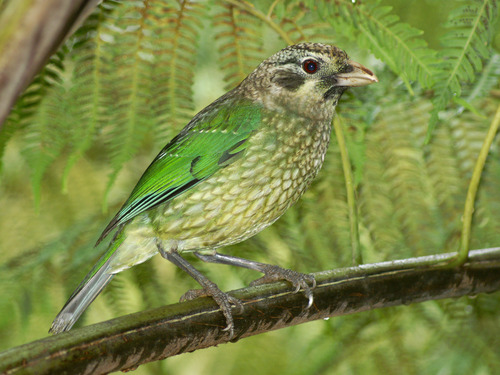
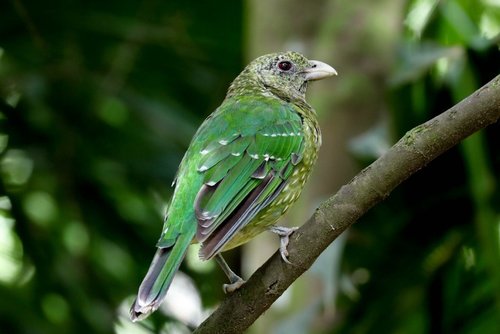
Ailuroedus crassirostris (Paykull, 1815), the green catbird, is a medium-sized stocky bird with long powerful legs and a long stout bill. Its back, wings, and rump are a brilliant emerald green, with very noticeable pure white spots at the tips of the tertiaries and secondaries. These white markings on the tips of coverts form two white wing-bars. The tail is brownish emerald with white tips. The head is greenish brown mottled with black and finely flecked with pale buff. The chest ranges from greenish buff to dull emerald, with distinctive short white streaks. The bill is horn-colored, the legs are greyish brown, and the iris appears bright red in direct sun, with a partial white eye-ring. Males and females have very similar plumage, so telling the sexes apart is extremely difficult. Juveniles also have similar plumage, though their coloration is duller, and very young juveniles have fluffy grey down on their heads (Donaghey. R. 1996).
According to the 2nd edition of The Field Guide to Australian Birds (Michael Morcombe, 2003), green catbirds are found along the full length of the east coast of New South Wales, in areas of suitable habitat, extending north to the Cooloola Coast in South East Queensland. They inhabit subtropical and temperate rainforests and paperbark stands, and are occasionally found in adjacent eucalypt forest. Their average home range is two hectares, though this size is greatly reduced during breeding season. Breeding territories usually hold multiple fig trees that regularly produce large volumes of ripe fruit over several months, a timeline that aligns with the green catbird breeding season. Green catbirds drink and bathe in pools of water found in the crevices of surrounding trees or along water courses.
Unlike males of other bowerbird species, male green catbirds do not build bowers. Instead, a male will clear a small open area where he performs and displays to females. Similar to other male bowerbirds, he attempts to attract mates by holding colorful fruits, flowers, and leaves in his beak to display them. Green catbirds are monogamous breeders: once a female accepts a male, the pair mates for life. Pair bonding is maintained year-round by the male feeding the female, as well as through duet calling. The breeding season usually runs from October to January, though it can start as early as September and end as late as March. The nest is large and bulky, constructed from large sticks bound with vine tendrils, with an inner lining of dry leaves. A distinctive unusual layer of wet, soft decayed wood lies beneath the lining of fine twigs and leaves inside the nest, making the nest overall much larger relative to the bird's body size. The nest is placed in the dense crown of a low understorey tree where many twigs and stems support its bulk. It may also be built in thorny or stinging trees, the crown of a tree fern, or in the upwardly cupped fronds of a bird's nest fern. A clutch typically contains 2 to 3 eggs, which are incubated by the female for 23 to 24 days. The male helps rear the young until they fledge, which takes 20 to 22 days. No detailed studies of green catbird longevity have been conducted in the wild or captivity, though the average wild lifespan is thought to be around eight years, and one captive individual is known to have lived at least fifteen years.