About Ailanthus triphysa (Dennst.) Alston
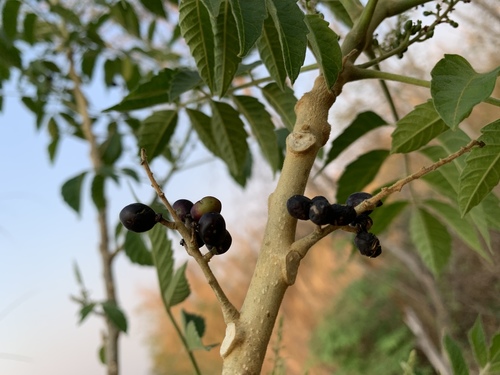
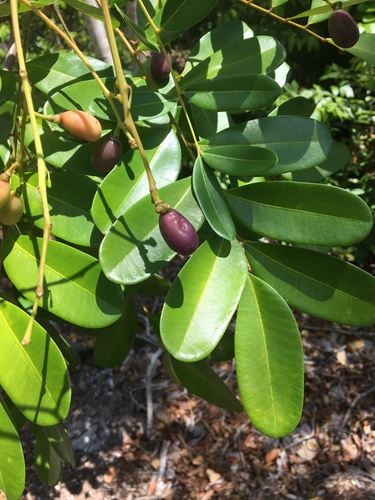
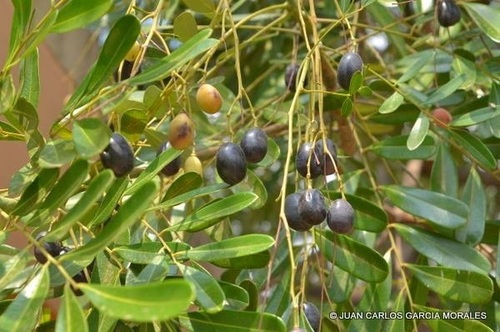
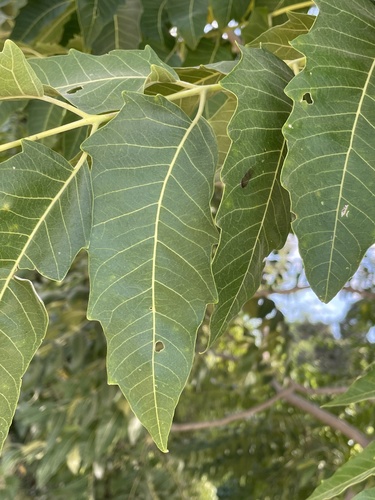
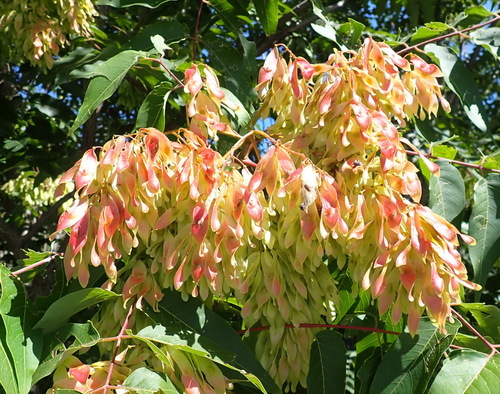
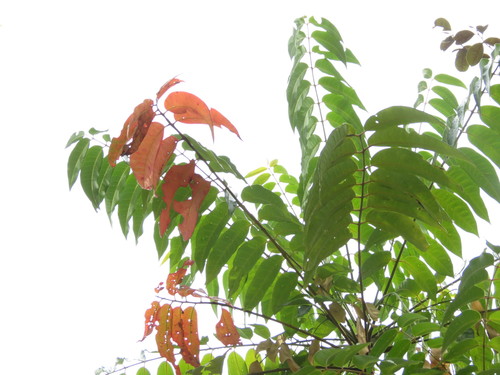
Ailanthus triphysa is a medium to tall evergreen tree that reaches up to 30 m in height, with a trunk diameter of up to 1.2 m. The trunk is straight and cylindrical, and does not form buttresses. Its bark is grey, somewhat rough, and has a sandpaper-like texture. Stems are lenticellate; the inner blaze of the stem is yellow with red speckles. Leaves are pinnate, and individual leaflets are curved, sickle-shaped (falcate), taper to a point, and are distinctly oblique and very unequal-sided at the base. Leaflet blades measure approximately 5-12 cm long by 0.9–2 cm wide. Venation is prominent; net veins are more visible on the underside of the leaf, and lateral veins form loops well inside the leaf blade margin. The midrib sits in a depression on the upper surface of the leaflet blade. Numerous closely spaced oil dots are visible on leaflets when viewed with a lens. Twigs that bear leaves are 1 cm or more in diameter, and stipules are very small. Flowers are polygamous, creamy green to greenish yellow, and arranged in axillary branched panicles that are 10–20 cm long. Sepals measure about 0.5-0.8 mm long; petals are approximately 3.5-4.5 mm long by 2 mm wide. In male flowers, stamens are 3–4 mm long. Carpels are 2-4 mm long, most often 3 mm, with one ovule per carpel. Flowering occurs from November to January in Australia, and from December to May in India. The fruit is a samara, which typically forms in groups of three. Fruits are green to greenish brown, with a papery texture, and measure about 5-6 cm long by 1–2 cm. The seed’s main vascular bundle connects to an intramarginal vein on the samara.
This species is distributed across India (including the Andaman Islands), Sri Lanka, Myanmar, South-Central and Southeast China, Thailand, Laos, Cambodia, Vietnam, Malaysia (including Peninsular Malaysia, Sarawak and Sabah), the Philippines, Indonesia (Jawa, Kalimantan, Sulawesi and Maluku), and Australia. In Australia, it grows in two isolated populations in the Kimberley region of Western Australia: at the Prince Regent River and on offshore Coronation Island. It also occurs from Cape York in Queensland south to Susan Island Nature Reserve on the Clarence River in New South Wales.
Its documented habitat includes dense dry deciduous forest on Yamdena (eastern Indonesia), where it grows in the understory as a tree over 4 m tall with a diameter at breast height under 30 cm; the canopy of these forests is dominated by Ebenaceae, particularly Diospyros, and Fabaceae. On Coronation Island (off the Kimberley coast, Western Australia), it grows in vine thickets, which are pockets of monsoon rainforest. The limited, isolated Western Australian populations have conservation significance.
The wood of Ailanthus triphysa is yellowish and brittle. Its timber is primarily used for matchwood and plywood, and is also used to make charcoal. When the bark is cut, it exudes a sticky resin that becomes brittle as it dries. This resin is used for medicinal purposes, and thanks to its fixative properties, it is used as an ingredient in incense sticks. In India, this incense resin is called halmaddi, named after the local common name for the tree. By the 1990s, crude resin extraction methods that commonly killed trees led the Indian Forest Department to ban resin extraction. This ban increased the price of halmaddi, leading to a decline in its use for incense production. In Cambodia, the resin is also used for incense, while the bark is used in local folk medicine to treat dysentery and intestinal edema. The wood contains various alkaloids and quassinoids, including beta-carboline, and has been used to treat dyspepsia, bronchitis, ophthalmia, and snake bite.