About Ahaetulla borealis Mallik, Srikanthan, Pal, D'Souza, Shanker & Ganesh, 2020
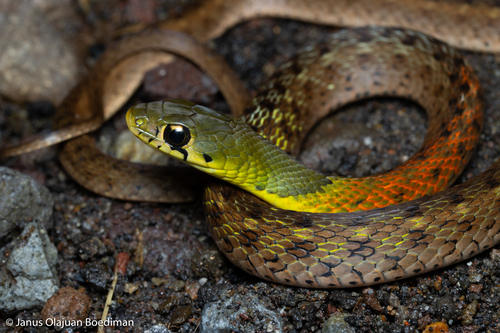
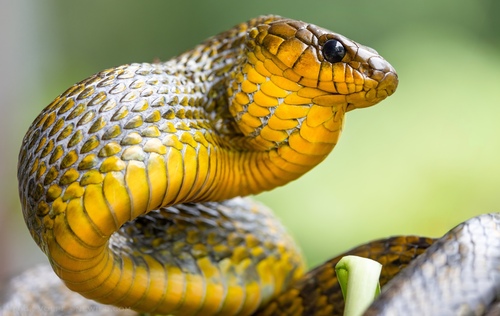
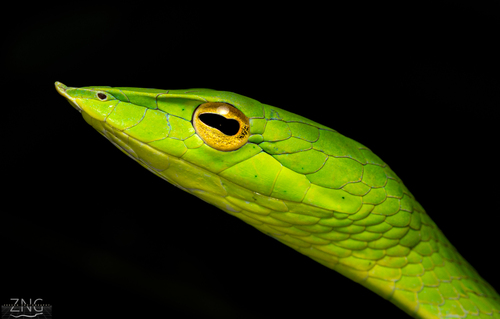
This section describes the appearance and scalation of Ahaetulla borealis. The dorsum ranges from uniform olive green to light green, and its scales are bordered with brown. Head scales sometimes have dark blue dots, which are themselves bordered with light blue. The eye is yellow to orange with light brown marbled patterns; it has a horizontal pupil, and the area around the pupil is light blue or yellow. The rostral scale, infralabials, and midbody venter range from light green to light blue. A yellow ventral stripe may sometimes be present along the notched ventral keels. The tail and subcaudals are green. Adults can reach a total length of 1 m; the head is very distinct from the neck, and the tail is relatively long and slender. Standard scalation characteristics are as follows: ventrals number 174–181, are notched and keeled; subcaudals number 142–157, and are divided; dorsal scale rows are 15-15–13/11, made up of smooth, obliquely arranged scales; the anal scale is divided; supralabials number 8–9, with the 6th supralabial being the largest; the 5th supralabial is in contact with the eye; the 4th supralabial is divided; the loreal scale is absent; infralabials number 8–9; pre-suboculars number 1–2; there is 1 pre-ocular on both the left and right side; postoculars number 2–3; sub-oculars are absent; temporals are arranged 2+2 or 2+3. Ahaetulla borealis is one of the most widespread Ahaetulla species in the Western Ghats. Its range extends from Sirsi, Karnataka northward to Matheran, Maharashtra. Along the southern edge of its range, it is bordered by A. farnsworthi, and the two species are likely separated by the Sharavathi River basin. This species inhabits low-to-mid-elevation moist deciduous and semi-evergreen forests, found at elevations of 300 to 750 meters above mean sea level.