About Agrocybe putaminum (Maire) Singer
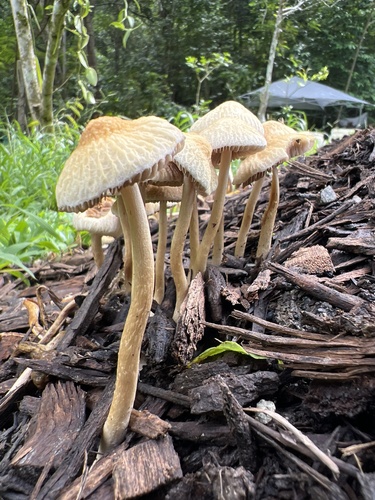
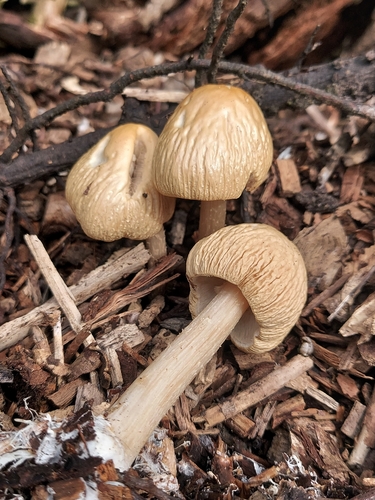
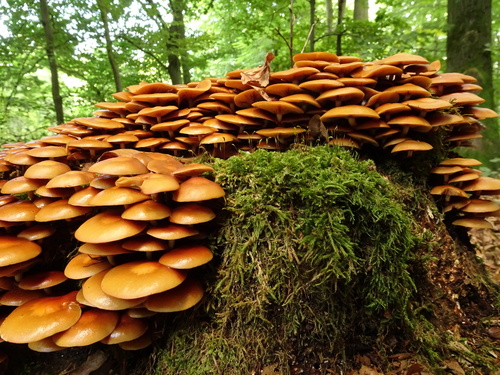
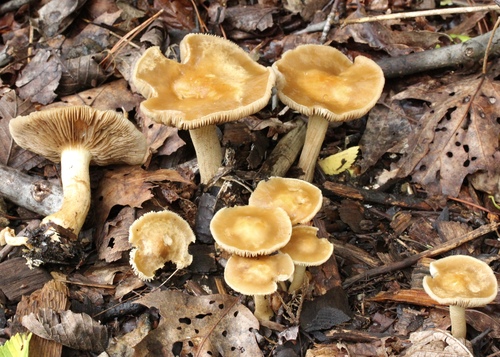
The fruitbodies of Agrocybe putaminum have convex caps that flatten out as they mature, and sometimes develop a shallow umbo. Mature caps reach a diameter of 3–10 cm (1+1⁄4–4 inches). When young, the cap is dark brown, fading to pale yellowish tan as it ages. The cap surface is smooth, matte, and finely pruinose, meaning it looks like it is coated with very fine flour. The gills attach adnately to the stipe; they start pale clay-brown, and deepen to dark brown once spores mature. Gills are moderately crowded, and are mixed with lamellulae — short gills that do not extend fully from the cap margin to the stipe. The cylindrical stipe is 5–8 cm (2–3+1⁄4 inches) long and 1–1.5 cm (1⁄2–1⁄2 inch) thick, and is thicker at both the apex and its club-shaped base. The stipe is initially stuffed with a cottony pith, and becomes hollow over time. It matches the cap in color, and its surface is marked by thin raised ridges, particularly near the top, that originate from mycelial cords. The mushroom's flesh is white, up to 1.5 cm (1⁄2 inch) thick, and does not change color when cut or injured. It has a farinaceous odor (like freshly ground flour) combined with a fungal scent, and a bitter taste with a cucumber aftertaste. This mushroom is not edible. Agrocybe putaminum produces a dark brown spore print. Its spores are roughly elliptical, smooth, thick-walled with a germ pore, and measure 10–12 by 5–9 μm. The spore-bearing basidia are club-shaped, four-spored, and measure 25–30 by 10–15 μm. Caulocystidia cover the stipe, giving it a velvety texture. Agrocybe putaminum is a saprobic species. Its fruitbodies grow on the ground in clusters or close groups, most often in woodchips. Because of this habitat preference, it can be found in gardens, parks, and other areas that use woodchip mulch. It is confirmed to occur in western North America and Europe. The species was once considered rare. After its initial discovery and reporting in France in 1913, it was recorded infrequently: in the Netherlands in 1958, Denmark in 1989, western Belgium and Italy in 1998, and India in 2003. It has since become more common, and its range has expanded alongside the growing use of woodchip mulch in ornamental flower beds. A 2007 report from central coastal California marked the first North American record of the species. It has also been reported multiple times in Southwest Australia.