About Agrochola macilenta Hübner, 1809
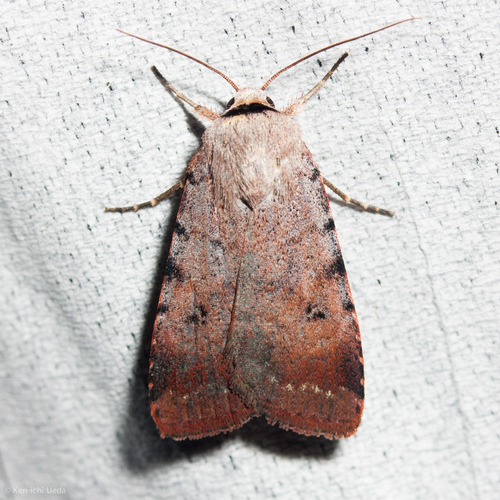
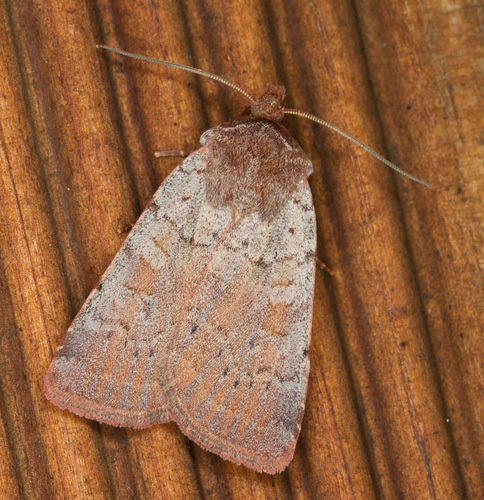
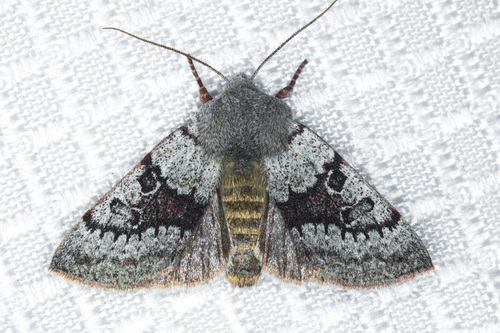
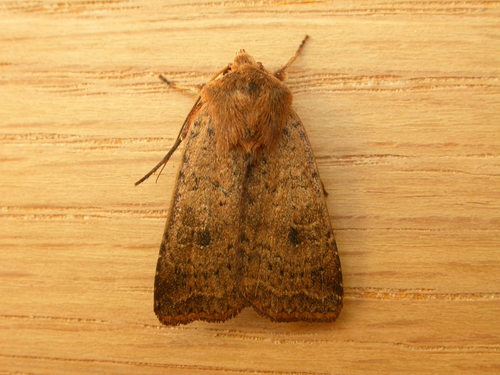
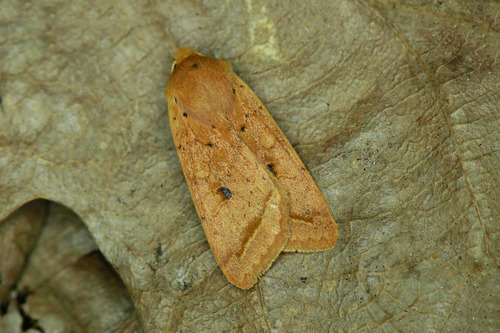
Agrochola macilenta, commonly known as the yellow-line Quaker, is a moth species belonging to the family Noctuidae. It was first formally described by Jacob Hübner in 1809. This species is distributed across Europe (excluding Russia) and Asia Minor. Its wingspan measures 32 to 36 mm. The forewing is ochreous, overlaid with pale fulvous colouring. The inner and outer lines are very faint, primarily marked by dark teeth on the veins. There is a dark spot at the base of the wing, and the median shade varies in intensity. The stigmata match the ground colour of the wing, with faint pale outlines; the lower end of the reniform stigma is almost always black. The submarginal line is ochreous, edged inwardly with rufous, and is nearly straight, only angled at vein 7. The hindwing is grey, with a rufous fringe. There is one noted aberration, ab. nigrodentata Fuchs, in which the basal, inner, and outer lines are all strongly marked, blackish, and dentate. The caterpillar is reddish brown with white dots, and bears three white lines along its back. The line running along the spiracles is whitish, with a dark dusky edge along its upper side. The head is ochreous brown, and the dorsal plate on the first abdominal segment is blackish with pale white lining. Adults of Agrochola macilenta fly from September to December, with the exact flight period varying by location. The larvae feed on a variety of shrubs and deciduous trees, and also feed on some herbaceous genera including Carpinus, Crataegus, Fagus, Populus, Prunus, Ulmus, Salix, Quercus, Calluna, Hieracium, and Plantago.