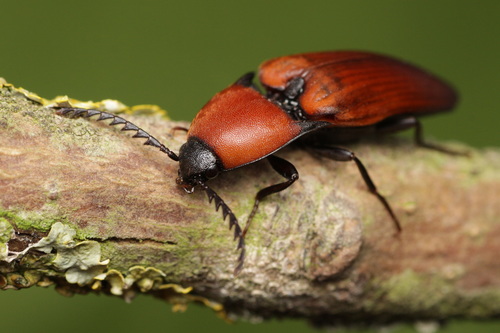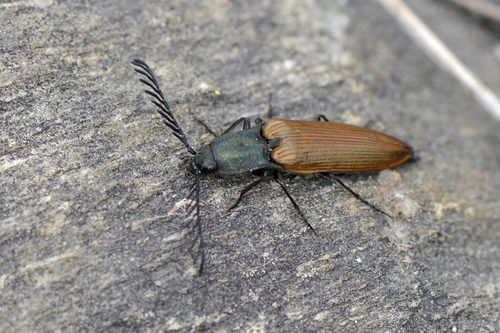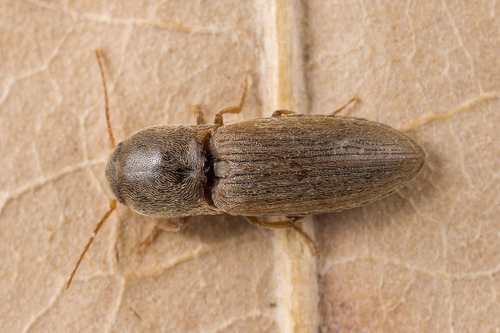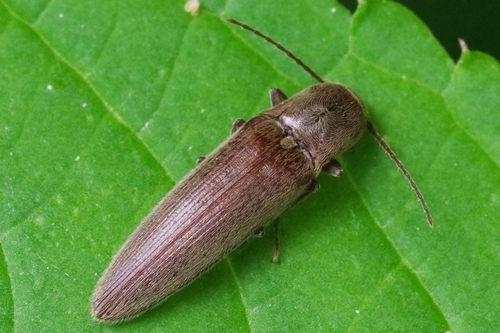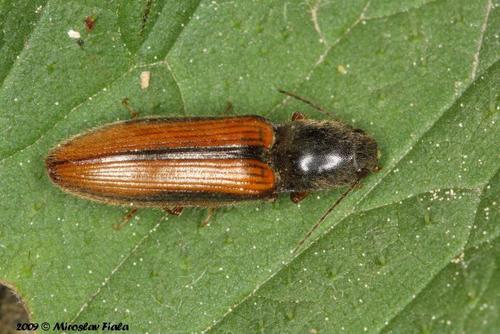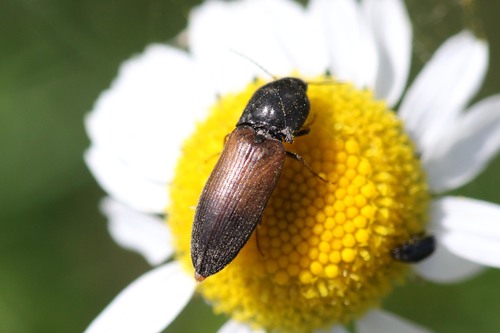
About Agriotes ustulatus (Schaller, 1783)
Adult Agriotes ustulatus range in length from 7 to 13 mm, with an average length of 10 mm. They can be distinguished from other European Agriotes species by a combination of morphological features, most on the pronotum, elytra, and antennae. The pronotum has a characteristic surface texture, and the hairs on its lower middle section all point toward a single spot above the hind margin, as marked by an arrow on the far right image. The base of the elytra near the scutellum bears elongated pits, as shown by arrows on the first image from the right. The 4th antennal segment is distinctly longer than the 2nd segment. Elytra color is variable, and is typically either light brown with often darker tips, or entirely dark brown to black. All populations of A. ustulatus contain mixtures of these two color forms, and intermediate color variants also occur. Studies of two populations, one in northern Italy and one in the Czech Republic, found the average share of dark color forms to be 40% and 32% respectively, and this percentage does not differ between male and female beetles. Before pesticides are applied to control Agriotes larva (wireworm) infestations in Europe, managers must confirm that the pest population exceeds the species-specific damage threshold, so identifying the infesting Agriotes species is required. A. ustulatus larvae can be identified via a combination of illustrated morphological features. The most reliable identification trait is the presence of dark, raised tubercles surrounding the base of setae on the tip of the larva's abdomen, which is the 9th abdominal segment, marked as figure a. Another distinguishing trait is the shape of the right mandible, which usually forms a large angle (clearly greater than 90°) between the mandible tip and the subapical tooth, marked as figure b. This angle is variable, however, and measures exactly 90° in approximately 15% of larvae. Additionally, the shape of the frontoclypeus on the larva's head is characteristic, shown in figures c and d. In 99.5% of A. ustulatus larvae, the angle formed by the frontoclypeus is slightly greater than 90°, a trait that differs from other Agriotes species. Molecular identification of A. ustulatus larvae is also reliable. Agriotes ustulatus is most common in parts of central Europe, where it is often considered an agricultural pest. Its core central European range includes France, Switzerland, Austria, northern Italy, Germany, Hungary, the Czech Republic, Poland, and the Netherlands. It also occurs in surrounding countries including Croatia, Romania, northern Spain, Denmark, Lithuania, and Estonia. In other parts of Europe and western Asia, the species may be rare or even listed as endangered. For example, it has only been recorded occasionally in far northern countries such as southern Finland, in southern areas such as Turkey and Iran, and in eastern areas such as western Russia. Within any given country and area, the distribution of A. ustulatus is often highly clustered, which appears to depend on environmental factors including temperature, rainfall, soil conditions, and crop or vegetation patterns. Until the 1990s, the persistent organochlorine pesticides lindane and aldrin were widely used for wireworm control in Europe, applied via broadcast applications. These pesticides were gradually withdrawn from the market once their negative impacts on human health and the environment were recognized. They were replaced by other pesticide groups such as neonicotinoids, which are most commonly applied as seed dressing for crops like maize or sugar beet. Neonicotinoids also cause negative environmental harm, particularly to beneficial insects including honey bees and other pollinators.