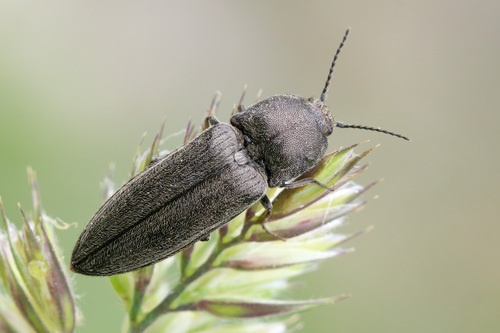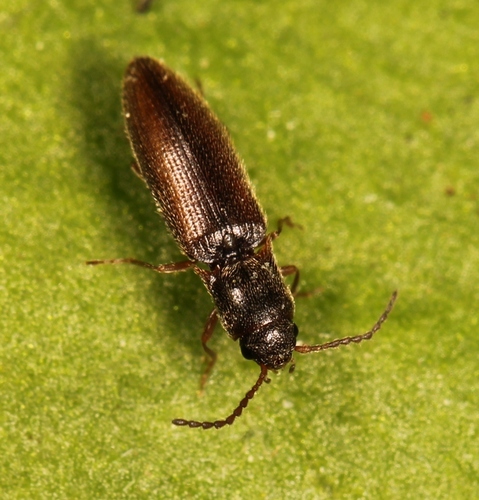
About Agriotes pallidulus (Illiger, 1807)
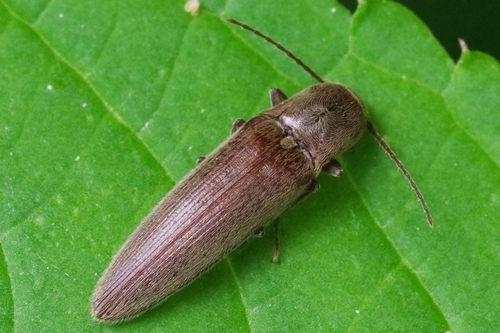
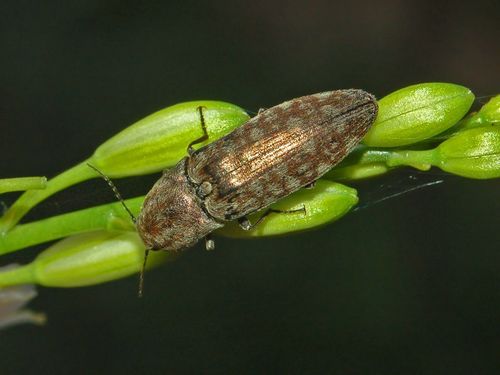
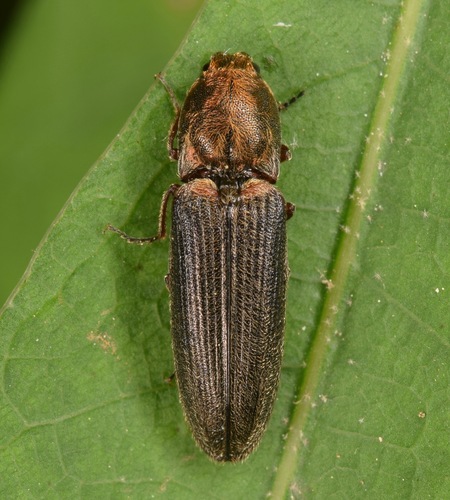
Adult Agriotes pallidulus beetles measure 3.5 to 6 mm long, usually between 4 and 5 mm. This makes it the smallest Agriotes species found in Europe, as all other European Agriotes species grow longer than 6.5 mm. Adults have an elongated body shape, with a punctured cuticle covered in short greyish hairs. The pronotum is shiny, and roughly as wide as it is long. The elytra feature strongly punctured longitudinal grooves. Body coloration is variable, ranging from dark brown to reddish-orange brown. Legs and antennae are a lighter brown, sometimes yellowish. The sides of the elytra are also often lighter brown, but may be dark near the middle where the two elytra meet. Molecular identification of this species is possible, and a partial cytochrome oxidase subunit 1 sequence from a German specimen of A. pallidulus has been published. Agriotes pallidulus was first described as Elater pallidulus by Johann Karl Wilhelm Illiger, based on a single specimen he obtained from northern Portugal, for his book on the beetles of Portugal. Despite this origin, Illiger also noted that the species is not uncommon in Germany. It has since been reported from other areas of Europe, especially the central, western, and north-western regions including the U.K., France, Germany, Belgium, the Netherlands, and Switzerland. Additional confirmed records come from Austria, the Czech Republic, Hungary, Ireland, Italy, Luxemburg, Poland, northern Romania, Slovakia, Spain, and parts of western Ukraine. Records from other European countries are considered doubtful. A. pallidulus is widespread and common in Britain, but reported as rare in Ireland. Multiple reports from eastern Europe also note that it is rare across this region, including in Austria, Hungary, and the Czech Republic. There is little published information on the biology and ecology of Agriotes pallidulus. It occurs in grasslands and forests, where its larvae feed on plant roots. Compared to other Agriotes species, the life cycle of A. pallidulus appears to be relatively short. Larvae overwinter only once, and pupate the following spring.