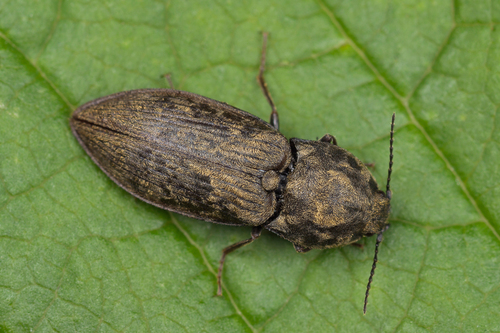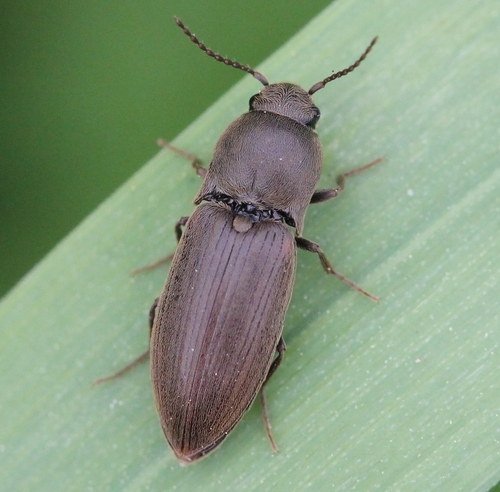
About Agriotes obscurus (Linnaeus, 1758)
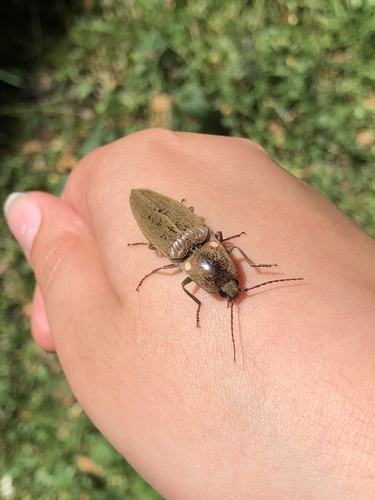
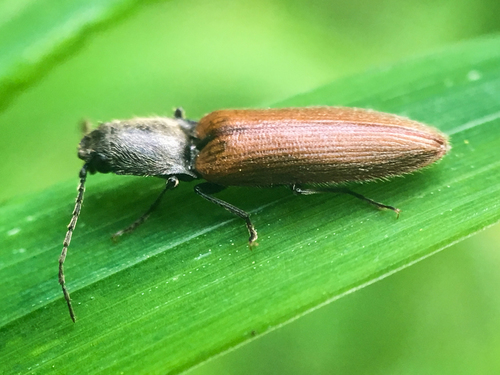
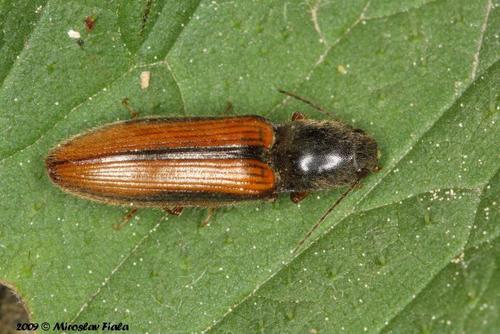
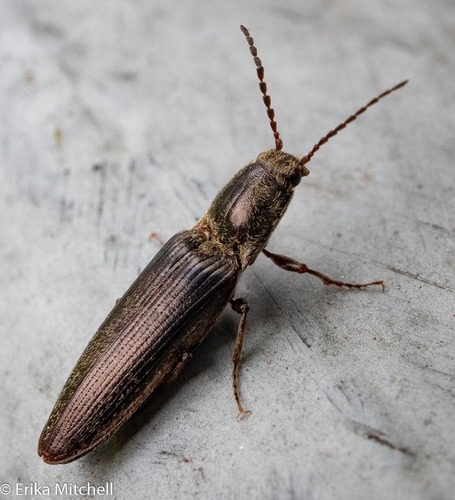
Adult Agriotes obscurus beetles are medium-sized among other Agriotes species, measuring 7 to 10 mm in length. They can be identified by a unique combination of morphological traits: the pronotum is clearly wider than it is long, with strongly curved sides; the entire thorax is strongly and densely punctured; the elytra are relatively short, with paired narrow longitudinal ridges, and the distal portion of the elytra is wedge-shaped. Most individuals are dark brown to black, with elytra, legs, and antennae often a lighter shade, though the entire body may be uniformly colored. The antennae are slightly longer than the combined length of the head and thorax. Agriotes obscurus is similar in appearance to two other common, agriculturally pestiferous European Agriotes species: A. sputator and A. lineatus. In both of these similar species, the pronotum is slightly longer than it is wide. Compared to A. obscurus, A. sputator has a pronotum that is wider near the head, with less curved, almost parallel sides. A. lineatus is easily distinguished from both A. obscurus and A. sputator by its striped elytra. Molecular identification of both adult and larval A. obscurus is also possible. The larvae of A. obscurus are morphologically very similar to the larvae of A. lineatus, making the two species difficult to separate as larvae. The shape of the abdominal spiracles is the most consistently differing trait between the two species: in A. obscurus, the spiracles are longer than wide and narrow toward the posterior end. When Linnaeus first described this species as Elater obscurus (the basionym of Agriotes obscurus), he listed Europe as its habitat. The type localities of three other species now considered synonyms of A. obscurus are Denmark, Germany, and Europe. A. obscurus is native to Europe and parts of Asia. It is most common in central Europe, including France, regions in and around the Alps, the United Kingdom, Germany, Poland, Scandinavia, and the Baltic states. Its full distribution range in Europe extends from parts of Spain and Italy in the southwest to the United Kingdom, Norway, and Finland in the north, to Ukraine and western Russia in the east, and to Serbia, Montenegro, Bulgaria, and Romania in the southeast. In Asia, it occurs in some northern and central areas, including Armenia, Azerbaijan, northern Kazakhstan, parts of Siberia, northern Mongolia, northern China, and Korea. Around 1900, A. obscurus was accidentally introduced to western Canada, most likely in soil associated with hop plants. It is now widespread and common in British Columbia, on both Vancouver Island and the Fraser Valley of the Canadian mainland, and is spreading into adjacent areas of the United States of America. A 1997 survey recorded A. obscurus in Washington State, just across the border from British Columbia. Further surveys in 2004 and 2005 showed that A. obscurus was widely distributed across some western parts of Washington State, with evidence of its presence also in parts of Oregon. Surveys conducted in Canada between 2017 and 2019 found A. obscurus in most southern areas of British Columbia. For many years, A. obscurus larvae (a type of wireworm) and other wireworms were controlled using organochloride pesticides such as lindane. This class of pesticides is now banned globally under the Stockholm Convention due to their environmental persistence and negative ecological impacts. Organochlorides were initially replaced by organophosphate pesticides, which are less persistent but highly toxic to humans. Currently, neonicotinoid pesticides are most commonly used to manage A. obscurus infestations. However, neonicotinoids have two major drawbacks: they are highly toxic to beneficial insects such as honey bees, and while they prevent damage caused by A. obscurus, they act mainly as repellents and do not significantly reduce pest populations. Due to these limitations, greater attention is being given to alternative control methods and integrated pest management (IPM). An IPM approach combines multiple different control methods and is recommended in Europe. It requires monitoring pest populations and establishing IPM treatment thresholds for specific crops, with control methods only applied when the population threshold is reached. However, such treatment thresholds have not yet been determined for A. obscurus.