About Agriotes lineatus (Linnaeus, 1767)
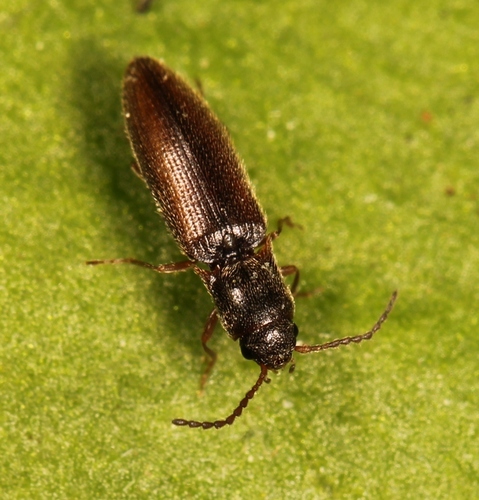
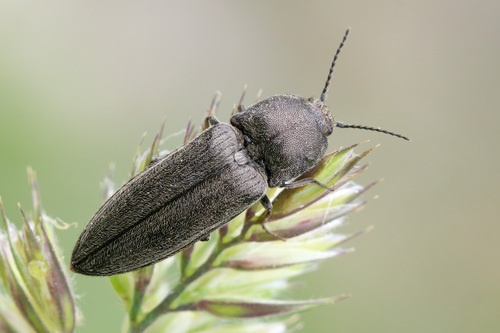
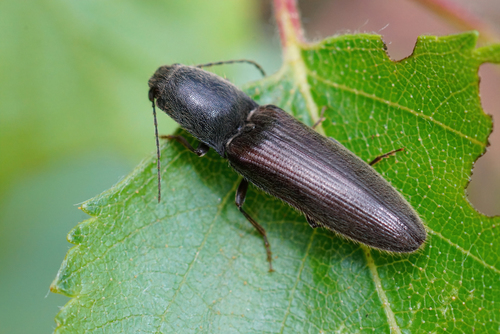
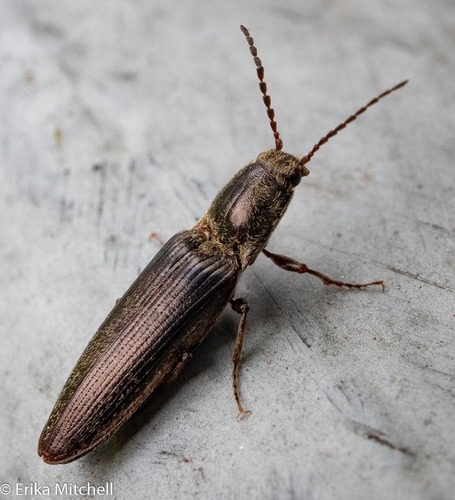
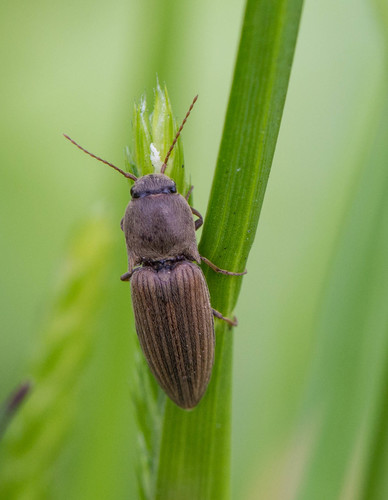
Adult Agriotes lineatus beetles typically measure 7.5–11 millimetres (0.30–0.43 in) in length, and most have a brownish-black body. The species is named for alternating brown-black and lighter brown longitudinal stripes on its elytra; these stripes occur in multiple Agriotes species, but are especially prominent in A. lineatus. The pronotum of A. lineatus is domed, and usually as long as or slightly longer than wide. This distinguishes it from the very similar species Agriotes proximus, which usually has a pronotum that is slightly wider than long. The antennae and leg segments distal to the tibiae are usually lighter brown. Molecular identification of this species has been studied and is generally feasible. Agriotes lineatus’s closest relative is Agriotes proximus, which also occurs in southern Europe and some neighboring areas of western Asia. The two species have only minor morphological differences in the adult stage, are attracted to the same pheromone, are indistinguishable as larvae, and no significant differences in their DNA structure have been detected. The mitochondrial cytochrome c oxidase subunit I gene of both species shares over 99% similarity. In addition to the pronotum shape difference, the male aedeagus of A. lineatus is shorter, and the hooks on its parameres are less sharp. In A. proximus, the paramere hooks are thinner, sharper, and also less developed. Larval features of Agriotes lineatus are very similar to those of Agriotes obscurus, and larvae of these two species are often difficult to tell apart. The most consistent distinguishing feature between the two is the shape of the abdominal spiracles, which are shorter in A. lineatus, with a parallel-sided, subquadrate shape. Other characteristic larval features of A. lineatus are: on the 9th abdominal segment, the inner longitudinal lines are the same length as the outer ones, the terminal spike is as long as it is wide, and the longitudinal lines are shorter than half the length of the 9th segment; on the right mandible, the angle between the apical and subapical teeth is less than or equal to 90°; on the frontoclypeus, the angle indicated in the left illustration (part C) is approximately 90°. There are no morphological differences between the larvae of A. lineatus and A. proximus. Agriotes lineatus was originally described from Germany, and the type localities of the three species now considered synonyms of A. lineatus are all located in Sweden. A. lineatus is native and common across most of Europe, and also occurs in parts of western Asia and the Near East. In Europe, it appears to be absent only from the northern regions of Norway, Sweden, Finland, and Russia. In western Asia, the species has been reported from Armenia, Azerbaijan, Georgia, northern Iran, Kazakhstan, Kyrgyzstan, Lebanon, Syria, Turkmenistan, and Turkey. The eastern extent of its native range is unclear, and it may include parts of Siberia, Mongolia, and China. While native Chinese authors have recorded A. lineatus from China, a thorough review of Chinese Agriotes species considered these records doubtful. A. lineatus was accidentally introduced to western Canada around 1900, and has since spread to neighboring parts of the United States. In western Canada, it is now found on Vancouver Island and in southern mainland British Columbia. It has also been recorded from western Washington State (U.S.A.), and may also occur in parts of Oregon. It has additionally been introduced to Nova Scotia in eastern Canada. There are a number of unconfirmed and/or insufficiently documented records of A. lineatus from several isolated locations worldwide, including Massachusetts (eastern USA), far eastern Russia, South Australia, and Western Australia. These reports have not been mentioned in recent publications on A. lineatus, and confirmation from experts familiar with the large, diverse genus Agriotes (where species often show considerable variation in coloration and morphology) would be desirable. After persistent organochloride pesticides were banned via the Stockholm Convention, organophosphate pesticides were used to control A. lineatus wireworms and other Agriotes species. These compounds are less persistent but highly toxic to humans, so they were later replaced by neonicotinoid insecticides and other products such as phenylpyrazole insecticides, most often applied as seed dressings. Phenylpyrazole insecticides also negatively impact human health, while neonicotinoids are very harmful to beneficial insects such as honey bees. Since 2014, an EU directive has restricted pesticide use overall and promotes the adoption of Integrated Pest Management (IPM). An IPM approach requires monitoring pest populations, only applying pesticides when significant economic damage is predicted, and prioritizing non-chemical control methods.