About Agrimonia parviflora Aiton
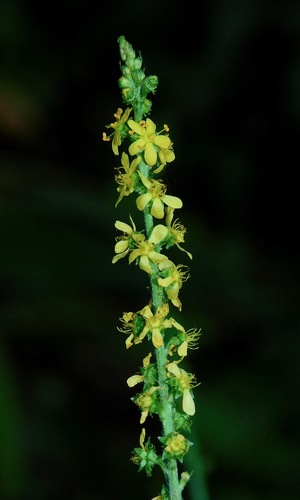
Agrimonia parviflora Aiton, commonly known as harvestlice or swamp agrimony, is an erect, rapidly growing plant that can reach up to 6.0 feet (1.8 m) in height. It has long fibrous roots that grow up to 6 inches (15 cm) in length, and produces multiple stems. Its stems are pubescent, and it bears alternating odd-pinnate compound leaves. Each leaf can hold up to 17 primary lanceolate leaflets with toothed edges; primary leaflets are glabrous on their upper surface and slightly pubescent on the underside. Much smaller, toothed secondary leaflets also grow between the primary leaflets. In midsummer, this species produces many small yellow flowers arranged in an elongate inflorescence; individual plants can bear as many as 100 flowers. Each flower is one fourth of an inch in diameter, has 5 petals, 5–10 stamens, and a hypanthium structure. Fruiting and seeding occur in summer, and plants senesce in the fall. The green fruits measure 4–5 mm in length, the calyx is 10-ribbed and tubernate, and fruits are typically single-seeded, indehiscent, and bur-like. This species prefers full sunlight, moist or wet ground, and grows in most soil types including sandy and silty soils. Its natural habitat includes swamps, woodlands, prairies, and roadside ditches. It is distributed across Ontario, Canada, and across 32 of the 50 United States. In the United States, it ranges along the Atlantic coast from Georgia to New York, is infrequent in the Atlantic coastal plain, and extends west to Texas and South Dakota. When cultivated, the plant requires very little care. It can survive temperatures as low as −33 °F (−36 °C) and periods of temporary flooding. Its bur-like fruit is dispersed by catching on mammal fur and bird feathers, and its seeds can survive over winter. Nectar from Agrimonia parviflora is eaten by bees and certain flies, while most mammals and reptiles avoid eating the plant because of its bitter taste. Some bird species use harvestlice in their nest construction. The plant's characteristic aroma and bitter taste repel predators and parasites such as lice and mites, keeping constructed nests free of these pests.