About Agrilus planipennis Fairmaire, 1888
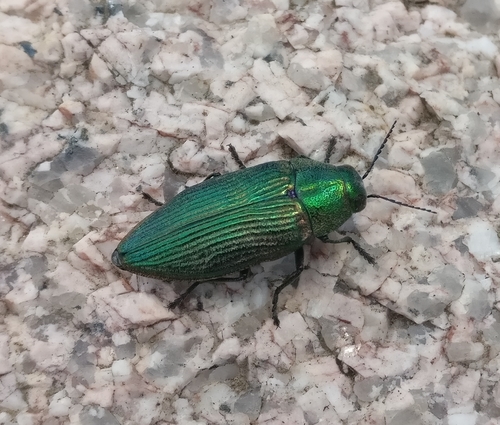
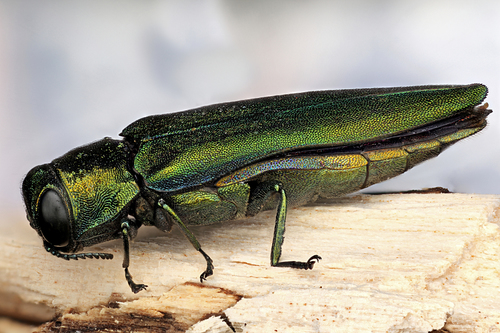
Identification: Adult Agrilus planipennis (emerald ash borer) beetles are typically bright metallic green, measuring around 8.5 mm (0.33 in) long and 1.6 mm (0.063 in) wide. Their elytra are usually a darker green, but may have copper tones. When wings and elytra are spread, this species is the only North American Agrilus that has a bright red upper abdomen. It also has a small spine at the tip of the abdomen, and serrate antennae that start at the fourth antennal segment. The beetles create visible feeding tracks under the bark of the trees they damage. Members of the public often misidentify adults of other beetle species as this one. Range: The emerald ash borer is native to temperate north-eastern Asia, including Russia, Mongolia, northern China, Japan, and Korea. It is an invasive species in North America, where its core population is located in Michigan and the surrounding U.S. states and Canadian provinces. Populations are more scattered outside this core area. The known northern edge of its distribution reaches Ontario, the southern edge reaches northern Louisiana, the western edge reaches Nebraska, and the eastern edge reaches New Brunswick. Separate satellite populations exist in Colorado and in Oregon, in the Pacific Northwest. In eastern Europe, a population was first detected in Moscow in 2003. Between 2003 and 2016, this population spread west toward the European Union at a rate of up to 40 km (25 mi) per year, and is projected to reach central Europe between 2031 and 2036. As of 2019, it had not been recorded within the European Union, but it had already spread from Russia into far eastern Ukraine. Life cycle: The emerald ash borer's life cycle takes either one or two years, depending on the time of year eggs are laid, the health of the host tree, and temperature. After 400–500 accumulated degree-days above 10 °C (50 °F), adults start emerging from host trees in late spring, with peak emergence occurring around 1,000 degree-days. After emerging, adults feed for one week on ash leaves in the tree canopy before mating, and cause very little defoliation. Males hover around host trees, locate females using visual cues, and drop directly onto females to mate. Mating can last 50 minutes, and females may mate with multiple males over their lifespan. A typical female lives around six weeks and lays approximately 40–70 eggs; females that live longer can lay up to 200 eggs. Females deposit eggs in bark crevices, flakes, or cracks, and the eggs hatch about two weeks after being laid. Eggs are approximately 0.6 to 1.0 mm (0.02 to 0.04 in) in diameter. They are initially white, and turn reddish-brown later if they are fertile. After hatching, larvae chew through the bark to reach the inner phloem, cambium, and outer xylem, where they feed and develop. The emerald ash borer has four larval instars. Larval feeding creates long, serpentine feeding galleries. Fully mature fourth-instar larvae are 26 to 32 mm (1.0 to 1.3 in) long. In fall, mature fourth-instar larvae dig chambers around 1.25 cm (0.49 in) deep into the sapwood or outer bark, where they fold into a J-shape. These J-shaped larvae shorten into prepupae, then develop into pupae and adults the following spring. To exit the tree, adults chew a hole from their chamber through the bark, leaving a characteristic D-shaped exit hole. Immature larvae can overwinter in their larval gallery, but may require an additional summer of feeding before overwintering again and emerging as adults the next spring. This two-year life cycle is more common in cool climates, such as European Russia.