About Agoseris aurantiaca (Hook.) Greene
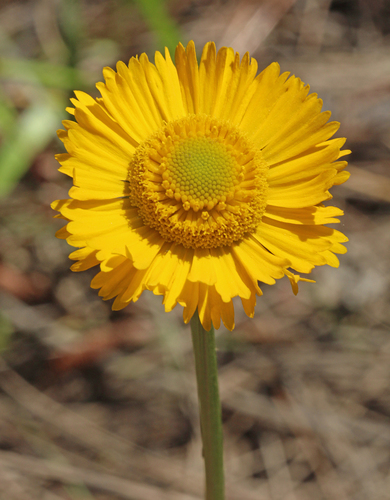
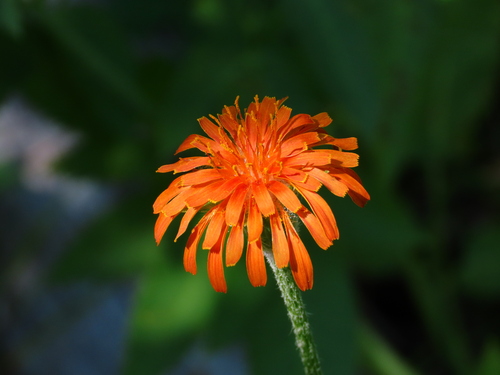
Agoseris aurantiaca (Hook.) Greene is a perennial herb or subshrub that reaches up to 60 centimeters (24 inches) tall. It grows a basal rosette of leaves that measure 5–35 cm (2–14 in) long, with smooth edges or irregular tooth-like lobes. This species does not have a true stem, but it produces several stem-like peduncles. From June to August, each peduncle holds a single flower head 2.5 cm (1 inch) wide, surrounded by phyllaries that range from hairless to hairy. The flower head is ligulate, meaning it contains only ray florets and no disc florets. The florets are most often orange, but may occasionally be yellow, pink, red, or purple. The specific epithet "aurantiaca" means "orange-red". Agoseris aurantiaca is the only species in its genus with orange flowers; most other species in the genus have yellow flowers. After flowering, the head matures into a ball-shaped cluster of beaked achenes, each topped with a terminal pappus made of many white bristles. Two varieties are recognized: Agoseris aurantiaca var. aurantiaca, which occurs across most of the species' range, and Agoseris aurantiaca var. purpurea (A.Gray) Cronquist, which is found in the southern Rocky Mountains. This species is widespread and common throughout western North America. Its range extends from Alaska and the Northwest Territories in Canada south to California, Arizona, and New Mexico, and east to the Rocky Mountains and the Black Hills. Isolated populations also grow in the Chic-Choc Mountains on the Gaspé Peninsula and in the Otish Mountains of central Quebec. It occurs primarily in mountainous regions and can grow in habitats ranging from wet to dry. A cold infusion of Agoseris aurantiaca is used for protection against witches by the Ramah Navajo.