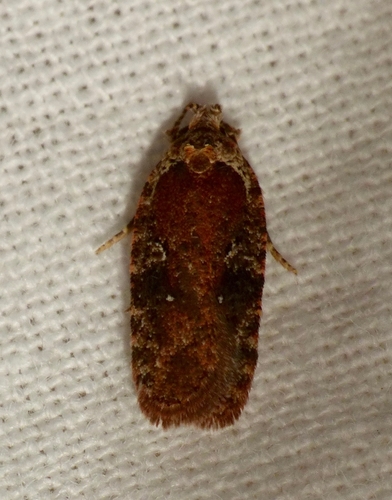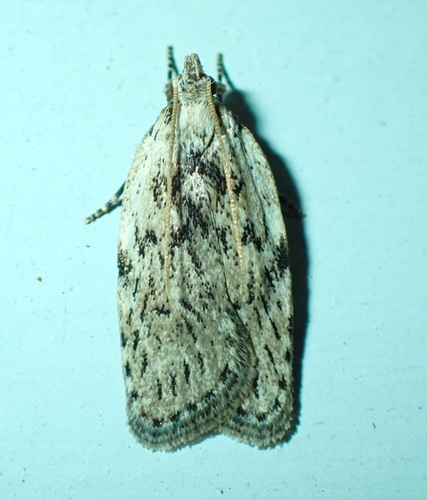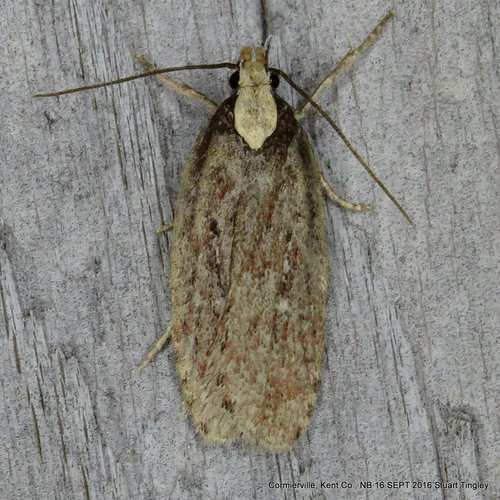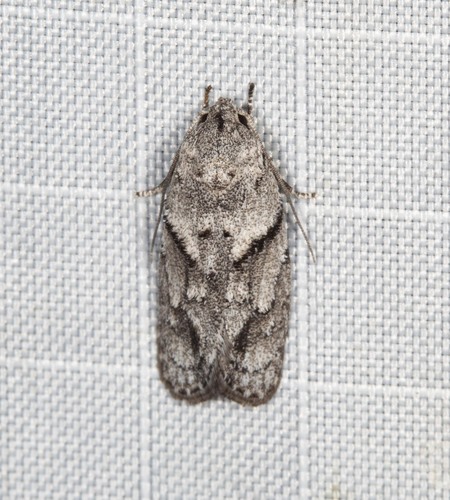
About Agonopterix alstroemeriana (Clerck, 1759)
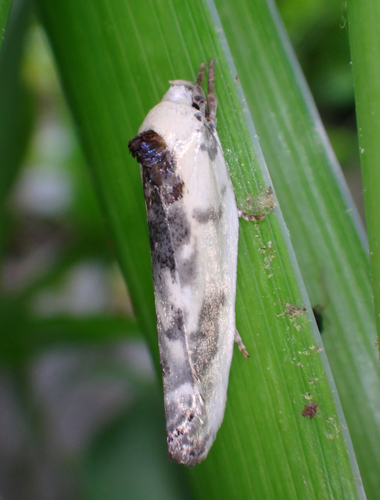
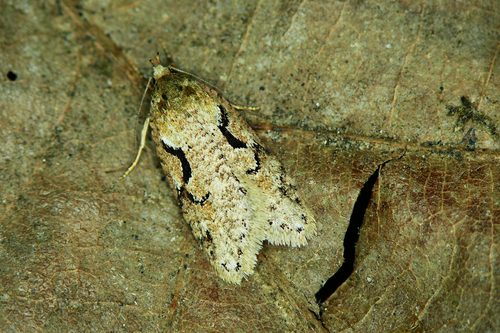
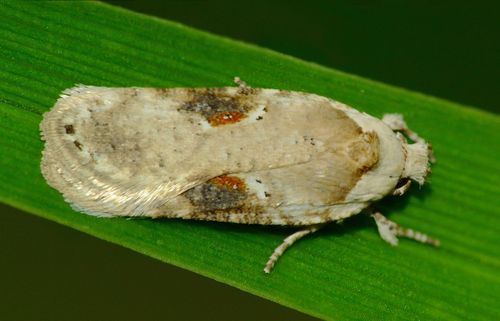
Identification: Adult Agonopterix alstroemeriana, also called the hemlock moth, are pale brown, nearly tan, with a lighter area near the base of their wings and a small number of darker spots close to the wing edges. Each wing has a distinct brown or reddish spot near its center, which is a key identifying feature. This moth can be mistaken for Exaeretia canella, another species in the Depressariidae family that has similar coloration. However, E. canella lacks the reddish central spot and has a dark head, unlike A. alstroemeriana. The eggs of A. alstroemeriana are a pale off-white color. Young caterpillars are yellow with a black head. Once they grow to approximately 10 mm in length, mature caterpillars are thin and light green, with three prominent darker green stripes along their sides. Range: A. alstroemeriana is a wide-ranging species native to Europe that has more recently spread to North America, Australia, and New Zealand. In North America, it is most common in the northeastern and northwestern United States, as well as in southern regions of Canada. It has spread inland in both countries, and is now commonly found in the Midwestern United States too. The first recorded North American sighting of the hemlock moth was a caterpillar found in Tompkins County, New York in 1973. After this initial sighting, A. alstroemeriana spread quickly across the United States. It was recorded in the Pacific Northwest between 1983 and 1985, possibly introduced by accidental shipping of dormant moths. The moth began appearing in the Midwest starting in 1990, when it was discovered near Columbus, Ohio. It became established in Illinois in 1993, where it was identified by the characteristic rolled leaves of its host plant Conium maculatum, a known sign of A. alstroemeriana presence. The species has been breeding in New Zealand since 1986, and it is likely that it later spread from New Zealand to southern Tasmania, where its presence was first discovered in 2019. Habitat: The poison hemlock moth can be found anywhere its host plant, Conium maculatum, grows. Because of this, the moth is most often seen in open fields and roadsides in suburban and rural areas. In the United States, A. alstroemeriana frequently overwinters under the bark of firewood; it will become active and fly away when the wood is brought indoors and warms up. Moths may also enter buildings and homes at night, since they are attracted to artificial light.