About Agonis flexuosa (Muhl. ex Willd.) Sweet
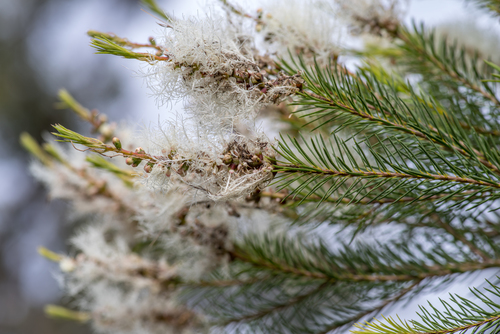
Agonis flexuosa is most commonly a tree that typically reaches 10 meters (33 feet) in height, but it sometimes grows as a wind-swept mallee or an almost prostrate shrub. Its branchlets are often twisted or zig-zagged, and usually become glabrous as they mature. The leaves of this species are very narrowly elliptic, narrowly elliptic, or narrowly egg-shaped, measuring 80–135 mm (3.1–5.3 in) long and 3.5–12 mm (0.14–0.47 in) wide. Leaves are either sessile or borne on a petiole up to 5 mm (0.20 in) long. Young leaves sometimes have soft, silky hairs, but become glabrous as they age. Leaves have a prominent mid-vein, and usually one other pair of veins.
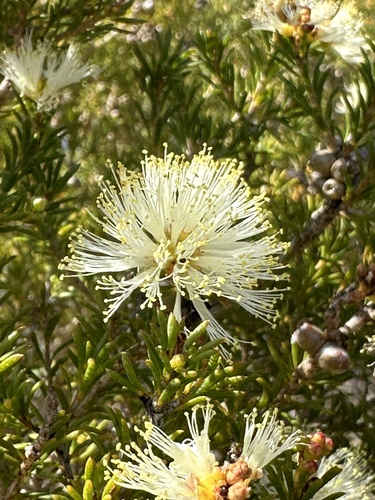
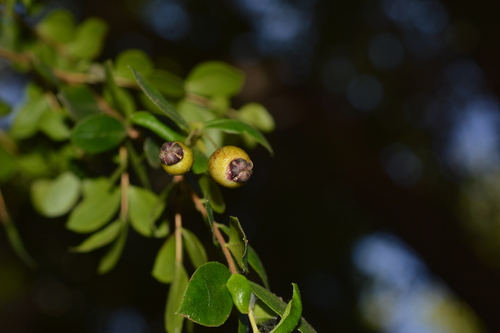
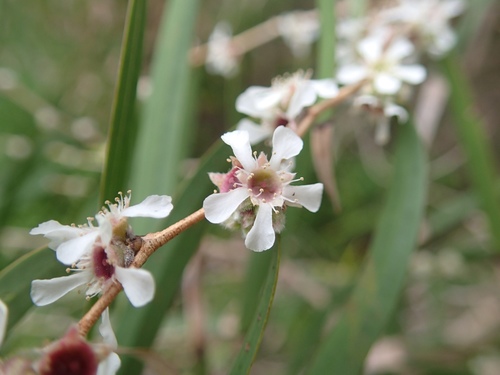
The flowers are arranged in clusters 10–15 mm (0.39–0.59 in) wide, accompanied by broadly egg-shaped bracts and elliptic bracteoles that are 1–2 mm (0.039–0.079 in) long. The floral tube is 1.5–2 mm (0.059–0.079 in) long, and the sepals are 1–2 mm (0.039–0.079 in) long with silky, greyish hairs. The petals are white and spatula-shaped, measuring 3–6 mm (0.12–0.24 in) long. There are 20 to 25 stamens in total: 3 to 5 (sometimes up to 7) stamens are positioned opposite the sepals, and no stamens are positioned opposite the petals. The filaments are 1–1.5 mm (0.039–0.059 in) long, and the style is 1–2.5 mm (0.039–0.098 in) long. Flowering occurs from July to December. The fruit is a broadly top-shaped to broadly cup-shaped capsule 2.5–4 mm (0.098–0.157 in) long, held in clusters 6–10 mm (0.24–0.39 in) wide.
Agonis flexuosa has two accepted varieties, both native to south-western Western Australia. Agonis flexuosa var. flexuosa grows in a wide range of habitats including coastal heath, woodland, and forest, across a variety of soil types, in the Esperance Plains, Geraldton Sandplains, Jarrah Forest, Swan Coastal Plain and Warren bioregions. Agonis flexuosa var. latifolia grows mainly in sandy soil in heath, shrubland or woodland between Walpole and Cheyne Beach, in the Esperance Plains, Jarrah Forest and Warren bioregions, with one recorded occurrence in the Stirling Range.
In horticulture, horticultural variants are most likely derived from the widespread wild population, growing as either shrubs or trees, and may be flowerless. Two commercially available cultivars are Agonis ‘Belbra Gold’ and Agonis ‘Fairy Foliage’. Noongar peoples have traditional uses for this plant: they use its leaves as an antiseptic, and use sapling trunks as spear shafts and digging sticks.