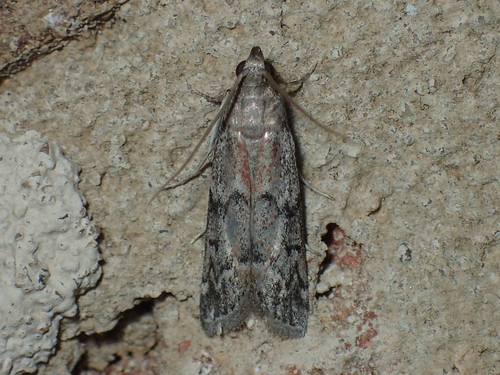
About Aglossa cuprina Zeller, 1872
The scientific name of this species is Aglossa cuprina Zeller, 1872.
A. cuprina eggs are off-white, rounded and oval-shaped. In the larval stage, individuals have a brownish head, a greyish body, black mandibles, and a black peritreme – the portion of the insect’s integument that surrounds the spiracles. Larvae of A. cuprina can be distinguished from larvae of A. caprealis by differences in their setae. The pupae of this species are reddish-brown and have six curved, hooked setae.
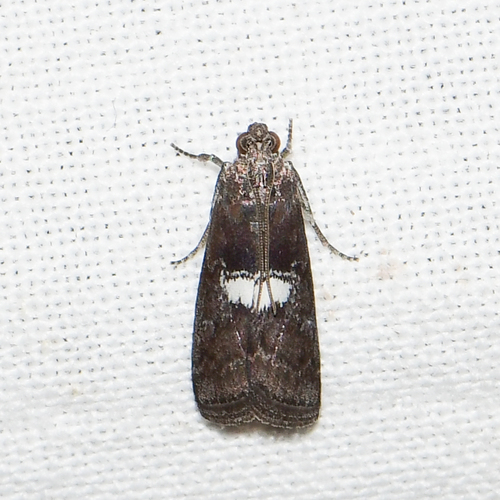
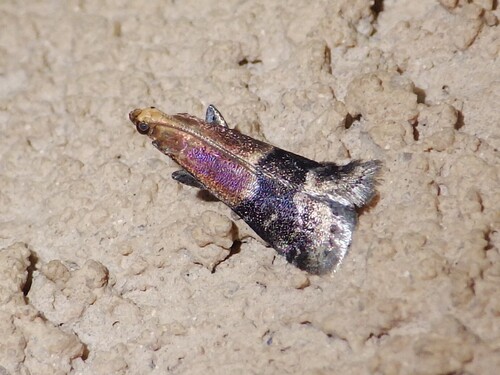
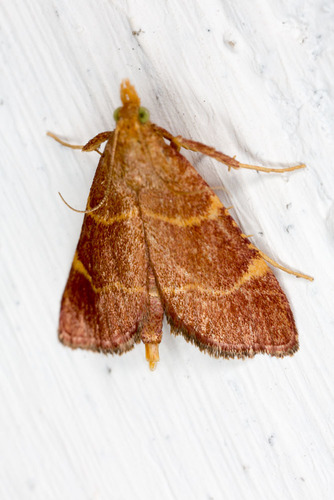
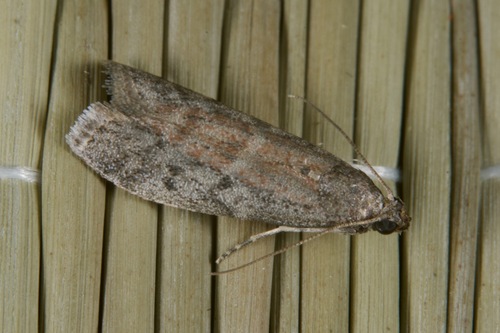
Adult moths have an average wingspan of 1.8–2.7 cm (18–27 mm) and an overall dark greyish-brown body coloration. Their forewings are brownish-grey with pale yellowish markings that resemble the patterning of a tabby cat, which is the origin of the species’ lesser-used common name. The top of the head and neck are plain pale yellow. Adult A. cuprina also have characteristic filiform, or thread-like, antennae.
A. cuprina has been recorded in Europe, Asia, Australia, North America, and South America. In North America, it is distributed across the eastern portion of the continent, with confirmed sightings in California, Arkansas, Arizona, Connecticut, the District of Columbia, Delaware, Florida, Illinois, Massachusetts, Maryland, Missouri, North Carolina, New Hampshire, New Jersey, New York, Pennsylvania, South Carolina, Texas, and Wisconsin. The adult moth stage is typically active in early summer, between May and August. This species tends to live in areas around or within human habitation and buildings. When found in homes, it usually occurs in the kitchen, specifically the pantry where its preferred food source is stored. It is also commonly found in locations that store dried grain products, such as warehouses and undisturbed sections of grain elevators.
Full research into the life cycle of A. cuprina has not yet been completed, but what is known indicates it has a similar life cycle to Aglossa caprealis. In the related A. caprealis, females lay an average of 60–300 eggs in a single reproductive cycle, most often on overhanging supports. Egg hatching time is temperature dependent, ranging from 2 to 14 days. After hatching, the larval stage lasts between 2 and 41 weeks before pupation. Larvae prefer dark, secluded environments, and build flexible tubular galleries supported by silken fibers they produce. Before pupation, larvae leave their galleries and disperse to an appropriate location. They entangle themselves in a loose, tough silken cover that they interweave with nearby materials; these materials add structure to the silken covering and camouflage the developing moth during metamorphosis. The duration of each developmental stage is temperature dependent. The full life cycle of A. cuprina ranges from approximately twelve months to over two years, depending on weather and temperature conditions. The adult imago stage emerges in early summer.