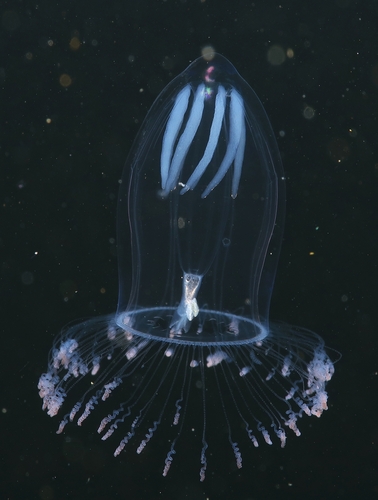
About Aglantha digitale (O.F.Müller, 1776)
Aglantha digitale is a small, transparent hydrozoan that reaches a maximum height of 4 cm (1.6 in) and is typically some shade of pink. Its bell is thimble-shaped, being taller than it is wide, with a small conical bulge at the apex. Around the bell margin there are approximately 80 slender solid marginal tentacles. Eight club-shaped statocysts sit on the bell margin between the eight radial canals. A gastric peduncle hangs inside the bell, and the mouth at the tip of the small manubrium has four simple lips. Mature individuals have eight white, sausage-shaped gonads that can be seen through the transparent bell.
This is the most common jellyfish species found in surface waters of the Arctic and sub-Arctic. It occurs above the continental slope, but is more common over the deep ocean, and is seldom found at depths greater than 200 m (660 ft).
Among all known jellyfish, Aglantha digitale is unique in having giant axons in the subumbrella (the concave inner surface of the bell) that enable a rapid escape response. Under normal conditions, the hydrozoan swims by slowly pulsating its bell; these slow movements are produced by muscle contractions that eject water through the velar opening. When the animal is stimulated by touching the bell margin, squeezing a marginal tentacle, or tugging a tentacle, it reacts very quickly with up to three vigorous contractions that propel it around five body lengths away. In its pelagic habitat, this hydrozoan travels alongside relatively fast-moving crustaceans, fish larvae, and arrow worms during jostling diurnal vertical migration, and this escape response may help it avoid damage to its fragile tissues. This escape behavior has been observed directly in this species from submersible craft.

