About Aglaja tricolorata Renier, 1807
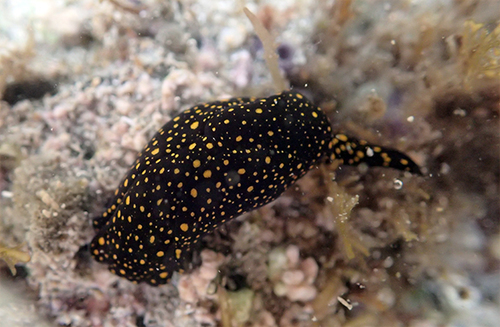
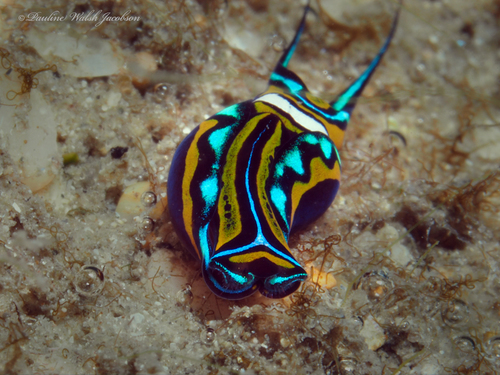
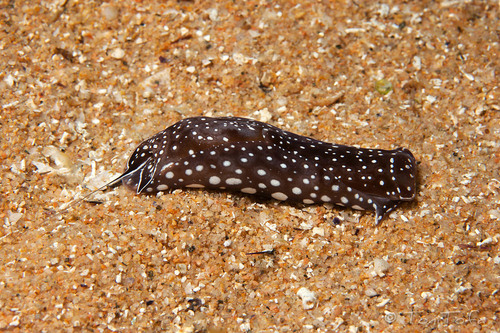
Aglaja tricolorata is a cylindrical sea slug that reaches an adult length of about 5 centimeters (2 inches). At its front end is a cephalic shield with a pointed tip on each side. Two parapodia extend from either side of the foot and fold over the slug's back; each parapodium ends at the rear with a horn-shaped projection that often curves backwards. The hind end of the mantle has two rounded lobes. The left lobe extends into a long flagellum, which measures about one fifth the total length of the body, while the right lobe conceals the bipinnate gill. The entire body of this sea slug is translucent, ranging from dark to pale brown, and is covered in scattered round white spots. A thin white line margins the cephalic shield and the posterior mantle lobes. The sole of the foot is often darker than the upper parts of the body, and its white spots are larger than those on the upper body. A small internal shell made of one or two coils is present, but it cannot be seen from outside the body. Aglaja tricolorata can be confused with Philinopsis depicta, a slightly larger related species. However, P. depicta has parapodia bordered by a double line: a blue outer line and an orange inner line, and it does not have a long flagellum like A. tricolorata. Aglaja tricolorata is native to the Mediterranean Sea and the coasts of tropical West Africa. It is a shallow-water species that lives on muddy sand seabeds. Like other members of its family, Aglaja tricolorata is a predator. Its exact diet has not been confirmed, but it is thought to feed on other opisthobranchs, as remnants of these organisms have been found in its digestive tract. Individuals have been observed moving through sediment in a ploughing motion, apparently following winding chemical trails left by their prey, and may detect these trails using sensory hairs located at the sides of the mouth. Glands at the front of the foot secrete a layer of mucus that the animal glides over. Other glands located in the skin produce a toxic mucus that may act to deter predators. Aglaja tricolorata is a hermaphrodite, and each individual's genital organs are positioned on the right front of its body. After receiving sperm, an individual lays white eggs in a thin strand of mucus, which it winds tightly around its own body to form a tangled egg mass. The animal then exits through the front of this structure, leaving the egg mass behind, and the egg mass may attach to the seabed.