About Aglais urticae (Linnaeus, 1758)
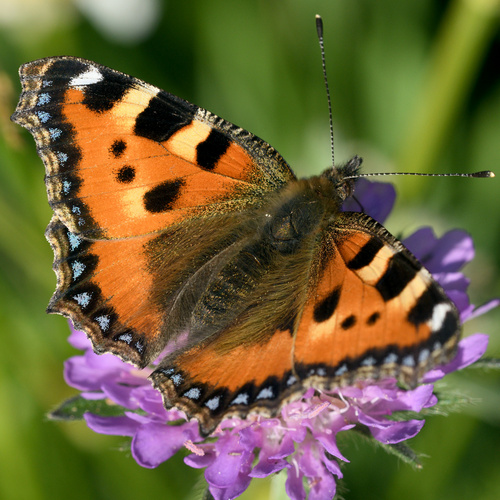
This is the small tortoiseshell butterfly, scientifically named Aglais urticae (Linnaeus, 1758). It is a medium-sized butterfly, primarily reddish orange, with black and yellow markings on the forewings, and a ring of blue spots along the wing edges. Its wingspan ranges from 4.5 to 6.2 cm. In more technical terms, its base wing color is bright foxy red. The forewing has three black spots along the costal edge, with yellow spaces between these spots. There is a larger black spot in the middle of the hindmarginal area, and two smaller black spots in the disc between the 3rd radial and 2nd median veins. The basal half of the hindwing is black. Both wings have a black submarginal band that holds blue spots. On the underside, the forewing is ochreous, with the same costal spots as described above, and the apex and distal margin are blackish. The underside of the hindwing is brown, with its basal half black and a toothed edge. The entire hindwing surface is marked with darker pencilled lines, and contiguous dull blue lunules sit along the distal margin of both wings. This species is the national butterfly of Denmark. It can be found throughout temperate Europe, Asia Minor, Central Asia, Siberia, China, Nepal, the Sikkim Himalayas in India, Mongolia, Korea, and Japan, in any location where common nettle (the food source for its larvae) grows. A small number of records exist from New York City, though these individuals are believed to be introduced. Like many other nymphalid butterflies, Aglais urticae caterpillars feed on stinging nettles (Urtica dioica) and small nettles (Urtica urens). Humulus lupulus has also been recorded as a larval food plant for this species. Adult butterflies feed on nectar. Aglais urticae has one of the longest activity seasons of any Eurasian butterfly, stretching from early spring to late autumn. Adult butterflies overwinter in hibernation, and emerge on the first warm sunny days of the year to mate and breed. In the southern parts of its range, the species may produce two broods each year, but northern populations cannot produce a second brood because long summer day lengths inhibit this additional breeding.