About Aglaeactis cupripennis (Bourcier, 1843)
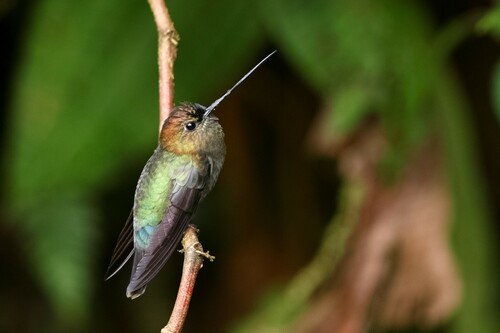
The shining sunbeam (Aglaeactis cupripennis) measures 12 to 13 cm (4.7 to 5.1 in) in total length. Males weigh 7.6 to 8.1 g (0.27 to 0.29 oz), while females weigh 6.9 to 7.5 g (0.24 to 0.26 oz). Both sexes share a short, straight, black bill. Uniquely among all sunbeam species, neither sex has any white plumage. Males of the nominate subspecies have dark brown crowns and upper backs. Their lower back and rump are colored lilac-gold, which shifts to silvery green on the uppertail coverts. Their tail feathers range from dark brown to rufous, and usually have bronzy edges. Their throat is rufous, dotted with dusky gray; their breast is patchy buff, and their belly is reddish brown. From north to south across the range, the male's underparts become brighter, the crown darker, and the tail redder. Females have similar patterning to males, but the gold and green tones on their lower back and rump are either duller or completely absent. The subspecies A. c. caumatonota differs from the nominate subspecies by having an iridescent amethyst rump and purplish amethyst uppertail coverts. The nominate subspecies of shining sunbeam occurs in all three Andean ranges of Colombia, and extends south through Ecuador to the La Libertad and Huánuco departments of Peru. A. c. caumatonota is found in Peru, ranging south from the nominate subspecies' range to the Lima and Cuzco departments of Peru. This species inhabits sub-páramo to páramo landscapes, which are defined by grasslands with scattered shrubs and trees. It also lives in cloudforest and semi-arid ridges that host only a small number of trees. Its elevational range spans 2,500 to 4,300 m (8,200 to 14,100 ft).