About Agkistrodon piscivorus (Lacépède, 1789)
Anatomy and description Agkistrodon piscivorus is the largest species in the genus Agkistrodon. Most adult individuals exceed 80 cm (31 in) in total length (tail included), and females are generally smaller than males. One study of adult specimens recorded total lengths between 65 and 90 cm (26 to 35 in). Average body mass ranges from 292.5 to 579.6 g (10.32 to 20.44 oz) for males, and 201.1 to 254.1 g (7.09 to 8.96 oz) for females. Rarely, adult individuals may exceed 180 cm (71 in) in total length, particularly in the eastern part of this species' range. The maximum reliably recorded total length is 189.2 cm (74.5 in), while Gloyd and Conant (1990) note that the largest recorded specimen of A. p. piscivorus reached 188 cm (74 in). This specimen was captured in the Dismal Swamp region and donated to the Philadelphia Zoological Garden; it was injured during capture, died several days later, and was measured when positioned straight and relaxed. Large specimens can be very bulky: a specimen roughly 180 cm (71 in) long is known to have weighed 4.6 kg (10 lb).
Contrary to the common expectation that aquatic snakes should have a small, narrow head that tapers posteriorly to reduce water drag during prey capture, this pit viper (commonly called the cottonmouth) has a bulky, triangular head. Despite assumptions that this shape would be poorly adapted to water, this is not the case. The broad head is clearly set apart from the neck, and the snout is blunt in profile, with the upper rim of the head extending slightly further forward than the mouth. The species has substantial cranial plates, though parietal plates are often fragmented, particularly toward the rear. A loreal scale is absent. There are 6 to 9 supralabial scales and 8 to 12 infralabial scales. At midbody, the species has 23 to 27 rows of dorsal scales; all dorsal scale rows bear keels, though the keels on the lowest rows are weak. Ventral scales number 130–145 in males and 128–144 in females, while subcaudal scales number 38–54 in males and 36–50 in females. Many subcaudal scales are divided.
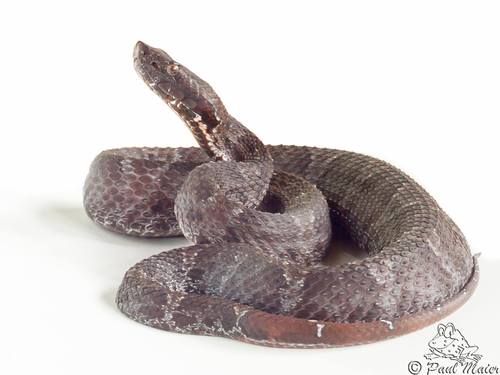
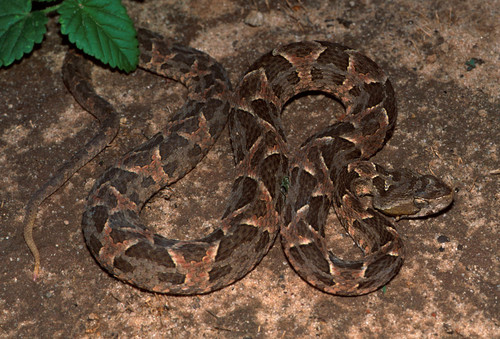
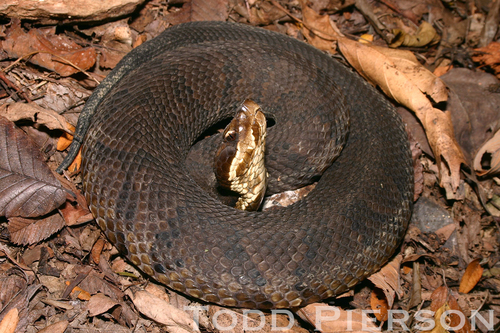
While most specimens are almost or entirely solid black (except for head and facial markings), background body color can also be brown, gray, tan, yellowish-olive, or blackish. This background is overlaid with 10 to 17 dark brown to nearly black crossbands that usually have black edges. These crossbands are sometimes broken along the dorsal midline to form staggered halfbands on either side of the body, and their centers are visibly lighter, often matching the background color. Crossbands frequently contain irregular dark markings and extend down onto the ventral scales. The dorsal banding pattern fades with age, so older individuals are almost uniformly olive-brown, grayish-brown, or black. The belly is white, yellowish-white, or tan, marked with dark spots that become more concentrated toward the posterior end; the amount of dark belly pigment varies from almost none to nearly fully black. The head is more or less uniformly brown, especially in A. p. piscivorus. Subadults may have the same dark parietal spots that are characteristic of copperheads (Agkistrodon contortrix), and these spots are sometimes still visible in adults. Eastern populations have a broad dark postocular stripe bordered by pale pigment above and below; this stripe is faint or absent in western populations. The underside of the head is generally whitish, cream, or tan.
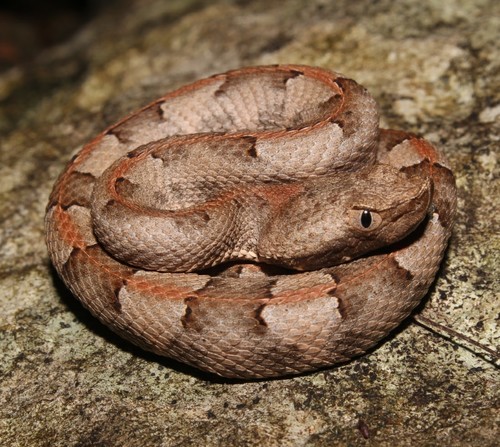
Specimens ranging from 26.8 cm to 120.3 cm in snout-vent length show a variety of dorsal colors including white, tan, brown, and black. Individuals longer than 60 cm in snout-vent length have less white and tan coloration. Juvenile and subadult specimens generally have a more contrasting color pattern, with dark crossbands on a lighter tan, brown, or reddish-brown background. The tail tip is usually yellowish, becomes greenish-yellow or green in subadults, and turns black in adults. Some juveniles also display the banding pattern on the tail. Young cottonmouths wiggle their tail tips to lure prey.
This species is often confused with the copperhead, A. contortrix, especially when juvenile, but there are clear differences. A. piscivorus has broad dark stripes on the sides of the head that extend back from the eyes, while A. contortrix only has a thin dark line that separates pale supralabials from the darker upper head. It is also similar in appearance to watersnakes of the genus Nerodia, which are thick-bodied with large heads. However, Nerodia watersnakes have round pupils, no loreal pit, a single anal plate, entirely divided subcaudal scales, and a distinct overall color pattern.
Geographic range A. piscivorus is found in the eastern United States, ranging from the Great Dismal Swamp in southeastern Virginia south through the Florida peninsula, and west to Arkansas, eastern and southern Oklahoma, and western and southern Georgia (excluding Lake Lanier and Lake Allatoona). There are a few records of specimens found along the Texas portion of the Rio Grande, but these are thought to be disjunct populations that are now possibly eradicated. The originally given type locality is "Carolina"; Schmidt (1953) proposed restricting this to the area around Charleston, South Carolina. Snakes observed in the northern parts of the species' range are typically larger older individuals. Campbell and Lamar (2004) list this species as present in Alabama, Arkansas, Florida, Georgia, Illinois, Indiana, Kentucky, Louisiana, Mississippi, Missouri, North Carolina, Oklahoma, South Carolina, Tennessee, Texas, and Virginia. Maps from Campbell and Lamar (2004) and Wright and Wright (1957) also confirm the species' presence in Western and Middle Tennessee and extreme southeastern Kansas, and limit its Kentucky range to the western part of the state. In Georgia, it occurs in the southern half of the state, up to a few kilometers north of the Fall Line, with very few exceptions. Its range extends into the Ohio River Valley as far north as southern Indiana, and it inhabits many barrier islands off the coasts of the states where it is found.
Habitat Agkistrodon piscivorus is the most aquatic species in the genus Agkistrodon, and is usually associated with bodies of water including creeks, streams, marshes, swamps, and the shores of ponds and lakes. This species has a distinctive swimming behavior: it typically floats on top of the water rather than swimming with its body below the surface. The U.S. Navy (1991) describes its habitat as swamps, shallow lakes, and sluggish streams, and notes that it is usually not found in swift, deep, cool water. Behler and King (1979) add lowland swamps, lakes, rivers, bayheads, sloughs, irrigation ditches, canals, rice fields, and small, clear, rocky mountain streams to the list of confirmed habitats. It also occurs in brackish-water habitats and is sometimes seen swimming in salt water. It has been far more successful at colonizing Atlantic and Gulf Coast barrier islands than the copperhead, though even on these islands it tends to favor freshwater marshes. A 1985 study by Dunson and Freda found that the species is not particularly salt-tolerant.
The species is not restricted to aquatic habitats: Gloyd and Conant (1990) note that large specimens have been found more than 1 mile (1.6 km) from water. Across its range, A. piscivorus is well-adapted to less moist environments, including palmetto thickets, pine-palmetto forest, East Texas pine woods, Florida pine flatwoods, eastern deciduous dune forest, dune and beach areas, riparian forest, and prairies.
Behavior and ecology In the southern United States, A. piscivorus is often incorrectly described as aggressive. In experiments testing the behavioral responses of wild specimens to human encounters, 51% (23 out of 45) of individuals tried to escape, while 78% (28 out of 36) used threat displays and other defensive tactics. Biting only commonly occurred when specimens were picked up with a mechanical hand: just 36% of picked up individuals attempted to bite, fewer than 20% bit when stepped on, and no snakes attempted to bite when researchers stood beside them. When approached by humans, cottonmouths seek the nearest available shelter. This sometimes means moving closer to humans, which creates the false impression the snake is seeking to attack. This behavior is often paired with raising the head, leading to further misinterpretation.
When sufficiently stressed or threatened, this species performs a characteristic threat display: it vibrates its tail, pulls its head back with its mouth open to show the stark white inner lining of the mouth, hisses loudly, and curls the neck and front portion of the body into an S-shape. Many common names for the species, including cottonmouth and gaper, reference this display; its habit of snapping its jaws closed when anything touches its open mouth has earned it the name "trap jaw" in some areas. Other defensive responses include flattening the body and emitting a strong, pungent secretion from anal glands at the base of the tail. This musk can be ejected in thin jets when the snake is sufficiently agitated or restrained, and its scent has been compared to that of a billy goat, as well as that of Pluchea, a common floodplain weed genus with a strong penetrating odor.
Harmless Nerodia watersnakes are often mistaken for cottonmouths. Both are semiaquatic, thick-bodied snakes with large heads that may act aggressively when provoked, but they behave differently: watersnakes usually flee quickly into the water, while A. piscivorus often holds its ground in threat display, and watersnakes do not vibrate their tails when excited. A. piscivorus usually holds its head at an approximately 45° angle when swimming or crawling. Brown (1973) noted that the species' heavy, muscular body is a striking trait, and this strength makes holding specimens for venom extraction difficult.
This species may be active during both the day and night. On bright sunny days, it is usually found coiled or stretched out in shade. In the morning and on cool days, it can often be seen basking in sunlight. It often emerges at sunset to warm on warm surfaces such as sidewalks and roads, and becomes fully active throughout the night, when it is usually swimming or crawling. Contrary to popular belief, cottonmouths are capable of biting while underwater. A number of parasite species are known to infect A. piscivorus, including K. coarctatus and P. ctotali. These parasites infect the lungs, but do not cause inflammation. In the northern part of its range, the species hibernates during winter. Observations from Niell (1947, 1948) in Georgia note that cottonmouths are one of the last species to enter hibernation, often remaining active until the first heavy frosts. At that point, they move to higher ground and can be found in rotting pine stumps; when discovered, they are often still active and attempt to burrow deeper into the soft wood or escape to the nearest water. In southeastern Virginia, Wood (1954) reported migratory behavior in late October and early November: over three to four days, up to 50 individuals were observed swimming across Back Bay from barrier island bayside swamps to the mainland, which Wood suggested is related to hibernation. In the southern part of the species' range, hibernation may be very short or omitted entirely.
Reproduction Agkistrodon piscivorus is ovoviviparous: females usually give birth to 1 to 16 live young, and litters of up to 20 are possible. Litters of 6 to 8 are most common. Neonates measure 22 to 35 cm (8.7 to 13.8 in) in length (excluding runts), with the largest neonates belonging to A. p. conanti and the smallest belonging to A. p. leucostoma. When weather conditions are favorable and food is abundant, growth is rapid. Females may begin reproducing at less than three years of age, at a total length as small as 60 cm (24 in). Females only reproduce every other year, unless conditions are optimal for reproduction. Cottonmouths breed seasonally, and are thought to be monogamous. Young are born in August or September, while mating can occur during any warmer months of the year, at least in some parts of the species' range. For A. p. piscivorus, an early 1895 account by Stejneger described a pair mating at the Berlin Zoological Garden on January 21, 1873, with eight neonates found in their cage on July 16 of that year. Each neonate was 26 cm (10 in) long and 1.5 cm (0.59 in) thick. The young shed for the first time within two weeks, after which they accepted small frogs but would not eat fish.
Combat between males has been reported many times, and follows a form very similar to that seen in many other viper species. This combat is an important factor in sexual selection, allowing males to establish and recognize dominance while competing for access to sexually active females. There are several recorded accounts of females defending their newborn litters. Wharten (1960, 1966) reported multiple cases where females found near their young stood their ground, which he interpreted as guarding behavior. Walters and Card (1996) described another case: a female was found at the entrance of a chamber with seven neonates crawling on or around her. When one young was moved a short distance from the chamber, the female became agitated and faced the intruder. After all offspring retreated into the chamber, the female remained at the entrance prepared to strike. One study found that females remain with their young for 1 to 2 weeks, until the young complete their first shed cycle.