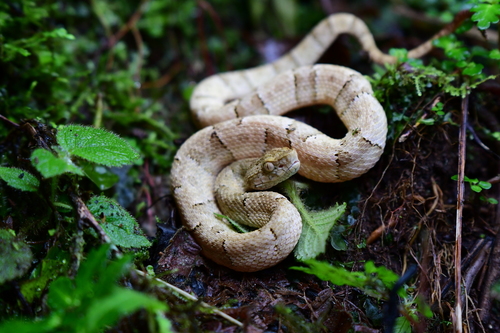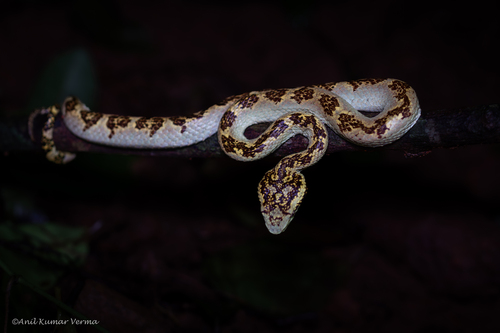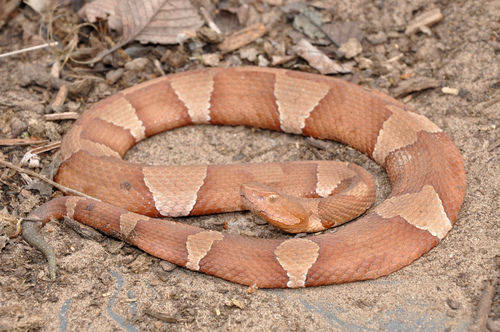
About Agkistrodon laticinctus Gloyd & Conant, 1934
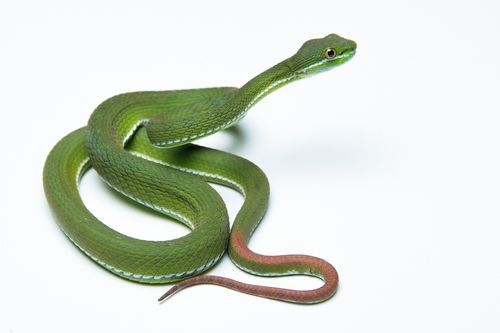
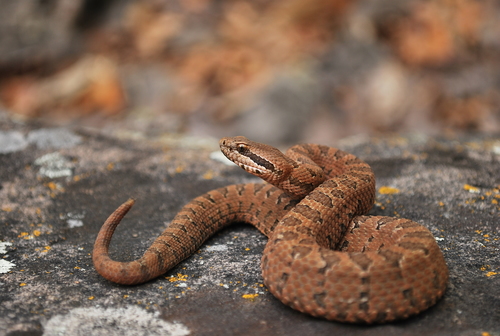
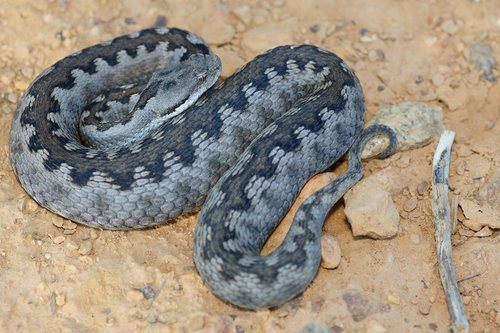
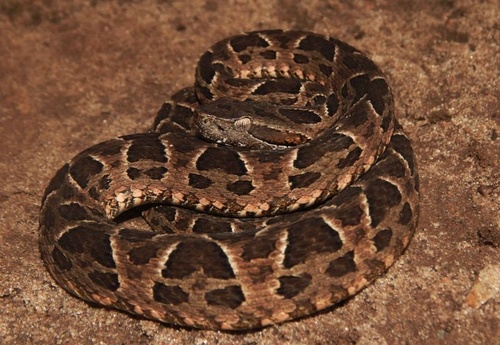
Agkistrodon laticinctus, commonly called the broad-banded copperhead, is typically light tan in color, marked with wide, darker brown crossbands, which is the source of its common name. Its base color varies by locality, ranging from red-brown to gray-brown. In the southern part of its range, it overlaps in distribution with the eastern copperhead, Agkistrodon contortrix, which makes identifying individuals from this overlapping area difficult. The two species can generally be distinguished by band shape: A. contortrix has bands that narrow at the spine, forming hourglass shapes, while A. laticinctus has bands of even width across the body. As juveniles, all species in the genus Agkistrodon have bright green-yellow tail tips, which are believed to act as a lure to attract prey within striking distance. This bright tail color fades to gray or brown when the snake reaches approximately one year of age. Adult broad-banded copperheads usually measure 45‒75 cm (17.7‒29.5 in) in total body length, and the longest recorded individual for the species measured 94.6 cm (37.25 in). This species is sexually dimorphic: adult males are typically slightly larger than females in total body length. One study measured 161 adult male and 119 adult female specimens (all over 30 cm in length), finding that 62.7% of males measured 50‒75 cm (19.7‒29.5 in) and 76.5% of females measured 45‒65 cm (17.7‒25.6 in). The same study also found that male tail lengths are only slightly longer proportionally than those of females: tails make up 11‒17% (average 13.9%) of total body length in males, and 11‒16% (average 13.3%) in females. Populations in the Trans-Pecos region average slightly longer tails overall: 15.3% of total body length for males and 14.6% for females. Copperheads generally show a reduction in average size from east to west: the eastern copperhead (A. contortrix) averages slightly longer in total body length than the broad-banded copperhead (A. laticinctus), while A. laticinctus populations from Oklahoma and central Texas average slightly larger than populations from the Trans-Pecos region and Mexico. In terms of scutellation, A. laticinctus has nine large, symmetrically arranged plates on the crown of the head: two internasals, two prefrontals, one frontal, two supraoculars, and two parietals. This trait is shared by all other Agkistrodon species, and distinguishes the genus from most New World pit vipers (Crotalinae), with the only exception being the genus Sistrurus (pigmy and massasauga rattlesnakes). A loreal scale is present in A. laticinctus and all other Agkistrodon species except for the cottonmouths A. piscivorus and A. conanti. In A. laticinctus, postocular and subocular scales usually form one continuous row of 2‒6 scales, with 4 scales present in about half of all specimens. Supralabial scales number 7‒10, with 8 being the most common count, and infralabial scales number 8‒12, with 10 being the most common count. Dorsal body scales are keeled, with paired apical pits. Keeling is strongest and most visible on the vertebral scales, and often becomes weaker, or is occasionally absent, on lateral and anterior scales. Most individuals have 23 midbody dorsal scale rows, though a small number have 21 or 25. Trans-Pecos region populations are an exception: nearly half of specimens from this area have 21 or 22 midbody dorsal scale rows. Ventral scale counts range from 138‒155 for both sexes, averaging 146.4 for males (Trans-Pecos populations average 149.3) and 145.5 for females (Trans-Pecos populations average 147.3). Subcaudal scale counts range from 42‒62, averaging 48 for males (Trans-Pecos average 54), and from 40‒57, averaging 45 for females (Trans-Pecos average 50). The broad-banded copperhead is endemic to North America, occurring in the South Central United States states of Oklahoma and Texas, and along the adjacent margins of the Mexican states of Chihuahua and Coahuila. Its range extends from north-central Oklahoma south to the Edwards Plateau in Texas, and west into the southern counties of Texas' Trans-Pecos region, including Brewster, Jeff Davis, Pecos, Presidio, and Terrell counties. Most of its distribution, including its zone of hybridization with A. contortrix, lies within a transition zone between the Eastern Temperate Forests of the United States and the Great Plains and Chihuahua Desert to the west. In Mexico, it is only known from the states of Chihuahua and Coahuila. While copperheads were expected to occur in Mexico for several decades before confirmed records were collected, verified records from the remote regions south of Big Bend were only confirmed as recently as 1986. In Chihuahua, all records are from riparian areas along the Rio Grande and adjacent canyons in the municipality of Manuel Benavides. In Coahuila, it has been reported from multiple localities further inland, including the Sierra del Burro, Sierra del Carmen, and Sierra Jardín, in the municipalities of Acuña, Müzquiz, Ocampo, and Zaragrza. A wide zone of intergradation exists between the broad-banded copperhead and its sister taxon, the eastern copperhead (Agkistrodon contortrix), along the eastern and northern boundaries of its range. One study analyzed genetic samples from 38 copperhead specimens collected across eastern Kansas and found that all copperheads from the state were either pure eastern copperheads (Agkistrodon contortrix) or hybrids between eastern and broad-banded copperheads (A. contortrix x laticinctus). No genetically pure broad-banded copperheads were identified in Kansas in that study. The broad-banded copperhead is a secretive, nocturnal species that prefers lightly wooded habitats, typically with abundant ground debris for cover, located not far from a permanent water source. It generally avoids areas with large human populations. A 1992 publication of longevity records, compiled from data from North American zoos, museums, and other institutions at the time, recorded a male Agkistrodon contortrix laticinctus from the San Diego Zoo that lived 21 years, 6 months, and 9 days, and a male Agkistrodon contortrix pictigaster at the Philadelphia Zoo that lived 20 years, 8 months, and 10 days. Though the broad-banded copperhead is not considered an arboreal species, it is capable of climbing, and has been observed coiled and resting in trees 7 to 8 feet above the ground, with no birds, nests, lizards, or other potential food sources visible nearby. Similarly, it is not an aquatic species, but it is capable of crossing large bodies of water, and has been found swimming in Lake Texoma, Texas, more than a quarter of a mile from shore. The broad-banded copperhead is ovoviviparous, and gives birth to litters of up to eight young in early fall.