About Agkistrodon contortrix (Linnaeus, 1766)
Adults of Agkistrodon contortrix (eastern copperhead) reach a typical total length (including tail) of 50–95 cm (20–37 in). A small number of exceptional individuals exceed 1 m (3 ft 3 in). Males do not usually grow longer than 74 to 76 cm (29 to 30 in), with a body mass ranging from 101.5 to 343 g (3 9⁄16 to 12 1⁄8 oz) and an average mass of roughly 197.4 g (6 15⁄16 oz). Females do not usually grow longer than 60 to 66 cm (23 1⁄2 to 26 in), with an average body mass of 119.8 g (4 7⁄32 oz).
The maximum confirmed length for the subspecies A. c. mokasen is 134.6 cm (53 in), recorded by Ditmars in 1931. Brimley (1944) noted an A. c. mokasen specimen from Chapel Hill, North Carolina that was reported as "four feet, six inches" (137.2 cm), though this measurement may be an approximation. For the nominate subspecies A. c. contortrix, the recorded maximum length is 132.1 cm (52 in), documented by Conant in 1958.
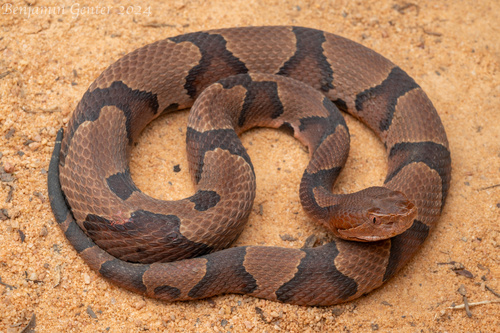
This species has a relatively stout body, with a broad head that is distinctly separate from the neck. The snout slopes downward and backward, so it appears less blunt than the snout of the cottonmouth (Agkistrodon piscivorus). As a result, the top of the head extends further forward than the mouth.
Scalation details: at midbody, there are 21–25 (most often 23) rows of dorsal scales. Both sexes have 138–157 ventral scales. Males have 38–62 subcaudal scales, while females have 37–57. Most subcaudals are single, but the percentage of undivided subcaudals decreases clinally across the species' range: around 80% are undivided in the northeast, while as few as 50% are undivided in the southwest. On the head, there are usually 9 large symmetrical scales, 6–10 (most often 8) supralabial scales, and 8–13 (most often 10) sublabial scales.
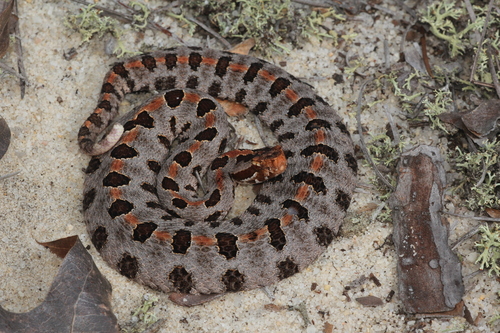
The base color ranges from pale tan to pinkish-tan, and darkens toward the front of the body. It is overlaid with a series of 10–18 crossbands, with an average of 13.4 crossbands per individual. For A. c. contortrix, both the base color and crossband pattern are characteristically pale. Crossbands are lighter tan, pinkish-tan, or pale brown in their center and darker along their edges. They measure about two scales wide or less at the midline of the back, and expand to 6–10 scales wide on the body sides. They do not extend down to the ventral scales. Often, crossbands are divided at the midline and alternate on either side of the body; some individuals even have more half crossbands than complete ones. A row of dark brown spots sits on the flanks next to the belly; these spots are largest and darkest in the gaps between crossbands. The belly matches the base body color, but may show some whitish patches. Near the base of the tail, there are one to three (usually two) brown crossbands, followed by a gray area. Juveniles have a more distinct tail pattern: 7–9 crossbands are visible, and the tail tip is yellow. On the head, the crown is usually unmarked aside from a pair of small dark spots, one positioned near the midline of each parietal scale. A faint postocular stripe is present; it is diffuse above and bordered below by a narrow brown edge.
Several aberrant color patterns have been reported for A. c. contortrix and populations that intergrade with it. A 1949 description by Livezey of a specimen from Walker County, Texas notes that 11 of its 17 crossbands were not joined at the midline; on one side, three crossbands were fused longitudinally to form a continuous undulating band, topped above by a dark stripe 2.0–2.5 scales wide. A second specimen from Lowndes County, Alabama had complete first three crossbands, followed by a dark stripe running down each side of the body, with six pigment points that extended toward but never reached the midline, then complete last four crossbands on the tail. A specimen found in Terrebonne Parish, Louisiana had a similar striped pattern, with only the first and last two crossbands matching the typical form.
Eastern copperheads are found in North America. In the United States, their range covers Alabama, Arkansas, Connecticut, Delaware, District of Columbia, Florida, Georgia, Illinois, Indiana, Iowa, Kansas, Kentucky, Louisiana, Maryland, Massachusetts, Mississippi, Missouri, Nebraska, New Jersey, New York, North Carolina, Ohio, Oklahoma, Pennsylvania, South Carolina, Tennessee, Texas, Virginia, and West Virginia. In Mexico, they occur in Chihuahua and Coahuila. The originally given type locality is "Carolina"; Schmidt (1953) proposed restricting the type locality to "Charleston, South Carolina". Unlike some other North American pit vipers such as the timber rattlesnake and massasauga, copperheads have mostly not re-established populations north of the Wisconsin glaciation terminal moraine after the last glacial period, though they are found in southeastern New York and southern New England, and occur north of the terminal moraine on Long Island.
Eastern copperheads are habitat generalists, able to survive in both fragmented and unfragmented habitats, and occupy a wide variety of habitat types across their range. In most of North America, they favor deciduous forest and mixed woodlands. They are often associated with rock outcroppings and ledges, but also live in low-lying swampy regions. During winter, they hibernate in dens or limestone crevices, often sharing these sites with timber rattlesnakes and black rat snakes. In the Gulf Coast states of the United States, this species is also found in coniferous forest. In the Chihuahuan Desert of West Texas and northern Mexico, it occurs in riparian habitats, usually near permanent or semipermanent water, and sometimes in dry arroyos (dry brooks). Habitat fragmentation has been found to reduce eastern copperhead access to feeding, brumation, and reproduction sites.
Eastern copperheads breed in late summer, and do not breed every year: females may produce young for several consecutive years, then skip breeding for a period. Mating is sometimes preceded by male combat; in combat events, the effect of losing has a greater impact than snout-vent length on a male's chance of winning access to females. Females give birth to live young; each neonate measures around 20 cm (8 in) in total length. Typical litter size is four to seven, but litters can be as small as one or as large as 20. Females can store sperm for up to one year. Aside from their smaller size, young copperheads resemble adults, but are lighter in color and have a yellowish-green tail tip, which they use to lure lizards and frogs. During the breeding season, males have longer tongue ties than females, a trait that may help with chemoreception as males search for females.