About Agkistrodon conanti Gloyd, 1969
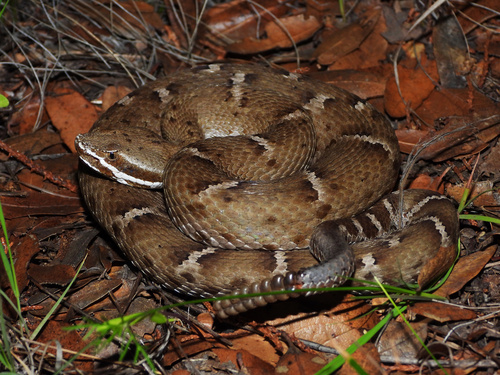
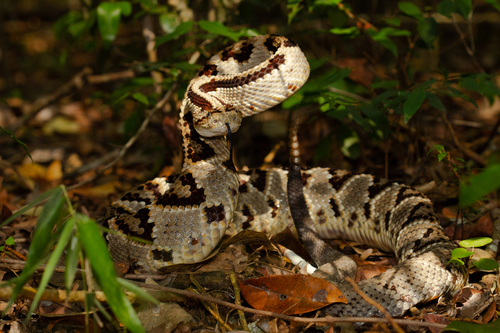
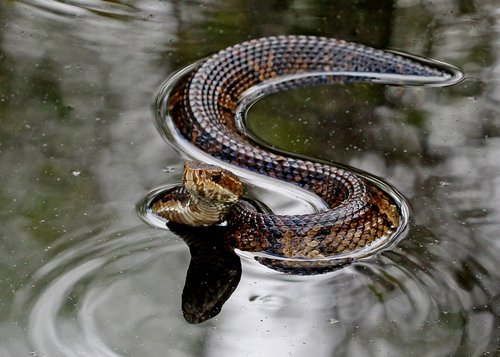
Description: Adult Agkistrodon conanti reach a maximum total length (including the tail) of 1,892 mm, or 74.5 inches. Allen and Swindell (1948) documented one male specimen collected from Marion County, Florida that measured 1,829 mm (72 inches) in total length and weighed 4.6 kg (10 pounds). Its overall color pattern is very similar to that of Agkistrodon piscivorus, but its distinct head markings are clearly visible even in older, darker A. conanti specimens. These markings include dark postocular stripes that are bordered above and below by narrow light lines, and a pair of dark stripes visible at the front of the lower jaw. Mature A. conanti specimens often have no visible dorsal pattern, while juvenile individuals have much more prominent dorsal patterns. Agkistrodon conanti, commonly called the Florida cottonmouth, can be distinguished from the northern cottonmouth (Agkistrodon piscivorus) by having a pair of dark vertical lines at the tip of the snout that run along the seams of the rostral, prenasal, and first supralabial scales. Additionally, the head patterns and markings of the Florida cottonmouth are typically lighter, cleaner, and more sharply defined in nearly all individuals, with the exception of a small number of very old specimens. A. conanti also has a longer tail: the mean relative tail length of adult and subadult male A. conanti is 17.4%, compared to a mean relative tail length of 15.9% in adult and subadult male A. piscivorus. Cottonmouths can be distinguished from all other members of the genus Agkistrodon by the absence of a loreal scale and 25 mid-body dorsal scale rows, which rarely number 23 or 27. For all other Agkistrodon species, mid-body dorsal scale rows are typically 23, rarely 21 or 25, and a loreal scale is always present. Additionally, the third supralabial of cottonmouths usually extends to the eye orbit; in all other Agkistrodon species, small scales are usually present between the supralabials and the eye orbit. Distribution: Agkistrodon conanti is found in the southeastern United States, across the entire Florida peninsula (including many barrier islands and keys), and extends north into southern Georgia. The Florida cottonmouth's range reaches at least as far south as Key Vaca in the Florida Keys. A 19th century record of the species from Key West has an uncertain origin, and by the end of the 20th century, no new records of A. conanti from Key West had been documented, and no suitable habitat for the species remains there. Different sources disagree on the exact location and extent of the intergradation zone between A. conanti and A. piscivorus. All earlier accounts of the two as subspecies mapped different intergradation regions. In one study, ecological niche models predicted hybridization could occur from North Carolina to the southern coastal plains of southeastern Louisiana. However, molecular DNA data from the same study indicated that individuals sampled from areas north of Savannah, Georgia, as well as from areas north and west of Mobile Bay, Alabama, were A. piscivorus, with the only exception being a single hybrid individual collected from southern Mississippi. Habitat: According to Wright and Bishop (1915), in the Okefenokee Swamp, A. conanti occurs in thickets along the edges of cypress ponds on islands, around the wooded edges of open water stretches, in areas where island woodlands meet pine woods, and throughout the swamp more broadly. In the Everglades, Allen and Swindell (1948) noted that A. conanti can be found in palmetto clumps as far as a quarter mile from water. Outside of these situations, these snakes tend to gather around drying water holes, most likely because prey becomes increasingly concentrated in these remaining wet spots. Duellman and Schwartz (1958) described A. conanti as inhabiting aquatic environments, cypress flats, and wet prairies, and stated it does not live in pine forests, scrub, or hammocks. This claim is contradicted by a report from northern Florida where large numbers of A. conanti were observed in wet pine-palmetto areas, except during very dry periods. Reproduction: Agkistrodon conanti is ovoviviparous. While there is no fixed specific mating season for the species, most births take place during the summer months. Females generally only breed every other year, and produce litters of between one and 15 live young. The average total length of a newly born A. conanti is 18 cm, or 7.1 inches.