About Agkistrodon bilineatus Günther, 1863
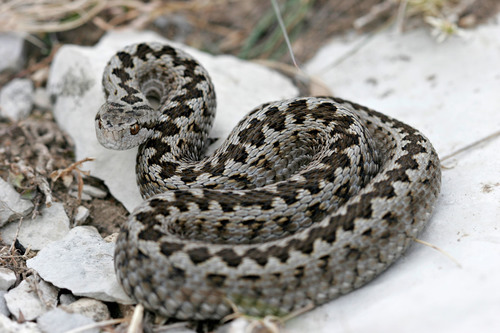
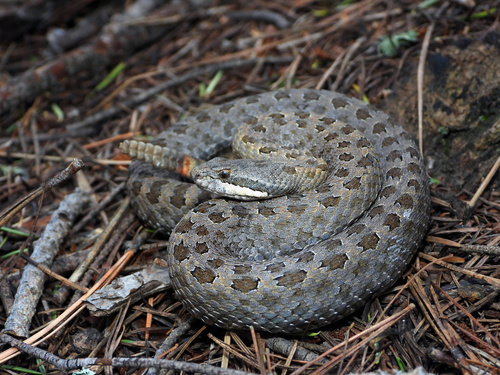
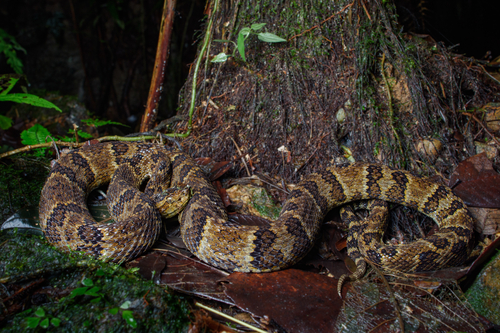
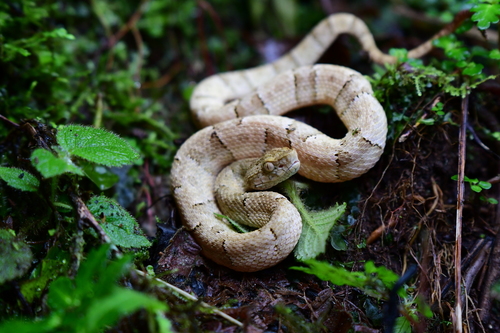
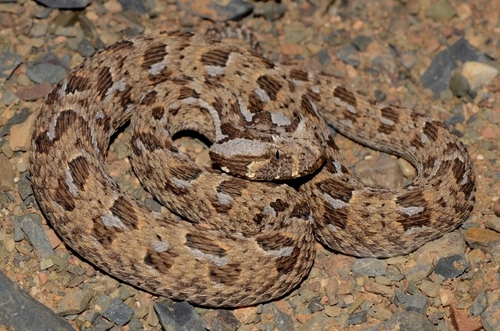
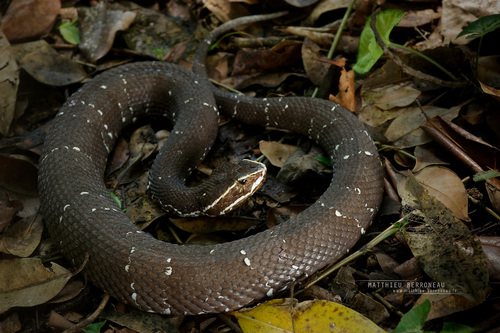
This species, Agkistrodon bilineatus Günther, 1863, consists of heavy-bodied snakes that share the same general body structure as copperheads. Adults average around 60 cm (24 in) in length, with a broad, triangular head, small eyes, and vertical pupils. Overall coloration is variable, but most individuals are brown or black with darker brown or black banding, sometimes marked with white or cream-colored accents. A closely related form, A. taylori, is known for more elaborate patterning, often with distinct tan-colored banding that sometimes includes orange or yellow accents that can appear almost gold in color. This species has characteristic yellow and/or white lines on the head: a vertical line on the rostral and mental scales, a fine line on the canthus that continues above and beyond the eye to the neck, and a broader line on the upper lip running from the anterior nasal scale to the last labial scale. Juveniles are almost always distinctly banded, with bright green or yellow tail tips that they use to lure prey. As individuals age, their pattern and coloration fade and darken. This species is found across Mexico and Central America, along the Pacific side from southern Sonora in Mexico, south through Guatemala, El Salvador, and Honduras. The species’ type locality is given as "Pacific coast of Guatemala." Breeding takes place in the spring. Like most other viper species, cantils are ovoviviparous, and give birth to between 5 and 20 young at a time.