About Ageratina riparia (Regel) R.M.King & H.Rob.
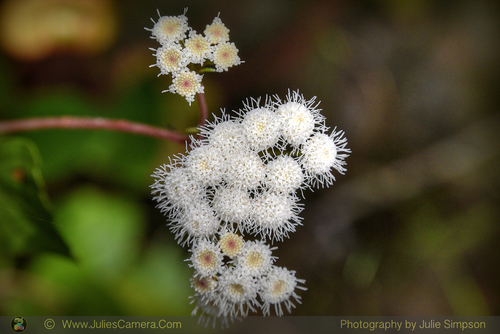
Ageratina riparia, commonly called mistflower, is a low-growing, sprawling perennial herb that can reach up to 1 meter in height under some climate conditions. It has a fibrous root system, and its stems are often woody, covered in purple hairs; stems that touch the ground can grow additional roots. Its serrated leaves average 7.5 cm long and 2.5 cm wide, tapering at both ends, and grow in opposing pairs. Leaves are coarsely serrated, except near their base. Mistflower is closely related to and strongly resembles Ageratina adenophora, but it can be distinguished from A. adenophora by its distinctive serrated leaves. Its white flowers are also similar in appearance to those of A. adenophora, growing in dense heads at the ends of branches. In some climates, mistflower forms buds from July to August, and flowers from August through March. Its seeds are black, slender, angular, and 2 mm long, with fine white hairs at the tip. Seeds are dispersed by wind and flowing water, and a single mature plant can produce between 10,000 and 100,000 seeds per year. Mistflower is native to western Mexico, where it grows sparsely in its natural habitat and may even be considered endangered. The first specimens were collected in 1857 from the canyon of El Mirador, Mexico, for use as an ornamental plant, then brought to Germany by Jean Jules Linden. From Linden's specimens, mistflower was introduced to many parts of the world as an ornamental plant during the late 19th and early 20th centuries. Outside its native range, the species spread quickly, and has become naturalized in many regions including parts of South Africa, tropical Asia, Oceania, Macronesia, Madagascar, the Mascarenes, Hawaii, and Peru. It is especially invasive in tropical and warm temperate climates, where it can form dense underbrush. Intertwining mistflower branches create a thick blanket that outcompetes native plants and blocks sunlight, preventing native species from reproducing. For example, it chokes out native plants in mountain and cloud forests of Sri Lanka, and often has disastrous effects in pastures, roadsides, barren areas, and bushlands of other introduced regions. Decaying mistflower plant matter produces allelopathic compounds that inhibit native plant germination by altering soil nutrients. It also harms grazing pastures, as it is toxic to horses and is generally avoided by grazing livestock. Outside its native range, mistflower is most often found in temperate pastoral areas and wetlands. It can grow in full sun or full shade, but prefers the higher light conditions of marginal habitats such as forest edges and streambanks. It grows best in warm, humid habitats, especially subtropical and tropical forests. Mistflower tolerates most soils, variable humidity levels, and shade, and recovers well from grazing damage. Mistflower is most commonly used as an ornamental plant. It may also be harvested for use as a tanning agent, and in some regions it is used to stabilize embankments and partition land. Near the village of Sangau in India, where the species is called Hlo-thar, dried leaves and flowers of mistflower are used to make an herbal tea consumed to reduce blood pressure and blood sugar. Methanol extracts made from the aerial parts of the plant have confirmed that mistflower contains the antifungal compound methylripariochromene. Research on the antifungal properties of mistflower suggests its components could be used to develop a fungicide that controls Colletotruchum musae, the pathogen that causes banana anthracnose disease.