About Ageratina altissima (L.) R.M.King & H.Rob.
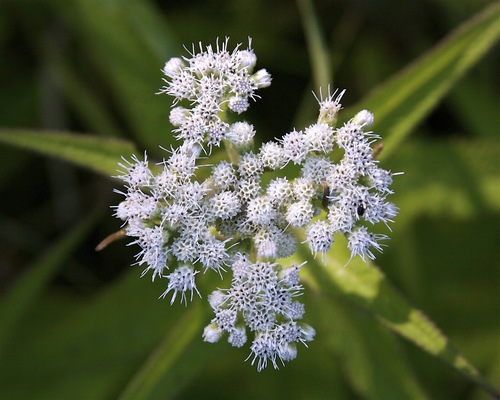
Ageratina altissima (L.) R.M.King & H.Rob. is an upright or sometimes ascending plant that grows up to 1.5 metres (4.9 ft) tall, forming single or multi-stemmed clumps from mid to late summer through fall. Stems are smooth, with opposite well-spaced leaves arranged in a decussate pattern, where each leaf pair sits at a 90-degree angle to the pairs above and below it. Multiple branches, usually growing in opposite pairs, form in the upper portion of the plant. Leaves have sharply serrated margins and reach up to 15 centimetres (6 in) long. Flat-topped panicles or compound corymbs of white flower heads develop at the ends of upper branches, and these clusters measure 5–15 centimetres (2–6 in) across. The flowers are bright clean white; after blooming, the plant releases small seeds with fluffy white tails that are dispersed by wind. This species spreads both via wind-dispersed seeds and through rhizomes. There are two recognized varieties: Ageratina altissima var. altissima and Ageratina altissima var. roanensis (Appalachian white snakeroot), which differ in the length of their flower phyllaries and the shape of the phyllary apices. A. altissima is native to central and eastern United States, ranging west to Texas, east and north to Maine, and south to Florida. It is also native to Canada, where it occurs in Quebec, Ontario, and the Northwest Territories. This species is adaptable to a range of growing conditions; it grows in woods, brush thickets, and shady areas with open bare ground, and can become weedy in shady landscapes and hedgerows. The plant blooms in fall, from July to October. Its nectar attracts many species of butterflies, moths, bees, wasps, and flies. It acts as a larval host for several moth varieties, including the Clymene moth (Haploa clymene), Leucospilapteryx venustella, and the hitched dart moth (Melanchra adjuncta). White snakeroot, the common name for Ageratina altissima, contains the toxin tremetol. When cattle consume this plant, the tremetol contaminates their meat and milk. If humans eat contaminated meat or drink contaminated milk, they ingest the toxin, and consuming large enough quantities causes tremetol poisoning in humans. This poisoning is commonly called milk sickness, because humans most often ingested the toxin by drinking milk from cows that had eaten snakeroot. While 80% of the plant's toxin tremetol breaks down after five years of drying and storage, the plant retains its full toxic properties. During the early 19th century, large numbers of newly settled European Americans from the East were unfamiliar with white snakeroot, as they began moving into the plant's native habitat in the Midwest and Upper South. Thousands of these settlers died from milk sickness; most notably, milk sickness is a possible cause of the 1818 death of Nancy Hanks Lincoln, mother of Abraham Lincoln. It took several decades for European Americans to trace milk sickness back to white snakeroot; today, Dr. Anna Pierce Hobbs Bixby is credited with identifying the plant as the source of the toxin in the 1830s. Legend holds that a Shawnee woman taught Dr. Bixby about the plant's toxic properties. In addition to cattle, white snakeroot is poisonous to horses, goats, and sheep. Symptoms of poisoning in these animals include depression and lethargy, characteristic hind foot positioning (placed close together for horses, goats, and cattle; held far apart for sheep), nasal discharge, excessive salivation, an arched body posture, and rapid or difficult breathing. A cultivar sold under the name Eupatorium rugosum 'Chocolate' is grown in gardens for its dark-tinted foliage. Plants grown in sunny locations develop the darkest foliage color, a deep chocolate black. This cultivar is shade-tolerant and grows best in moist soils. More recently, this cultivated plant is also sold under the correct current species name.