About Agelena labyrinthica (Clerck, 1757)
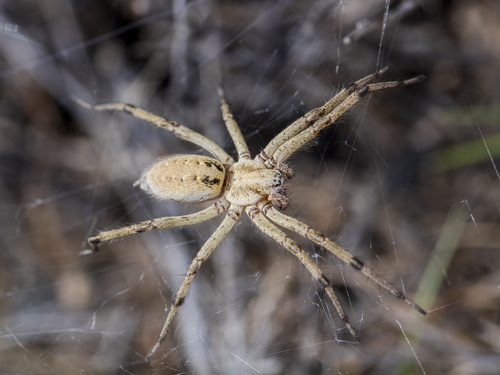
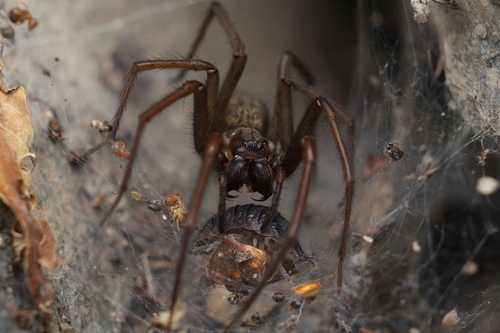
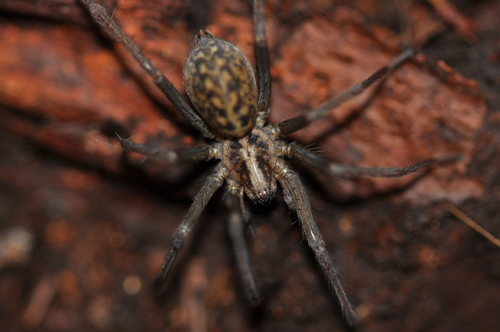
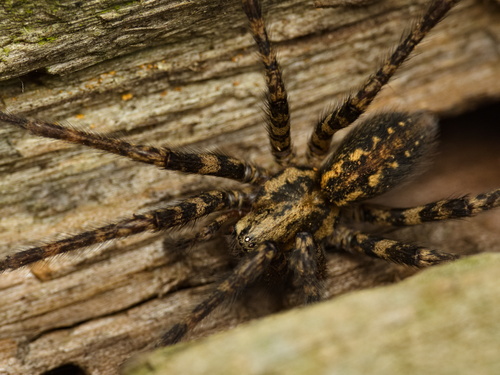
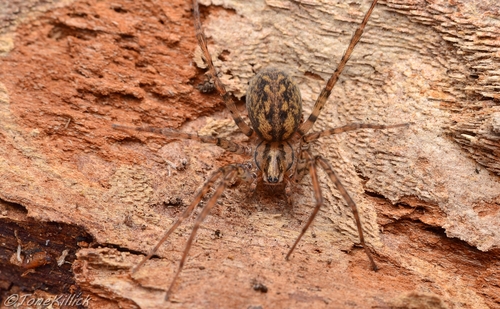
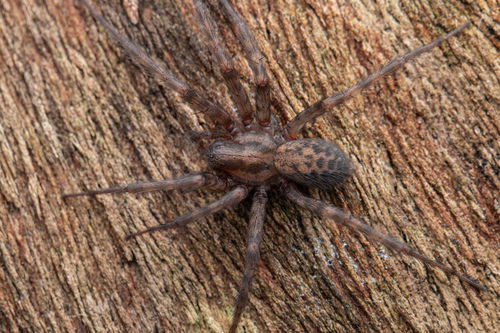
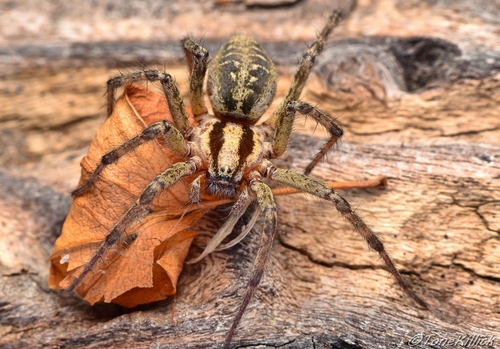
Most funnel-web spiders in the Agelenidae family have body lengths of 8–12 mm (0.31–0.47 in) for males and 10–14 mm (0.39–0.55 in) for females, but Agelena labyrinthica can reach a maximum body length of 18 mm (0.71 in). This species has a dark abdomen marked with a pale central band flanked by white chevron patterns, and a yellow-brown cephalothorax that carries two broad longitudinal stripes near its front. Like all agelenid spiders, A. labyrinthica has a prominent pair of two-segmented posterior spinnerets. In this species, these segmented spinnerets are further elongated: the second segment is almost twice as long as the basal segment. Agelena labyrinthica has a distinct venom apparatus that shares many similarities with that of Loxosceles intermedia. Its venom glands are paired structures located in the abdomen. These paired structures connect to two ducts that run into the spider’s fangs. The venom glands of A. labyrinthica are relatively large, extending out from the chelicerae to reach the middle of the abdomen. They are also uniquely long and tubular, and surrounded by a complete layer of encircling muscle tissue. Agelena labyrinthica is fairly common across Europe, including Central Europe, where it is typically concentrated in habitats near forests, around low-lying vegetation, and in dry grasslands. Its range extends further into Central and East Asia, including Mongolia, China, Korea, and Japan. This species builds webs made of a flat plate surface connected to funnel-shaped retreats that resemble labyrinths. These webs are almost always constructed between low grass and vegetation, and can be placed at ground level or up to 1.5 metres (5 ft) above ground. Most webs are found around 60 centimetres (2 ft) off the ground. Mating season for A. labyrinthica usually begins in mid-July. Males use their pedipalps to tap the female’s web to signal they are seeking a mate. If the female is receptive, she stays in her funnel retreat and the pair mates. Around August of the same year, the female constructs a large white egg sac that holds 50 to 130 eggs. She suspends the egg sac within the central chamber of her web using multiple radiating silk bands. She may camouflage the outer wall of her retreat with grass and leaves. Young spiders survive on stored egg yolk in their abdomens through the winter after laying, and emerge from the retreat the following spring. Like many other spider species, A. labyrinthica practices matriphagy: the female stays with her developing egg sac through incubation, but if she dies before incubation ends, newly hatched young will eat her corpse.