About Agelas tubulata Lehnert & van Soest, 1996
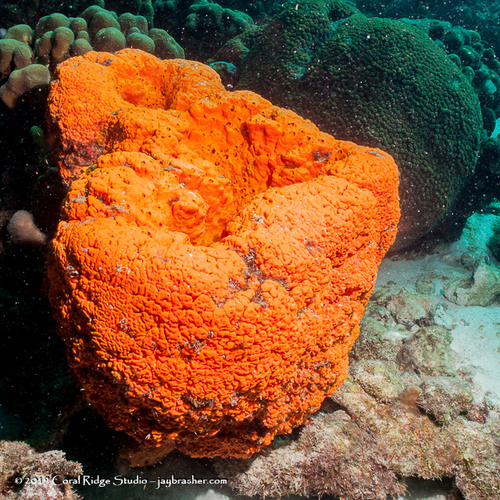
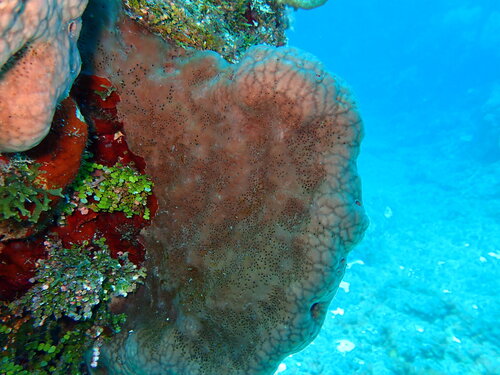
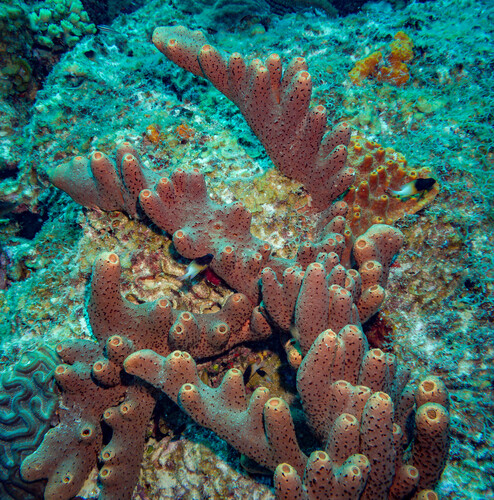
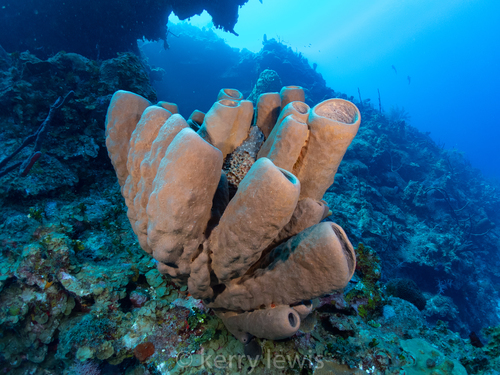
Agelas tubulata (Lehnert & van Soest, 1996) is quite variable in shape and colouring. It usually grows as a group of vases or tubes, sometimes fused together, directly from a narrow base. Its outer surface may be tan, orange or pinkish, while its interior ranges from orangeish-yellow to orange. The surface is usually smooth, and its spicules are acanthostyles. It is similar in appearance to Agelas conifera, but A. conifera has a narrower base, with some tubes branching from the sides of other tubes, sometimes forming antler- or club-shaped structures. Large solitary specimens of A. tubulata may be barrel-shaped with deep recesses in their walls, and may resemble Agelas cerebrum; however, A. cerebrum has more regularly arranged recesses with orifices between them. This sponge has an elastic and compressible consistency, and zoanthids sometimes grow on its walls. The type specimen was yellowish-orange, 20 cm (8 in) high, with a diameter of 5 to 8 cm (2 to 3 in). Larger specimens can reach 40 to 60 cm (16 to 24 in) in diameter, with tubes 3 to 6 cm (1.2 to 2.4 in) across and 20 to 40 cm (8 to 16 in) long. This species is found in the Caribbean Sea, the Gulf of Mexico, the east coast of Florida, the Bahamas, Cuba, Jamaica, Panama, Belize and northeastern Brazil. It was first collected in 1993 during exploration of steep fore-reef slopes in the Caribbean Sea at depths between 70 and 90 m (230 and 300 ft), and was formally described in 1996 by German zoologist Helmut Lehnert and Dutch zoologist Rob van Soest.