About Agelas clathrodes (Schmidt, 1870)
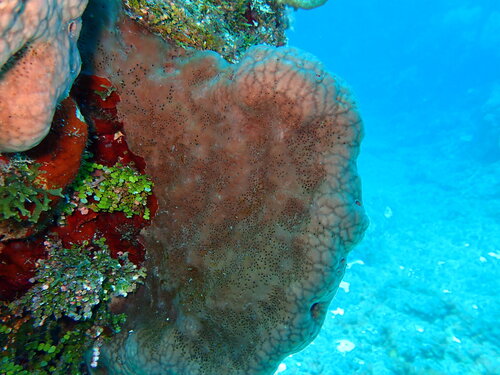
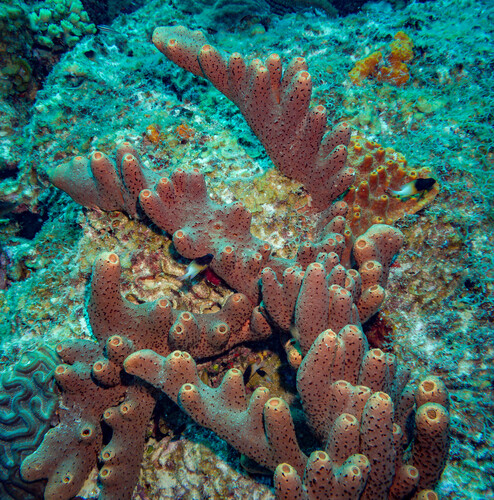
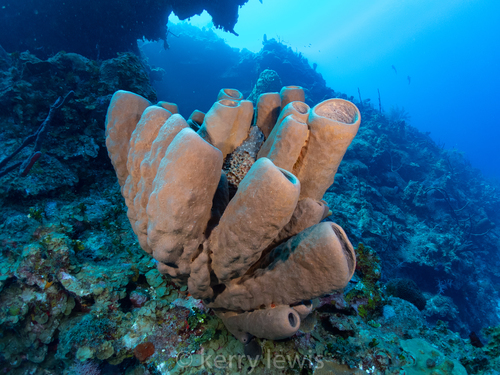
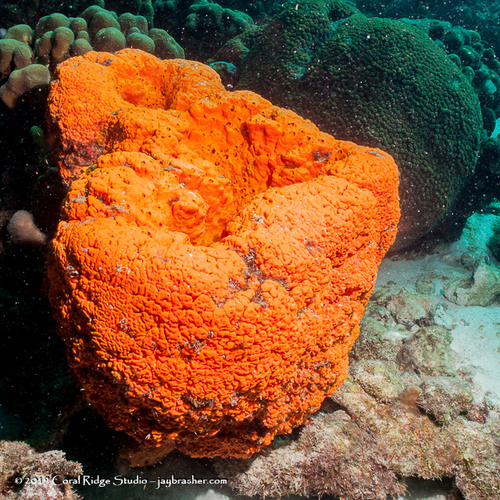
The orange elephant ear sponge, scientifically named Agelas clathrodes (Schmidt, 1870), has a highly variable form. It may grow as an encrusting layer up to 10 cm (4 in) thick, develop large flabby lobes, or take on a fan, tube, or ridge shape. Large individual specimens often combine multiple of these forms. Its surfaces are perforated by small holes that are both circular and irregularly elongated, with these holes being especially common on the side oriented away from water current. The sponge's flesh is tough, firm, and resilient, while its thick outer skin has a rough texture. Its color ranges from yellow through orange to brick red or brown. This species can be mistaken for Agelas citrina, but Agelas citrina is typically pinkish or creamy yellow. It is also similar in appearance to Agelas sventres, which differs by having round holes with noticeable rims on its exposed side. The orange elephant ear sponge occurs in the Caribbean Sea, the Bahamas, and Florida. It grows on reefs, reef slopes, and vertical rock surfaces, particularly in locations with strong water current, and is usually found at depths greater than 10 metres (33 ft). It is most commonly found in mesophotic reefs, at depths between 30 and 150 meters, where light levels are limited and competition for space is very high.