About Agelaius xanthomus (P.L.Sclater, 1862)
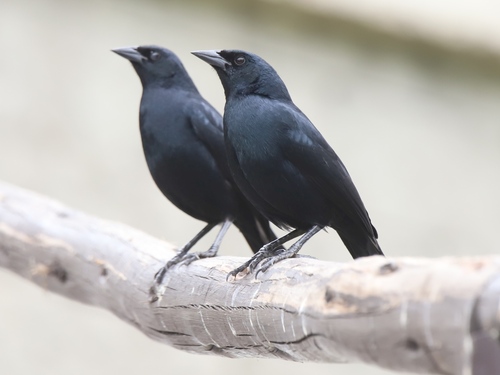
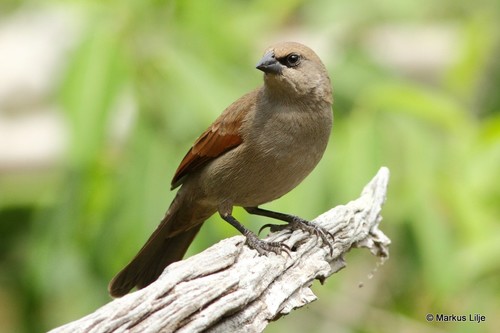
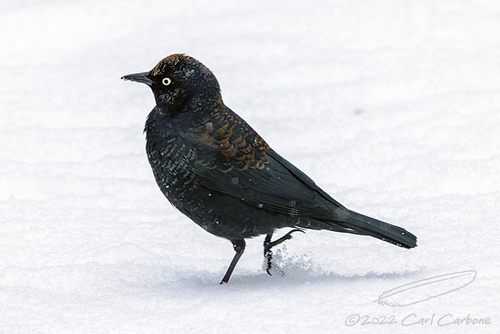
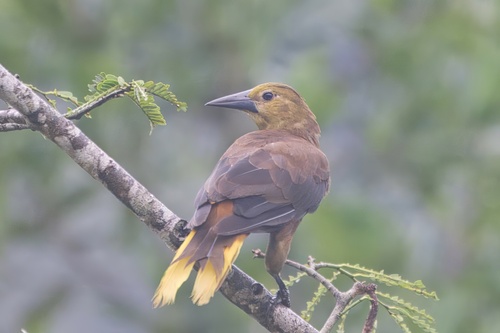
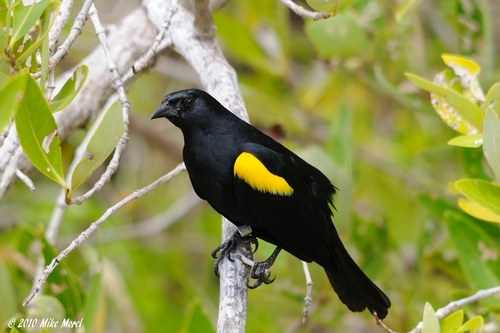
Agelaius xanthomus, commonly called the yellow-shouldered blackbird, is a glossy black bird with a small yellow humeral patch around its shoulders that is outlined by a white margin, matching its common name. Immature individuals have duller overall coloration and a brown abdomen. While male and female plumage color is indistinguishable, the species shows sexual dimorphism: males are larger than females. Plumage abnormalities are rare in this species. Adults measure 20–23 cm (7.9–9.1 in) long. On average, males weigh 41 g (1.4 oz) and females weigh 35 g (1.2 oz). Sex can also be distinguished by wing measurement: males have wings that average 102 mm (4.0 in), which is 1.1 times larger than females' average wing length of 93.3 mm (36.7 in).
This species was once common across the coastal forests of the Puerto Rico archipelago. In the early 20th century, these coastal forests were cleared to develop sugarcane plantations. After the sugar industry declined following the 1930s, coastal areas were further developed for housing. As a result, the species is now restricted to three separate regions: the islands of Mona and Monito, where a subspecies (A. x. monensis) has evolved; the Roosevelt Roads Naval Station area in eastern Puerto Rico; and the southern Puerto Rican dry forests and mangroves. All three of these current ranges are coastal subtropical dry forests, but the species has been observed as far inland as the mountain town of Lares, and in subtropical wet forests, during the non-breeding season. It has also been recorded at the Cabo Rojo National Wildlife Refuge. Habitat destruction and brood parasitism by the shiny cowbird (Molothrus bonariensis) caused a sharp population drop between the mid-1970s and early 1980s. In 1976, the population of the nominate form was estimated at 2000 individuals, but by 1982 this estimate had fallen to just 300 individuals. Targeted conservation efforts have since increased the population to 1250 breeding pairs. In 1976, Post and Wiley estimated the Mona subspecies population at 200 individuals. Later roost counts and studies conducted between 1981 and 1995 put the subspecies population between 220 and 400 individuals. Studies on Monito, an island 5 km (3.1 mi) northwest of Mona, found an average of 25 individuals, with confirmed breeding activity recorded there. These studies also showed that birds travel from the west coast of Mona to Monito. Yellow-shouldered blackbirds are non-migratory, though a portion of the nominate form population moves from coastal areas to inland areas to feed during the non-breeding season.
The yellow-shouldered blackbird's breeding season most often runs from April to August, but breeding activity has been recorded as early as February and as late as November. The start of the breeding season lines up with the start of the local rainy season, which explains the observed fluctuation in the timing of breeding season start and end. The species is thought to be monogamous, with only one nesting attempt per year, and nesting occurs in loose colonies. Clutches for both the nominate form and the Mona subspecies contain between one and four eggs, with an average clutch size of three. The eggs are blue-green with brown spots, and are incubated for 13 days by the female. Both sexes reach sexual maturity at one year of age. Like other species in the genus Agelaius, it usually builds open, cup-shaped nests in trees, but nest location and shape can vary based on local site conditions and available building materials. The Roosevelt Roads population builds nests in hollows in dead mangroves, while the Mona subspecies builds nests on ledges or in crevices near coastal cliffs. Overall, the species uses eight distinct nesting habitat types: mudflats and salinas, offshore red mangrove cays, black mangrove forest, lowland pastures (dry coastal forest), suburban areas, coconut plantations, and coastal cliffs. Only females build the nest, while both sexes feed the young after hatching. Nestlings leave the nest 13 to 16 days after hatching. Males defend small territories, typically around 3 metres across, during the nesting period. Before the nesting season begins, males defend slightly larger territories to drive off other competing males. Yellow-shouldered blackbirds engage in anting, a rare behavior among West Indian birds that has only been recorded in this species and the Puerto Rican tanager. Individuals have been observed applying ants of the genus Pheidole to their body and feathers for short periods, up to 8 minutes. The species also engages in mobbing, a defensive behavior where a group of birds, from one or more species, jointly attack a known predator, usually to protect eggs or hatchlings.