About Agelaius tricolor (Audubon, 1837)
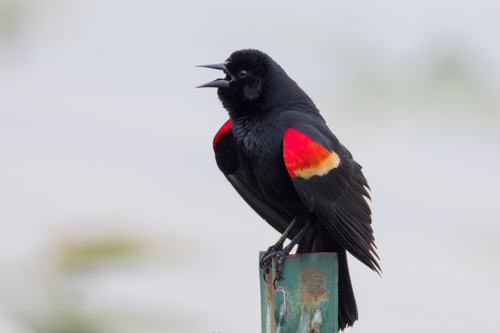
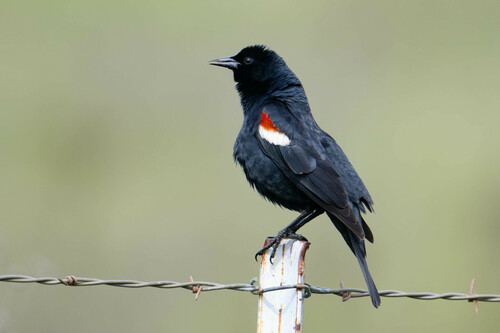
The tricolored blackbird (Agelaius tricolor) is a passerine bird belonging to the family Icteridae. Its range is restricted to Pacific coastal areas of North America, stretching from Northern California in the United States, with occasional stray individuals reaching Oregon, down to upper Baja California in Mexico. This highly social, gregarious species forms the largest colonies of any North American landbird; a single breeding colony often includes tens of thousands of individual birds. The species gets its common name from distinctive white stripes located under the red shoulder patches (called "epaulets") of male birds, which are visible when the bird is flying or displaying. Despite sharing a similar common name, it is not related to the Old World common blackbird, which is a thrush in the family Turdidae. The tricolored blackbird's call is slightly more nasal than the call of the red-winged blackbird, consisting of a nasal kip and a sharp check. The male's song is a garbled on-ke-kaaangh. The species migrates south to Mexico during colder seasons, and returns to northern California during warmer seasons. Tricolored blackbirds nest in colonies, but researchers disagree on whether the costs of this breeding behavior outweigh its benefits. Nesting in colonies leaves the species vulnerable to environmental changes. While tricolored blackbirds have adapted to some landscape changes, habitat loss has been a major driver of population reduction. Originally, the species was found in California's marshes, nesting in wetland cattails and bulrushes. Researchers have recorded a large reduction in available freshwater marsh breeding grounds for tricolored blackbirds, caused largely by human activity. It is estimated that between the 1930s and 1980s alone, over 95% of these wetlands were lost. During this same period, the observed tricolored blackbird population decreased by 89%, and average colony size decreased by 63%. Overall, the species' population fell from several million to only a few hundred thousand over the course of the twentieth century. Despite severe landscape loss, tricolored blackbirds have adapted: they now use both native and non-native vegetation, as well as agricultural fields, as breeding and foraging grounds. In the 1930s, over 93% of tricolored blackbird colonies nested in freshwater marshes, but by the early twenty-first century, only 35% of colonies were located in wetlands. In 2008, over a quarter of colonies nested in non-native vegetation, most commonly Himalayan blackberry brambles. While population decline resulted from twentieth century agricultural intensification, the birds were able to benefit from these environmental changes. The 2008 tricolored blackbird census found that nearly half of the total population nested in colonies within dairy farm grain fields. As the twentieth century progressed, tricolored blackbirds became increasingly concentrated in a small number of large colonies. In 2000, 59% of the population lived in one of California's ten largest colonies; this number rose to 81% by 2011. Mega-colonies of tricolored blackbirds have formed in the numerous agricultural fields of California's San Joaquin Valley. Although the overall tricolored blackbird population decreased consistently through the twentieth century and into the twenty-first century, the population located in the San Joaquin Valley grew exponentially during this time. In 1994, the number of tricolored blackbirds in California's San Joaquin Valley was 230% of the 1937 population. By 2008, over 86% of California's entire tricolored blackbird population was located here. Conservation efforts led by the National Audubon Society in collaboration with the U.S. Fish and Wildlife Service have had measurable impacts on population numbers. The 2017 California state survey recorded an increase in the state's tricolored blackbird population compared to previous years. However, nearly all of this population gain was concentrated in the San Joaquin Valley and San Benito County. Other regions of California recorded population reductions in the 2017 census: the Sacramento Valley saw an approximately 33% drop from the prior 2014 census. A steady population decline has been observed in the Sacramento Valley over the twentieth and twenty-first centuries, as a larger share of the population has moved to the San Joaquin Valley. Southern California has also seen an overall population decline after the dairy industry moved out of the region in the 1980s to relocate to the San Joaquin Valley. The only other California region to record a population increase in 2017 was the Central Coast. Historically, the Central Coast and Central Valley were home to millions of tricolored blackbirds before human agricultural activity caused population decline. The drastic 2017 population increase from 627 to 17,576 birds is likely not the result of growing numbers of tricolored blackbirds moving to the Central Coast. Instead, this large increase is most likely due to improved survey methods. Three large new colonies were observed in 2017, two of which were in previously unknown or unsurveyed locations. Improved understanding of the species' breeding habits led researchers to increase survey efforts in locations suspected to host colonies. While most regions of California saw either stable populations or declines in 2017, the overall state population increased. The 2017 census also demonstrated that human conservation efforts can succeed. In Southern California, the overall population remained relatively stable between 2014 and 2017, but the species' distribution within the region changed. Riverside County saw a significant population increase, and 57% of all tricolored blackbirds observed in Southern California were located in a single colony. The San Jacinto Wildlife Area in Riverside County has been the site of successful conservation work to create nesting and foraging habitat for the species.