About Agelaius phoeniceus (Linnaeus, 1766)
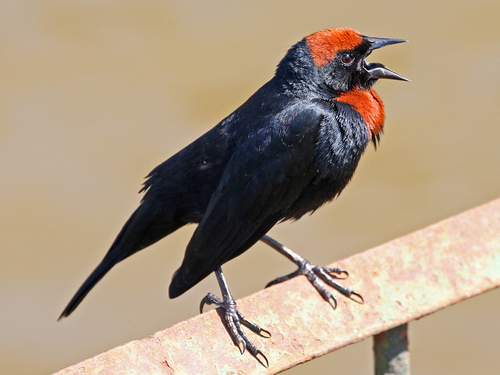
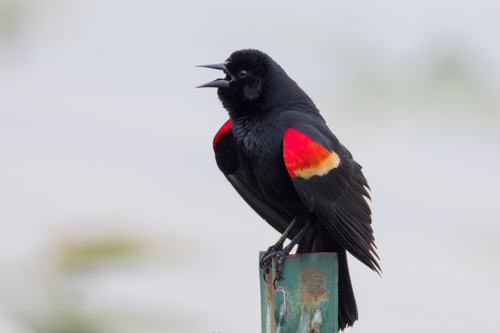
Agelaius phoeniceus (Linnaeus, 1766), commonly called the red-winged blackbird, gets its common name from the distinctive red shoulder patches (epaulets) of its mostly black adult males, which are visible when the bird flies or displays. Males at rest also show a pale yellow wingbar. Males under one year old, which are generally subordinate, have smaller spots that are more orange than those of adult males. Females are blackish-brown and paler on the underside, and smaller than males. Females measure 17–18 cm (6.7–7.1 in) long and weigh an average of 41.5 g (1.46 oz), while males measure 22–24 cm (8.7–9.4 in) long and weigh an average of 64 g (2.3 oz). The smallest females can weigh as little as 29 g (1.0 oz), and the largest males can weigh up to 82 g (2.9 oz). Wing length ranges from 8.1–14.4 cm (3.2–5.7 in), tail length from 6.1–10.9 cm (2.4–4.3 in), culmen length from 1.3–3.2 cm (0.51–1.26 in), and tarsus length averages 2.1 cm (0.83 in). The approximate wingspan of the species ranges from 31 to 40 cm (12 to 16 in).
Female upperparts are brown, while lowerparts have bold white and dark veining, and females also have a whitish superciliary line. Per Crawford (1977), one-year-old females have a salmon-pink shoulder stain and light pink coloring on and below the face; older females typically have a more crimson shoulder stain and darker pink coloring on and under the face. Observations of captive females show that small amounts of yellow pigment are present on the shoulders shortly after leaving the nest. Pigment concentration increases with the first winter plumage after the molt, and the shift from yellow to orange generally occurs in the second summer when the second winter plumage is acquired; no further feather color changes happen after this point. The colored area on females' wings grows larger as they age, and its color intensity ranges from brown to a bright red-orange similar to that of first-year males.
Young birds resemble females, but are paler below and have buff feather fringes. Both sexes have a sharply pointed bill, a medium-length rounded tail, and black eyes, bill, and feet; females have dark brown beaks that are paler on the lower half. Unlike most North American passerines, which develop adult plumage within their first year of life (making one-year-old and older individuals indistinguishable in the breeding season), red-winged blackbirds only acquire adult plumage after the breeding season of the year after hatching, when they are 13 to 15 months old. Young males go through a transitional stage where their wing spots are orange before developing the intense color typical of adults.
Red-winged blackbirds are polygynous, and exhibit strong sexual dimorphism in both plumage and size. Males are 50% heavier than females, 20% larger in linear body dimensions, and 20% larger in wing length. The pattern of greater size dimorphism in non-monogamous icterid species indicates male larger size evolved through sexual selection. Adult males are generally unmistakable, except in the far western United States where the tricolored blackbird is found. Male tricolored blackbirds have darker red epaulets edged with white rather than yellow. It can be difficult to tell females of tricolored, bicolored, red-shouldered, and red-winged blackbirds apart in areas where more than one of these species occur. When field marks are not easily visible in flight, red-winged blackbirds can be distinguished from less closely related icterids like common grackles and brown-headed cowbirds by their different silhouette and undulating flight.
The red-winged blackbird is widespread across most of North America. It is absent from arid deserts, high mountain ranges, arctic regions, and areas of dense forest. Its breeding range extends from central-eastern Alaska and Yukon in the northwest, and Newfoundland in the northeast, south to northern Costa Rica, and spans from the Atlantic to the Pacific coasts. Northern populations migrate to the southern United States for winter, while populations breeding in the southern United States, Mexico, and Central America are sedentary. Migratory northern populations begin migration in September or October, though migration can occasionally start as early as August.
This species inhabits open grassy areas, and generally prefers wetlands: it lives in both freshwater and saltwater marshes, particularly where cattails are present. It also occurs in dry upland areas including meadows, prairies, and old fields. Across much of its range, it is the most abundant passerine bird in the swamps where it nests. It also lives in open areas (often agricultural areas) with little standing water, and in sparse deciduous forests.
In the winter of 1975–1976, near Milan, western Tennessee, red-winged blackbirds were observed roosting in a large mixed roost that reached 11 million individuals by January and early February. The roost was located in a 4.5-hectare plantation of yellow pine (Pinus taeda) with little undergrowth. During the day, the red-winged blackbirds foraged in soybean fields, which made up only 21% of the local habitat; other bird species present in the roost were not commonly seen in these soybean fields. Red-winged blackbirds were also common in local cornfields. Their presence in cattle and pig feedlots increased as winter progressed, but they made up less than 5% of all icterids and starlings recorded at these feedlots, and were much rarer there than brown-headed cowbirds, common grackles, and common starlings.
During the breeding season, the density of breeding adults is much higher in swamps than in upland fields. While the highest concentrations of nesting red-winged blackbirds are found in swamps, most of the total population nests in upland habitats because upland areas are far more abundant. A study conducted in Wood County, Ohio between 1964 and 1968 found that the density of territorial males in wetland habitat was 2.89 times higher than in upland habitat. However, due to the small total area of wetland habitat, the total estimated population of territorial males in uplands was 2.14 times the population in wetlands. Alfalfa (Medicago sativa) and other legume hay crops were the primary breeding habitat for red-winged blackbirds in the county. The larger total population in uplands, despite a clear preference for wetlands, reflects the general scarcity of wetland habitat.
Because red-winged blackbirds feed on crops, farmers have used traps, poisons, and surfactants to control their populations. Surfactants destroy the waterproofing of birds' feathers, leaving them extremely vulnerable to cold, but their effectiveness relies on specific atmospheric conditions: low temperatures and rainfall. Late summer programs using poisoned baits to reduce icterid numbers have been unsuccessful. While thousands of birds occasionally die from these programs, the impact on large roosting flocks (which can number more than a million individuals) is small, and individuals of other species are often killed as well. Large lure traps, which can catch hundreds of birds per day, are also ineffective against these large flocks.
The chemical 4-aminopyridine is used for red-winged blackbird control, applied to 1 out of every 100 particles of ground corn bait. Planes generally distribute this bait over fields at a rate of about 3.4 kg (7.5 lb) of bait per hectare, covering one third of the land. This rate of application delivers approximately 2050 toxic particles per treated hectare, as one kilogram of ground corn contains roughly 60,000 particles. When a red-winged blackbird eats one or more of these toxic particles, it experiences erratic flight, distress calls, and eventually death. This behavior often causes the rest of the flock to leave the field. The chemical DRC-1327, which is effective for reducing damage to maturing corn, works the same way: when a bird eats a kernel from a partially hand-peeled corn cob that has been sprayed with the chemical, its erratic flight and 5–15 minutes of pre-death distress calls chase flocks away from the fields.
The initial application of 4-aminopyridine should be done as soon as possible after grain enters the milky stage of ripening. Two additional booster applications, spaced five to seven days apart, are generally recommended, though one booster is often sufficient. Prolonged bird activity may require more than three applications at shorter intervals. In a 1965 study in Brown County, northeastern South Dakota, hand-spread 4-aminopyridine baits applied at roughly one-week intervals reduced projected red-winged blackbird damage to maturing corn crops by 85%. The distress behavior of affected birds triggered a strong fear response in other flock members, and fields remained free of red-winged blackbirds even when less than 1% of the birds present were directly killed by the chemical. It has even been suggested that years of continuous 4-aminopyridine use could alter the species' southward migration pattern, as birds learn to avoid areas that are repeatedly treated with the chemical. In another experiment in the same county, the number of blackbirds using the treated area dropped dramatically over five days after treatment began, and remained low for the rest of the corn damage season.
This control method largely affects only icterids. Though common pheasants were abundant in the study area, there was no evidence any were affected, and mortality among other non-target bird species was negligible. Weed abundance reduces the chance that birds will find bait particles scattered on the ground, so use of this chemical must be paired with a weed control program. A less obvious problem is bait removal by insects. If field crickets (Gryllus) are present in a field, ground corn bait will disappear quickly. Crickets generally prefer untreated bait particles and leave toxic ones behind, but the rapid reduction in total ground corn volume makes ground feeding less attractive to blackbirds. Because cricket populations are hard to control, more frequent applications or other control techniques may be needed under these circumstances. Heavy rain is a third issue: it can cover bait with soil or wash bait into cracks in the ground. Low icterid population density can also reduce the effectiveness of 4-aminopyridine control.