About Agelaia multipicta (Haliday, 1836)
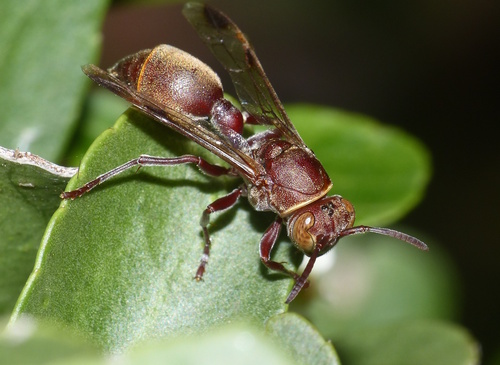
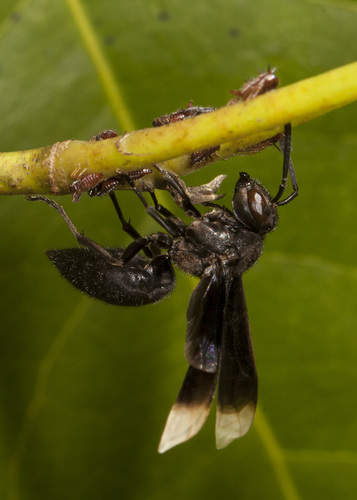
James Carpenter’s taxonomic key defines the characteristic features of Agelaia multipicta. These include a normal, non-reduced jugal lobe on the hind-wing, a present occipital carina on the head, and a pronotum that lacks a sinuous carina. The body has no pale maculations; its cuticle is partly to entirely bluish metallic, or yellowish with some bluish highlights. When viewed from the side, the temple of the head is as wide as, or wider than, the eye at the ocular sinus. Queen and worker castes of this species differ substantially in appearance and ovarian development, which corresponds to their different biological roles. Non-reproductive workers have reduced ovaries, and brown coloring on the middle tibia and the face between the antennal insertions. Queens have a larger, hairier petiole and gaster, and yellow mid tibia and face. Agelaia multipicta occurs in Mexico, Argentina, Trinidad, and Southern Brazil. Their nests are most commonly observed in forest and rural habitats. This pattern may be linked to the species’ preference for using natural cavities as nesting sites, which are typically less common in urban areas. A. multipicta is the most abundant wasp species in Matão, São Paulo, Brazil, a well-preserved area that hosts low wasp species diversity and is surrounded by citrus crops. One study of forest fragmentation found that A. multipicta did not show a strong preference for any specific habitat type, which is likely explained by the species’ generalist ecology.