About Agave schottii Engelm.
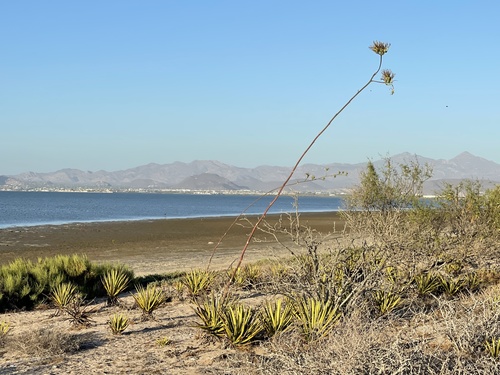
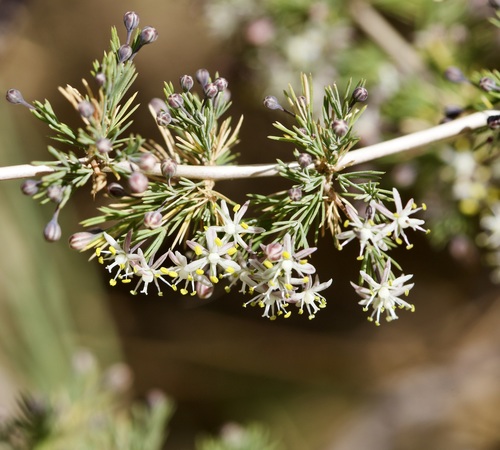
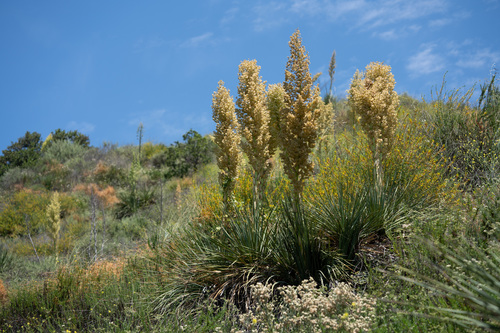
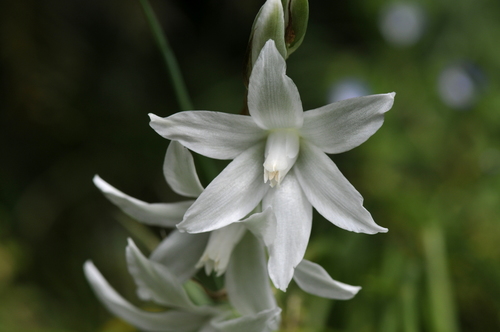
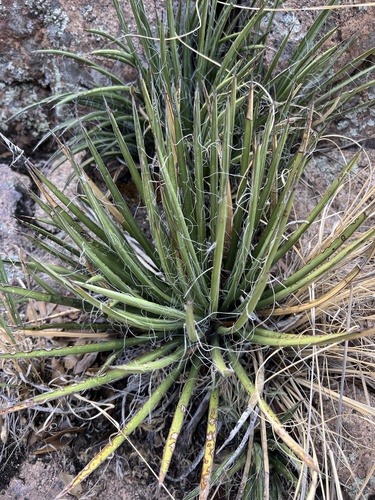
Agave schottii Engelm. is a species of flowering succulent shrub in the Agave genus. Like other agaves, it grows a rosette of thick, blue-green, finger-shaped leaves with sharp spines at their tips. Unlike most other Agave species, its leaf edges do not have spines, which places it in the Agave subgenus Littaea. Its leaves typically reach a length of roughly 0.3 meters (0.98 feet). Since the plant reaches a height about equal to a person's shin and has sharp spiny leaves, its common name is shindagger. The leaf rosettes of this species are monocarpic. Its pale to bright yellow flowers grow on branches attached to the main stem; flowers are arranged in spicate inflorescences, have a tubular shape, and measure approximately 8 by 4 mm (0.31 by 0.16 inches). One variety, A. schottii var. treleasei, has paniculate inflorescences. The flowers of Agave schottii produce a pleasant sweet fragrance. The fruit of this species are loculicidal capsules: dry fruits that split open to release seeds. The pulp of Agave schottii contains steroidal sapogenins, which account for around 2% of the plant's dry weight. Agave schottii is native to North America. In the United States, it occurs in Arizona and New Mexico. In Arizona, it is limited to the southern part of the state, specifically Pima, Santa Cruz, Graham, and Cochise counties. In New Mexico, it is found only in the southwestern tip of the state, in Hidalgo County. It also grows in the Mexican states of Chihuahua, Sonora, and Baja California. Agave schottii var. treleasei is classified as a Highly Safeguarded Native Plant with restricted salvage, and is only found in Pima County, Arizona. This species grows in arid regions at elevations between 1,100 and 2,000 meters (3,600 to 6,600 feet). It inhabits sunny, open, gentle rocky slopes or small drainages in high desert scrub, grassland, and juniper-oak woodlands growing on gneiss substrate. It is most often found on northern and eastern facing slopes, where temperatures stay cooler than on slopes with full direct sun. Like most Agave species, Agave schottii has a range of potential pollinators including bats, butterflies, moths, bumblebees, honeybees, and hummingbirds. On average, it produces 1.6 μL of nectar per day, which is a low volume compared to other plant species pollinated by birds or insects. It produces most of its nectar during the night, and the nectar has a low sugar content, two traits that support bat pollination. However, its yellow flower color, sweet fragrance, and low protein concentration in nectar point to pollination by insects, birds, or both. Agave schottii is a clonal plant, meaning it can reproduce asexually by cloning itself to produce genetically identical offspring. This asexual reproductive method is not favorable because it produces offspring with low heterozygosity, that is, low genetic diversity. Experimental research shows that the species favors outbreeding, with an optimal distance of 10 to 100 meters (33 to 328 feet) between cross-breeding individuals. Closer cross-breeders result in lower genetic diversity, while cross-breeding at distances greater than this optimal range carries the risk of mating with a plant that is too genetically dissimilar. Agave schottii is a useful model organism for studying this type of outcrossing behavior.