About Agave parviflora Torr.
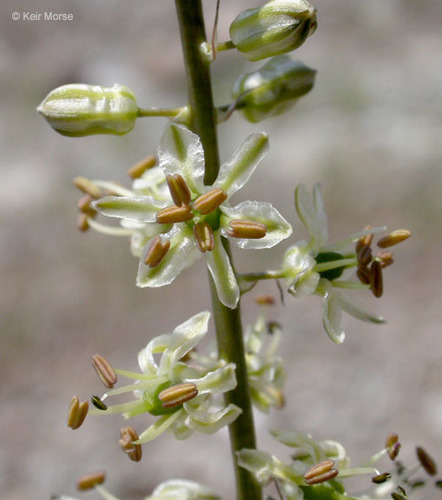
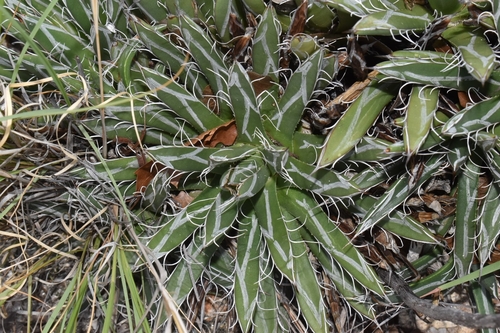
The specific epithet parviflora of Agave parviflora Torr. means "small-flowered". This agave forms a small rosette that reaches up to 25 cm (10 in) tall and 20 cm (8 in) wide. Its succulent, spine-tipped leaves grow up to 20 cm (8 in) long, have a waxy dark-green color with white markings, and bear hair-like naturally peeling leaf threads along their margins, similar to the related species Agave filifera. The leaves are narrow, stiff, and strongly whorled, growing tightly around ramets, and tapering to a sharp point; the plant has a medium coarse texture. It has slow to moderate growth, a growth habit shared with most other members of the Agave genus. After 10 to 15 years of growth, the mature plant produces a tall inflorescence in summer. This inflorescence reaches 1–2 m (3–7 ft, or up to roughly 2.13 m/7 ft) tall, and has the shape of an oversized asparagus stalk before flowers open; this asparagus-like appearance reflects the placement of Agave in the Asparagaceae family, the close relation between Agave and asparagus. The flowers themselves are cream or pale yellow, grouped in clusters of 1–4 (mostly opening in spring). When fully open, the flowers attract bumblebees and other bees for pollination, and are also popular with hummingbirds; fully bloomed flowers also attract other pollinating birds including sunbirds and butterflies. After flowering finishes, the original agave plant dies. Its fruit are small ovoid capsules 6 to 10 millimeters in diameter, and it produces wedge-shaped half-round seeds. If the plant's roots are kept chronically damp, it can develop black root rot caused by Thielaviopsis basicola; this rot can spread and turn a healthy plant mushy. Like all agaves and some other asparagales, Agave parviflora is vulnerable to the agave snout weevil (Scyphophorus acupunctatus) if the pest is not detected and eradicated early. This small black beetle has a distinctive long snout, and lays its eggs in the core of agave plants that already have some root rot or receive excessive irrigation. When the eggs hatch, the resulting maggots feed on the agave's tissue and kill the plant. For healthy cultivation, growing media requires extra amended drainage material such as pumice, perlite, or sand, as well as proper airflow and outdoor growing where appropriate. Best results come from a growing mix with less organic matter and a higher proportion of inert rocky material. Two subspecies are recognized: A. parviflora ssp. parviflora and A. parviflora ssp. densiflora. Agave parviflora grows in dry, rocky habitats including semi-desert grasslands and oak woodlands, at elevations between 900 and 1,520 m (3,000 and 5,000 feet). It is a rare species with a limited native range, restricted to Arizona (United States) and parts of northern Mexico. The state of Arizona lists Agave parviflora as endangered and affords it strict legal protection, while the U.S. Forest Service designates it as a Sensitive Species. As a federally listed endangered species, collecting wild plants is illegal. It is the smallest agave native to Arizona, and it is sought after by plant collectors, a demand that has caused declines in its native habitat. Only around two dozen natural populations remain in Arizona. Additional threats to wild populations include road construction and mining. Despite these threats, the IUCN does not consider the species threatened overall, as its remaining populations are stable and many grow within protected areas. It is valued in cultivation and has been awarded the Royal Horticultural Society's Award of Garden Merit. For traditional use, the leaves and heart of Agave parviflora are baked and eaten. This species is the sweetest and most edible Agave, but it is not commonly eaten because it is also the smallest in the genus. It is also used to produce the distilled liquor mezcal; mezcal can be made from any Agave species, though around 7 species are the most commonly preferred.