About Agave coetocapnia subsp. coetocapnia
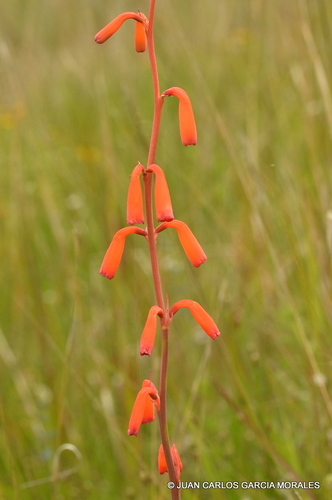
Agave coetocapnia subsp. coetocapnia grows from a tuber. Its leaves are primarily arranged in a basal rosette, with a broad base that tapers into a linear shape. The flowering stem, or scape, reaches around 30 cm (12 inches) in height, and bears small leaves that gradually transition into bracts within the plant's terminal raceme inflorescence. Individual flowers are orange-red, drooping, and have six tepals around 32 mm (1.25 inches) long. At the base of the raceme, flowers grow one at a time. Higher up the raceme, two pedicels, each holding a single flower, grow from the same set of three bracts. Flowers have six stamens, plus a style that extends outside the flower and ends in a three-lobed stigma. This subspecies is native to central, northeastern, and southwestern Mexico. The original published description only noted its habitat as 'montibus Micciacanis', meaning 'in Mexican mountains'. It has more recently been recorded growing in winter-dry oak forests. Under several of its synonyms, Agave coetocapnia subsp. coetocapnia has been cultivated as an ornamental bulbous plant since before 1853. In 1853, it was described as a 'beautiful plant' that flowers in July, and is easy to grow in a warm greenhouse in England. It has been grown outdoors in North Carolina, where it survived temperatures as low as approximately −14 °C (6 °F). It has also been reported to survive winter successfully outdoors in a warm location in southern England. It is recommended to keep this plant dry over the winter.