About Agathis australis (D.Don) Lindl.
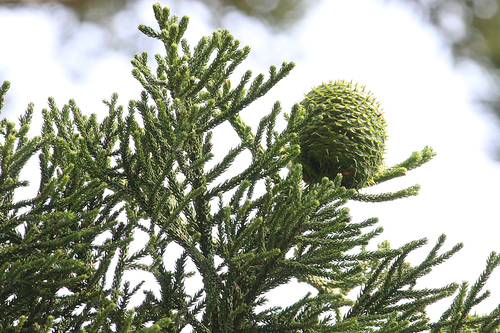
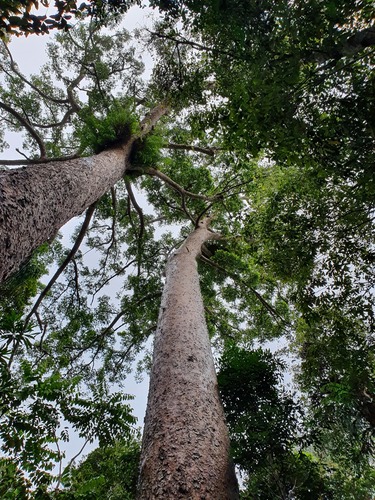
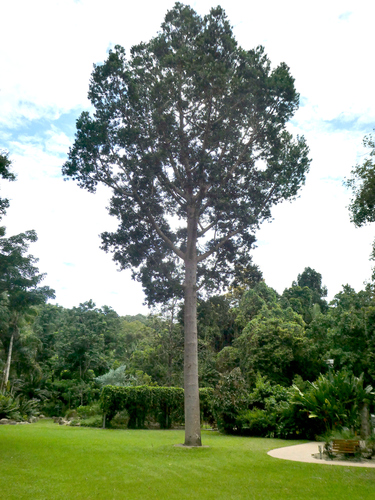
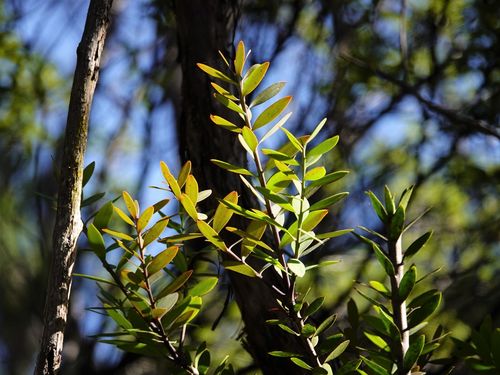
Agathis australis (D.Don) Lindl., commonly known as kauri, changes form as it grows: young plants grow straight, with a narrow conical shape and branches along the full length of the trunk. As the tree gains height, it sheds its lowest branches to prevent vines from climbing. When mature, its upper branches form a large, prominent crown that rises above all other native trees, dominating the forest canopy. Kauri has flaking bark that protects the tree from parasitic plants; this bark accumulates around the base of the trunk, and on large trees can pile up to 2 metres or more in height. Kauri often grow in small clumps or scattered patches within mixed forests. Kauri leaves measure 3–7 centimetres long and 1 centimetre wide, have a tough, leathery texture, and lack a midrib. They are arranged in opposite pairs or whorls of three along the stem. Kauri produces both male and female seed cones on a single tree. Its female seed cones are globose, 5–7 centimetres in diameter, and mature 18 to 20 months after pollination. At maturity, the cones disintegrate to release winged seeds that are dispersed by wind. Pollination for fertilization can come from pollen of the same tree or a different kauri tree. In terms of local topography, kauri is not randomly dispersed. Kauri survives by depriving competing plants of nutrients. Slope affects nutrient distribution: water flows downhill on hills, carrying soil nutrients with it, creating a gradient of nutrient-poor soil at the top of slopes and nutrient-rich soil lower down. Where leached nutrients are replaced by nitrates and phosphates from uphill, kauri is less able to inhibit the growth of strong competitors like angiosperms. Leaching is more intense at higher elevations, which favors kauri. In Waipoua Forest, this pattern results in higher kauri abundance on ridge crests, while its main competitors such as tarairi are more concentrated at low elevations. This niche partitioning allows multiple species to occupy the same area. Tawari, a montane broadleaf tree normally found at higher altitudes where nutrient cycling is naturally slow, is one species that grows alongside kauri. In its natural ecosystem, kauri is found north of 38°S latitude. Its natural southern limit extends from Kawhia Harbour in the west to the eastern Kaimai Range. Mature kauri can be found as far south as Christchurch and Dunedin, including within the Dunedin Botanic Gardens. Climate change has greatly altered kauri's distribution over geological time. After the peak of the last ice age, during the Holocene epoch, kauri migrated southwards. During the last ice age, when large ice sheets covered much of the world's continents, kauri could only survive in isolated pockets, with its main refuge in the far north of New Zealand. The coldest recent period occurred 15,000 to 20,000 years ago, when kauri was apparently confined to areas north of Kaitaia, near North Cape, the northernmost point of the North Island. Scientists have used radiocarbon dating on kauri stumps recovered from peat swamps to map the history of the species' distribution. Kauri requires a mean temperature of 17 °C (63 °F) or higher for most of the year, so the tree's range shifts can be used as a proxy for temperature changes during this period. Large quantities of kauri gum found in soils of the Aupōuri Peninsula (far northern North Island) confirm this area was a kauri ice age refuge, though kauri is not currently more widespread here than elsewhere. It remains unclear whether kauri recolonised the North Island from a single far northern refuge, or from multiple scattered pockets of isolated stands that survived despite adverse climatic conditions. Kauri spread south through Whangārei, past Dargaville, and reached as far south as Waikato. It reached its maximum distribution between 3000 BP and 2000 BP. There is some evidence that its range has receded slightly since this period, which may indicate a small decline in temperatures. During its peak southward expansion, kauri spread as fast as 200 metres per year, which is relatively rapid for a tree that can take a millennium to reach full maturity. Kauri depends on wind for both pollination and seed dispersal, unlike many other native New Zealand trees whose seeds are carried long distances by frugivores such as the native kererū pigeon. Kauri can begin producing seeds when relatively young: it takes around 50 years for a tree to produce its first offspring, which is a trait similar to pioneer species, despite kauri's long lifespan being characteristic of K-selected species. In good conditions with above-average access to water and sunlight, trees can reach a diameter over 15 centimetres and start producing seeds in as little as 15 years. Māori traditionally used kauri wood to build large waka that could seat hundreds of people, thanks to the large size of kauri logs. In the past, the large size and strength of kauri timber made it popular for construction and shipbuilding, especially for sailing ship masts, because it has a parallel grain and lacks branches along most of its trunk. Today its use is far more restricted. Kauri crown and stump wood was highly valued for its attractive appearance, and was sought after for ornamental wood panelling and high-end furniture. The lighter-coloured wood from the kauri trunk, while less prized, was well-suited for utilitarian furniture, and was also used to make cisterns, barrels, bridge construction material, fences, moulds for metal forges, large rollers for the textile industry, railway sleepers, and cross bracing for mines and tunnels. Kauri timber was so common in early European settlements that when Ferdinand von Hochstetter visited Auckland in 1859, he estimated nearly every non-stone building was constructed from kauri timber. In the late 19th and early 20th centuries, semi-fossilised kauri resin called kauri gum was a valuable commodity, most commonly used for varnish; this demand spurred the development of a kauri gum-digging industry. Today, kauri forests are considered a valuable long-term carbon sink. Estimates of total carbon content in living above-ground biomass and dead biomass of mature kauri forests are the second highest of any recorded forest type in the world, with total carbon capture reaching nearly 1000 tonnes per hectare. Only mature Eucalyptus regnans forests hold more total carbon than mature kauri forests, which hold far more carbon than any recorded tropical or boreal forest type. It has been hypothesised that carbon capture in kauri forests does not reach an equilibrium, and that kauri forests require no direct maintenance. These traits make kauri forests a potentially attractive alternative to short rotation forestry options such as Pinus radiata.