About Agastachys odorata R.Br.
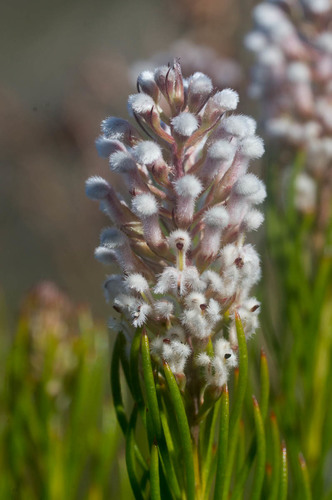
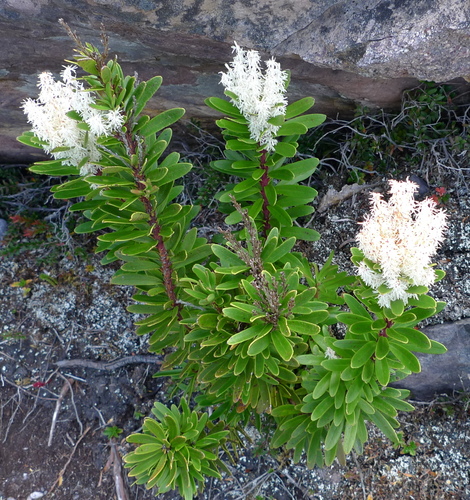
Agastachys odorata R.Br. is an erect, evergreen shrub endemic to Tasmania. Its shape can be variable, but mature individuals typically reach 1–3 metres (3.3–9.8 ft) in height and 0.5–1 m (1.6–3.3 ft) in width. This species shows many of the diagnostic characteristics of the Proteaceae family, the main ones being leathery alternate leaves and irregular woody floral structures. Its leaves have entire margins with rounded tips, are bright green, have a thick, almost leathery texture, are shaped from narrow-oblong to oblanceolate, and lack hairs. Peak flowering occurs in the early Australian summer months of December and January. Its flower spikes look like fluffy white-to-creamy yellow candles, which matches one of its common names: fragrant candlebush. The flowers also resemble an erect, paler version of the Tasmanian waratah (Telopea truncata), giving it its other common name: white waratah. Large numbers of white-to-creamy yellow flowers grow in erect flower spikes that are clustered at the ends of branches. The spikes are 8 to 12 cm long, so they stand out from a distance as they rise above the shrub's canopy. The flowers produce a scent that many people describe as pleasant. After flowering, the plant produces small, inconspicuous woody winged nuts, which are often brown. The relatively large wings on the nut support wind dispersal (anemochory) of the seeds. Agastachys odorata is endemic to Tasmania, Australia, and grows in the highest abundance in the western and southern regions of the state. It occurs in a range of wet vegetation types across Tasmania, most commonly in heath, scrub, wet sclerophyll/eucalypt forest, and temperate rainforest, and occasionally grows in alpine regions. It prefers areas with high rainfall, which explains why its distribution is limited in the drier eastern parts of Tasmania. It is commonly found on nutrient-poor soils. Like other Proteaceae, A. odorata produces proteoid roots that boost its nutrient absorption, helping it thrive in harsh conditions. Proteoid roots increase nutrient absorption because their dense root clusters create more surface area for nutrient uptake. A. odorata can be found in Tasmania's Southwest National Park and Franklin-Gordon Wild Rivers National Park.