About Agaricus hondensis Murrill
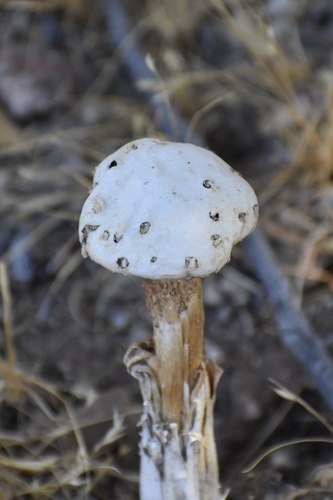
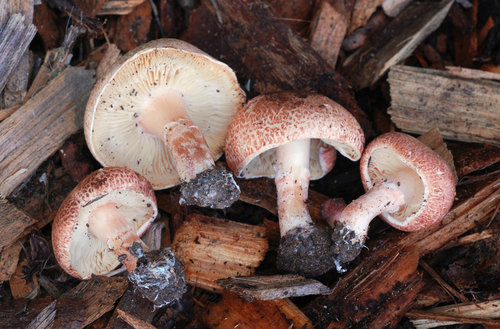
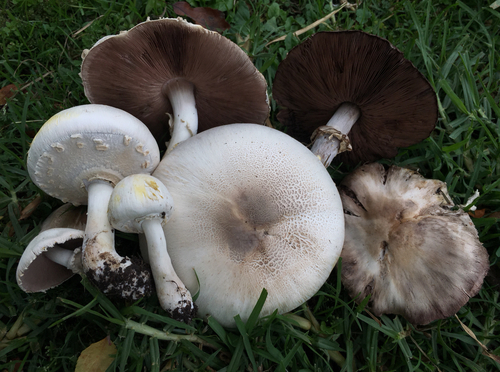
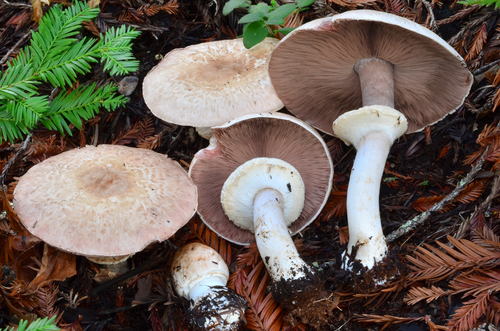
Agaricus hondensis Murrill has a cap that starts globose, becomes convex, and sometimes flattens out at maturity, reaching a diameter of 6–15 cm (2+1⁄2–6 in). The cap surface is dry and smooth, whitish, or marked with pale pinkish-brown to pinkish-gray to fawn-colored flattened fibrils or fine fibrillose scales, most noticeably in the cap center. As the mushroom matures, these fibrils usually darken to brown, reddish-brown, or reddish-gray; one northern variant has darker brown fibrils from the start. The cap flesh is thick and white. When bruised or injured, the flesh either does not change color, or stains pale yellowish before slowly turning pinkish. Crushed flesh has a mild or faintly phenolic odor, while the base of the stipe usually has a distinct phenolic odor. The gills start pale pinkish to pinkish-gray, turning brown as they develop, and become chocolate-brown or darker once spores mature. In mature specimens, the gills do not attach to the stipe, are closely packed with very little space between them. The stipe measures 7–20 cm (3–8 in) long and 1–3 cm (1⁄2–1+1⁄4 in) thick, with a thicker or bulbous base. It is firm, smooth, and lacks the scales found on the cap; it is white when young, and discolors dingy pinkish or brownish with age or after handling. Flesh in the extreme base of the stipe usually stains pale yellowish when bruised. The membranous white partial veil forms a thick, felt-like ring on the upper stipe. The ring is skirt-shaped, but often flares outward instead of collapsing against the stipe. A drop of dilute potassium hydroxide applied to the cap turns yellow. Spore prints are purplish brown to chocolate brown. The spores are smooth, thick-walled, broadly ellipsoidal, and typically measure 5.8–7.3 by 3.7–4.4 μm. The spore-bearing basidia are four-spored, club-shaped, hyaline (translucent), and measure 20–21.3 by 5.8–7.0 μm. Cheilocystidia (cystidia on the gill edge) are sac-shaped to club-shaped, ranging in color from hyaline to pale yellowish brown, measuring 18.3–25.6 by 7.3–11.0 μm; there are no pleurocystidia (cystidia on the gill face). Agaricus hondensis is a saprobic species; its fruit bodies grow scattered or in groups under conifers or in mixed forests, and have also been recorded growing in fairy rings. It is distributed along the Pacific Coast of North America, ranging from British Columbia, Canada south to California, and is most common in California. Across most of its range, it fruits in fall, from September to October; in California, its fruiting season typically runs from November to February. Agaricus hondensis is toxic: eating its fruit bodies causes gastroenteritis. Some fruit bodies have a creosote odor that becomes more prominent after cooking, and cooking also produces an unpleasant soapy-metallic flavor. The fruit bodies are eaten as food by the vagrant shrew (Sorex vagrans) and the American shrew mole (Neurotrichus gibbsii). Fruit bodies contain relatively high levels of the chemical hydroquinone.